
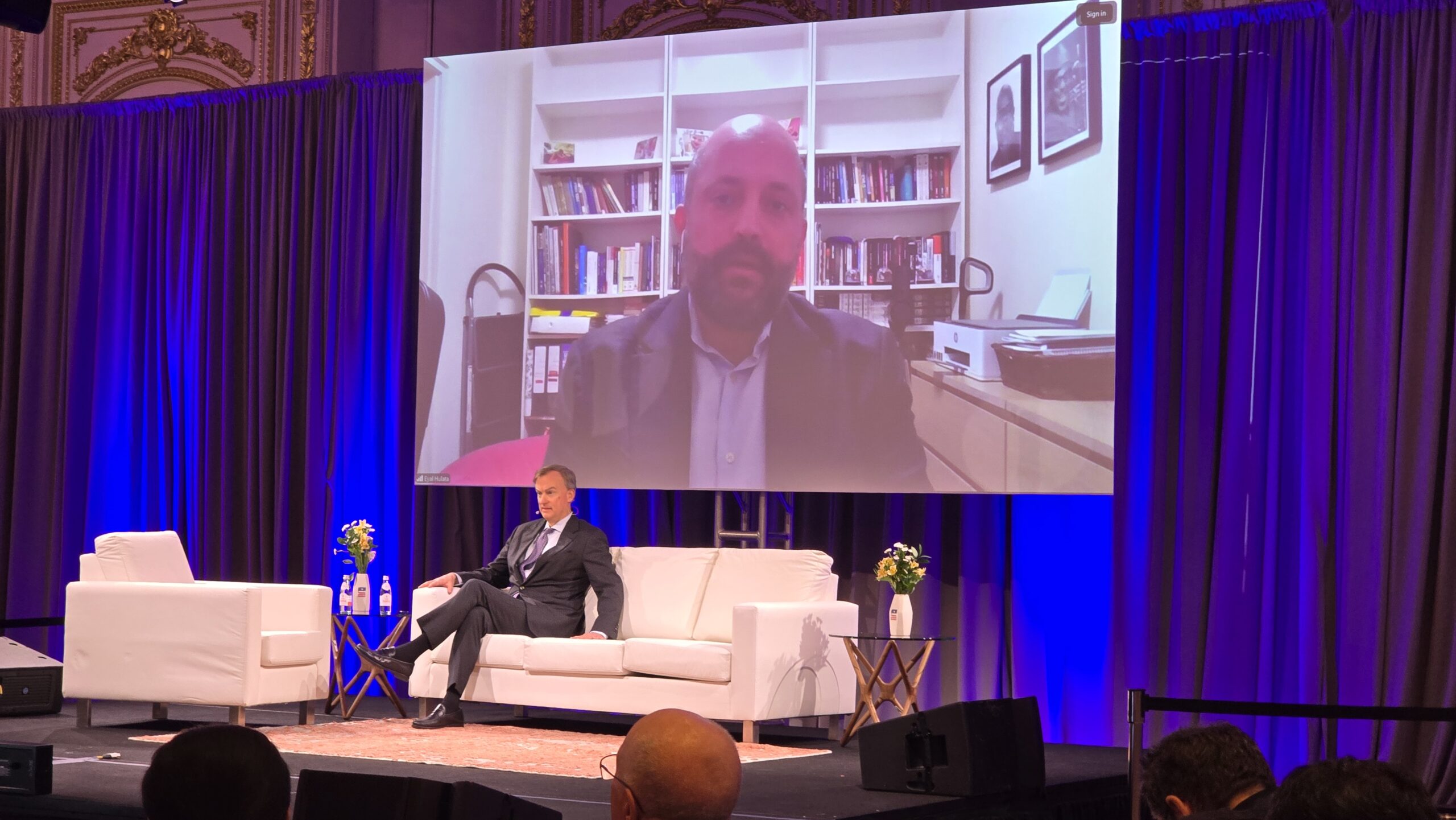
At the recent Special Competitive Studies Project (SCSP) summit, the focus shifted from domestic policy to the jagged edges of active conflict. Dr. Eyal Hulata, former Israeli National Security Advisor and former head of the Mossad’s technology division, joined Michael Allen of Beacon Global Strategies for a session that was part tactical briefing, part futurist warning.
For those of us tracking the “Agentic Economy,” Hulata’s insights provided a visceral look at how AI and autonomous systems are no longer “emerging”, they are the baseline. From the “AI sieve” used to maintain intelligence superiority over Iran to the “epidemic” of low-cost drones, the discussion offered a masterclass in how modern technology is compressing the OODA loop (Observe, Orient, Decide, Act) to near-instantaneous speeds.
The Macro View: The Degradation of the Cleric and the Rise of the Military State
Hulata opened with a profound geopolitical observation: the Iranian regime is undergoing a structural metamorphosis. No longer purely a theocracy ruled by clerics, it is transitioning into a military dictatorship under the IRGC (Islamic Revolutionary Guard Corps).
From a technologist’s perspective, this shift is mirrored in their digital behavior. Despite a massive domestic crackdown that has throttled Iranian internet traffic to just 5% of its pre-protest volume, the regime remains a “weak but dangerous” actor. Hulata noted that while 80% of the Iranian population, largely a younger, tech-savvy generation, resents the regime, the government is leaning into “civil-military fusion” (much like China) to survive. This macro-instability creates a volatile battlespace where intelligence must be persistent, predictive, and incredibly fast.
The Micro View: The “AI Sieve” and the End of Big Data
One of the most compelling segments involved Hulata’s reflection on his time at the Mossad. He pushed back against the term “Big Data,” suggesting it’s a prehistoric concept. In modern intelligence, the challenge isn’t the amount of data; it’s the velocity of the “sieve.”
The Intelligence Challenge:
- Data Fragmentation: Collecting reams of data is useless if you cannot find “normalcy” within it. Hulata described AI not as a tool for translation or search, but as a mechanism to identify the “needle in the haystack” in real-time.
- The Target Cycle: He revealed that the campaign against Iranian nuclear scientists and commanders required eight months of meticulous preparation, culminating in a “huge final surge” in February 2026. This surge was powered by AI algorithms capable of correlating diverse data sets, satellite imagery, communications, and open-source intelligence, to track high-value targets with humiliating precision.
Notable Insights from Dr. Eyal Hulata
“There was a time we called it ‘Big Data.’ Those days are gone. Now, it is about the spirituality of the aggregate… if you don’t find ways to fish effectively, you cannot avoid the disasters.”
“We are experiencing an ‘epidemic’ of drones. The first lesson we all need to observe is that defense is much more difficult than offense.”
“We cannot wait a decade to develop solutions for swarms of drones. The cycle of development and deployment must move in six months, not ten years.”
The “Drone Epidemic” and the Cost of Defense
The most urgent technical warning from the session concerned the democratization of aerial threats. Hulata described a “drone epidemic” where non-state actors use low-cost, off-the-shelf technology to coordinate attacks.
The Economic Asymmetry: The “dogfights” of 2026 aren’t just between fighter jets; they are between AI algorithms and price tags. Hulata highlighted a critical flaw in current Western defense: we are using million-dollar missiles to take out thousand-dollar drones.
- The Solution: Israel is moving toward a “holistic” defense that uses AI for rapid detection and low-cost interception (lasers and electronic warfare).
- The Cycle: The traditional ten-year defense acquisition cycle is dead. In the drone battlespace, the cycle of “development-to-deployment” must happen in six months.
The Cyber Stalemate: Why Infrastructure Hasn’t Fallen
Interestingly, Hulata noted that while Iran has tried to hit Israel’s “backbone databases,” they haven’t achieved the catastrophic success they desired. His technical assessment? The Russians and Chinese, both “cyber superpowers”, have been selective in the tools they provide to Tehran. They are offering enough to cause “defacement” of websites, but withholding the “zero-day” exploits that could topple critical infrastructure. This suggests a calculated geopolitical “throttle” on Iranian capabilities by their senior partners.
Final Takeaway: The Optimistic Architecture
Despite the “anxiety” and the “devastation” of the conflict, Hulata concluded with a vision of a “Digital Silk Road.” He sees a future where, once the “bad guys” are sufficiently degraded, a coalition of pragmatic Middle Eastern countries can connect through a joint command-and-control architecture. This wouldn’t just be for security, but for sharing advanced technologies in energy, water, and food security.
For the technologist, the lesson from Israel is clear: AI is the only way to manage the modern battlespace, but the winner won’t just have the best algorithms, they’ll have the fastest ability to iterate them in the field.
For more information, please visit the following:
Website: https://www.josephraczynski.com/
Blog: https://JTConsultingMedia.com/
Podcast: https://techsnippetstoday.buzzsprout.com
LinkedIn: https://www.linkedin.com/in/joerazz/
Leave a Reply
You must be logged in to post a comment.