
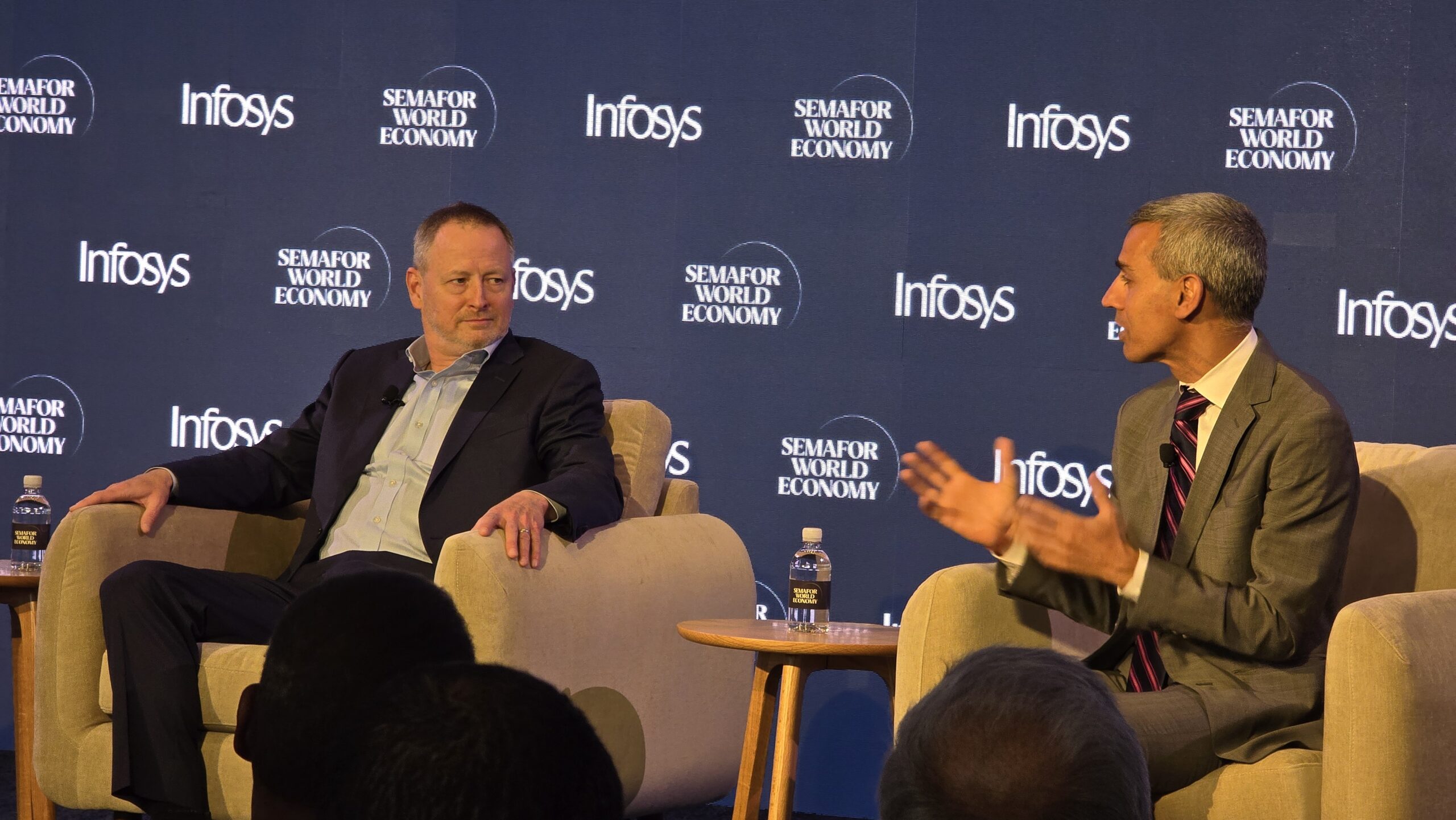
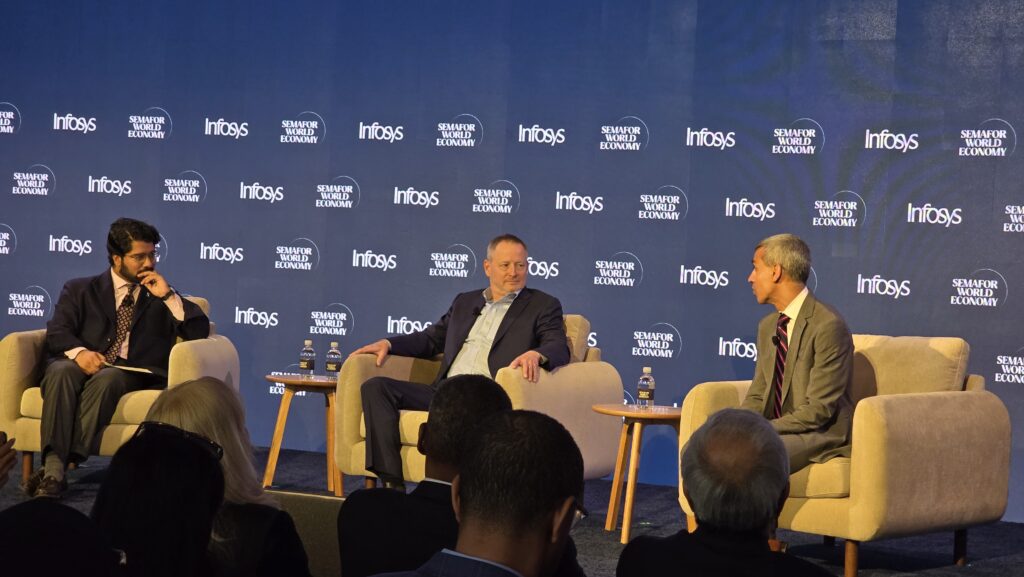
At the Semafor World Economy summit, the “Building Intelligent Enterprises” session cut through the usual AI hype with a dose of pragmatic operational reality. While the morning sessions at the World Bank and IMF Spring Meetings focused on macro-fiscal policy, this panel, featuring Kunal Kapoor (CEO of Morningstar) and Woodsen Martin (CEO of OutSystems), zeroed in on how artificial intelligence is rewriting the software backbone of the global economy.
From a technologist’s vantage point, the discussion moved past the “is it a bubble?” debate and into the structural re-engineering required for the Agentic Economy. We aren’t just moving from “search” to “chat”; we are moving from “User Interfaces” to “Agent Experience Management.”
The Macro View: Market Caps and Moderate Returns
Kunal Kapoor offered a sober perspective on the investment landscape. He noted that the term “bubble” might be a misnomer, but warned that we are in a unique cycle where “hyperscalers” (the AI giants) are coming to the public markets at $1 trillion valuations rather than the smaller entries of the past.
For the macro-investor, this suggests that the “best days” may have already been earned in private markets. Kapoor predicts a shift where equal-weighted market indexes may outperform traditional market-cap-weighted ones over the next 5 to 7 years. The takeaway? The gains of the AI revolution will be real, but the returns for retail investors might be more moderate as the “froth” settles into actual infrastructure.
The Micro View: Hot-Swapping the Brain of the Enterprise
Woodsen Martin brought the conversation down to the “engine room” of the enterprise. OutSystems sits at the layer where core business processes—banking, insurance, manufacturing—meet AI.
The Infrastructure Shift:
- The Context Engine: Martin pointed out that while models like Claude are “intoxicating” to use personally, they are useless to an enterprise without context. An intelligent enterprise requires a backbone that can feed proprietary data to a model in a governed, secure way.
- Technological Agility: Martin introduced the concept of “hot-swapping” technologies. As new models come out every month, enterprises cannot afford to be locked into one vendor. They need a foundational layer that allows them to swap the “brain” (the model) while keeping the “body” (the business process) intact.
- Agent Experience Management (AEM): This was perhaps the most “clever” insight of the session. We are moving away from designing websites with “soft color buttons and rounded corners” for humans. Instead, we must optimize for the Intelligent Agent that will be browsing the web on behalf of the human.
Notable Insights from the Panelists
“We are infatuated today with the power of models… but when you think about translating that to core infrastructure, you realize you’ve got to give it context so it can help you reason through your own problems.” — Woodsen Martin, CEO, OutSystems
“I think tomorrow, it’s not even going to be a person [making a decision]… it’s going to be somebody’s agent… We need to start thinking about Agent Experience Management.” — Woodsen Martin, CEO, OutSystems
“Historically, the startup would never get sued, and the established company would get sued. Well, it turns out these days the startups are worth a trillion dollars… that changes things.” — Kunal Kapoor, CEO, Morningstar
The Token vs. The Subscription: The Pricing War
A fascinating point of friction emerged regarding how AI is paid for. Kapoor expressed a visceral frustration with the “uncertainty” of token-based pricing. For a CEO, budgeting for “tokens” is like trying to plan a household budget based on the fluctuating price of every individual drop of water from the tap.
The Pricing Evolution:
- Subscription Certainty: Kapoor argued that enterprises crave the certainty of the “Prime model”, pay once, use as needed.
- Outcome-Based Models: Martin countered that we are seeing a move toward “shared risk, shared reward” models where companies pay for the result (the outcome) rather than the “seat” or the “token.”
Governance and the “Legal Splash”
The session concluded with a warning about the impending legal fallout. As AI begins to make material decisions, the question of liability becomes paramount.
Martin argued that organizations must implement “hardened guardrails” at the transaction level to ensure AI doesn’t go “off-script.” Whether it’s an internal HR query or an external customer interaction, the accountability ultimately falls on the CEO. However, as Kapoor noted, the risk of “not acting” is far greater than the risk of being sued. In the AI race, the “fast movers” will be the ones who build the infrastructure of resilience and digital sovereignty.
Final Takeaway
The “Intelligent Enterprise” of 2026 isn’t just a company that uses AI; it’s a company that has built a governed, agile infrastructure capable of supporting autonomous agents. The shift from UX (User Experience) to AX (Agent Experience) is the next frontier of digital competition.
For more information, please visit the following:
Website: https://www.josephraczynski.com/
Blog: https://JTConsultingMedia.com/
Podcast: https://techsnippetstoday.buzzsprout.com
LinkedIn: https://www.linkedin.com/in/joerazz/
Leave a Reply
You must be logged in to post a comment.