
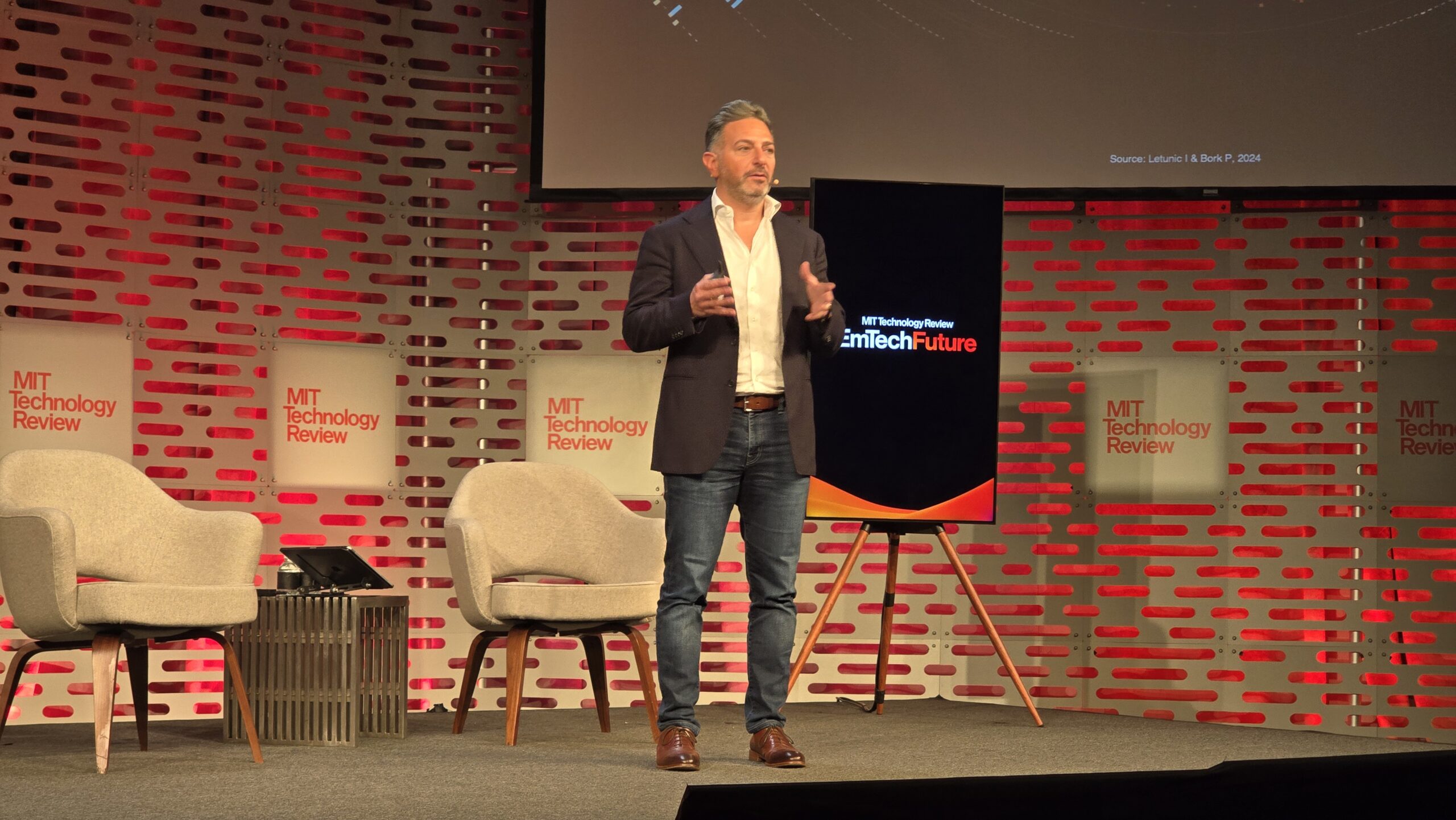
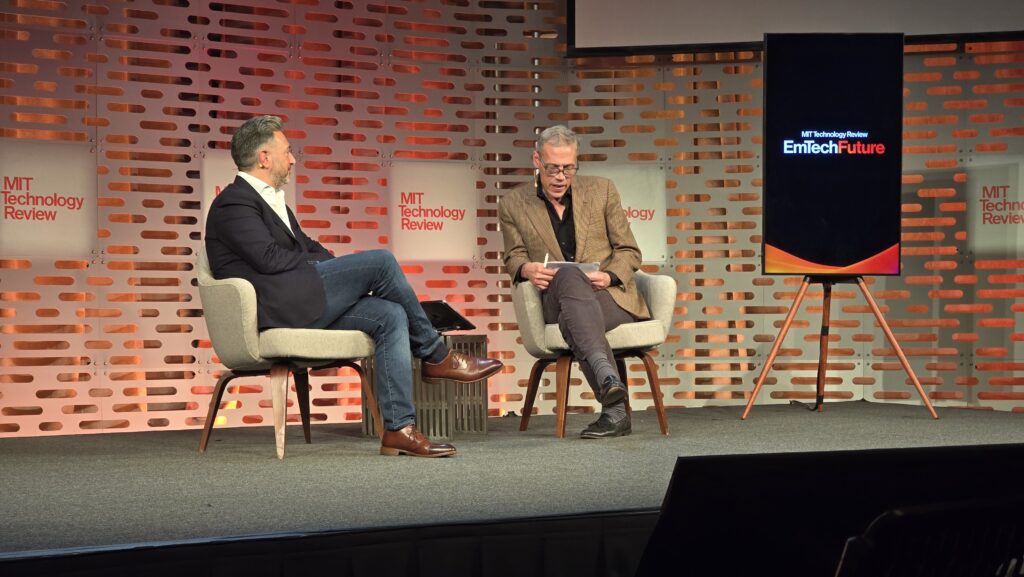
Cambridge, MA – MIT Media Lab – EmTech Future. Nature has spent roughly 3.8 billion years conducting the most sprawling, creative research and development campaign in history. Evolution engineered millions of functional molecular machines, intricate cellular networks, and robust organisms long before humans ever conceptualized a microscope. Yet, Flagship Labs, President Avak Kahvejian took the stage, introduced by conference host and journalist Antonio Regalado, he delivered a stark reality check: our conventional tools for discovering biology remain painfully slow, artisanal, and expensive.
Bringing a single therapeutic to market still eats up over a decade and costs upwards of two billion dollars. Worse, those resulting medicines typically address narrow patient cohorts and a tiny fraction of human disease. To rewrite this paradigm, we cannot rely on human intuition and manual pipetting alone. We have reached an inflection point where artificial intelligence must move beyond cataloging the observable living world to fundamentally catching up with evolution.
The Illusion of Rich Data
In an era of high-throughput genomics, wearable telemetry, and digitized clinical registries, common wisdom suggests biology is awash in data. That assumption is deeply flawed. While genomic sequence repositories run deep, our functional knowledge of biological wiring remains remarkably sparse.
“Think about how a large language model learns. It sees the same word over and over again in a variety of context… But in biology, that information is not always available. Yes, we may have sequence, but the sentences around that individual element don’t exist all the time, so we have to go create it.” – Avak Kahvejian
Large language models excel because they absorb familiar tokens embedded across billions of human-authored sentences. In cellular biology, however, massive gaps persist in the vocabulary itself. Flagship entity ProFound Therapeutics has unearthed thousands of completely novel protein-coding elements within human cells that conventional biology missed entirely. When an AI encounters thousands of unmapped words lacking relational context, predicting their downstream actions in disease becomes impossible without deliberate biological intervention.
Association does not equal causality. To train generative systems that design functional therapies rather than hallucinations, laboratories must systematically perturb the cellular machinery by adding, deleting, and modifying genes to physically record the cellular response.
Closing the Wet Lab Feedback Loop
The emerging industry consensus is that building biological software without dedicated physical infrastructure is an empty exercise. Tech giants building foundation models are acquiring automated wet laboratories because biological ground truth cannot be synthesized entirely in silicon. Unlike software engineering or chess, where an agent can play millions of synthetic games against itself, biology requires reality-checking in physical test tubes.
Flagship has built a slate of platform companies around this closed-loop philosophy:
- Generate:Biomedicines: Applying generative algorithms directly to de novo protein design, successfully driving computationally designed biologic candidates into human clinical trials.
- Sail Biomedicines: Employing machine learning to optimize circular RNA, turning fragile genetic instructions into stable, programmable therapeutic modalities.
- Lila Sciences: Handing the scientific method over to autonomous computational loops, allowing AI to draft hypotheses, plan experiments, process laboratory readouts, and iteratively refine predictions.
- Cellarity: Decoupling discovery from predetermined, single-target human hypotheses. By feeding models broad phenotypic and molecular perturbation data, Cellarity identified non-obvious targets to switch sickle hemoglobin to fetal hemoglobin, driving molecule CLR-124 straight into the clinic.
The Faustian Complexity Trap
During the interactive discussion, Regalado raised the audacious claims echoing across Silicon Valley, specifically highlighting venture projections that AI will eradicate all human disease within five to ten years. Biondi pushed back with pragmatic discipline.
The primary friction is what Biondi terms a Faustian bargain with biological reductionism. High-throughput screening requires scientists to isolate individual cell types to feed clean data into machine learning engines. The algorithm solves that simplified puzzle flawlessly. But when that candidate enters a complex human organ system governed by unpredictable immune cross-talk, systemic physiology often shatters the algorithmic model. Scaling complexity from single cells to organoids, and ultimately to living immune microenvironments, demands immense physical capital and time.
Furthermore, autonomous biological laboratories do not operate as unconstrained digital swarms across open networks. Physical biological experimentation mandates contained, air-gapped wet-lab facilities, where human teams remain the inventors and ultimate arbiters of legal patentability and clinical safety.
Key Takeaways
- Data Scarcity Over Abundance: While static genetic sequence data is plentiful, functional phenotypic data showing how molecules dynamically interact remains scarce, requiring active experimental perturbation.
- Hypothesis Generation Outpaces Wet Labs: AI parallelizes target exploration within days, shifting the critical bottleneck from theoretical ideation to real-world laboratory testing capacity.
- Computational Platforms Demand Ground Truth: Pure algorithmic simulation fails in biology without rigorous wet lab integration, forcing top frontier AI efforts into wet-lab infrastructure.
- The Reductionist Dilemma: Simplifying biological assays yields rich training datasets, but compounds the risk of translational failure inside human tissue.
- Pragmatism Over Hype: Generative AI is reshaping the mechanics of pre-clinical discovery, but complex clinical validation ensures the eradication of all disease remains decades away rather than years.
Looking Forward
The trajectory of AI in the life sciences inspires immense long-term optimism, tempered by a sobering respect for evolutionary complexity. We are exiting the era of artisanal, hit-or-miss drug discovery and entering a disciplined engineering discipline where biological machines are designed systematically. However, those anticipating overnight clinical miracles will be humbled by the sheer friction of human physiology. The winners in this space will not be the entities with the largest compute clusters alone, but the organizations that seamlessly fuse algorithmic reasoning with relentless, automated physical experimentation.
Call to Action: Forward-looking technology leaders should evaluate biological design platforms not by their theoretical compute power, but by the rigor and automation velocity of their closed-loop wet lab architectures.
For more information, please visit the following:
Website: https://www.josephraczynski.com/
Blog: https://JTConsultingMedia.com/
Podcast: https://techsnippetstoday.buzzsprout.com
LinkedIn: https://www.linkedin.com/in/joerazz/
Leave a Reply
You must be logged in to post a comment.