

At ETHConf in New York City, Tim Beiko, Protocol Lead at the Ethereum Foundation, delivered a foundational keynote addressing the ultimate trajectory of decentralized infrastructure. Entitled “A Reasonably Necessary World Computer,” Beiko’s address marked a mature pivot in protocol philosophy. After eight years of spearheading core protocol upgrades, ranging from EIP-1559 and the historic Merge to the current rollup-centric scaling roadmap, Beiko framed the next major existential hurdle for the network.
The question is no longer whether Ethereum can scale without compromising its foundational security or decentralization. Thanks to production-ready breakthroughs like Zero-Knowledge (ZK) primitives and data availability sampling, technical scalability is actively being realized. The more critical question facing technologists today is structural: What should this scaled capacity be used for?
To maximize global impact, Beiko argues that the developer ecosystem must transition from building things that are unreasonably sufficient to applications that are reasonably necessary, identifying frontiers where Ethereum’s core guarantees are utterly irreplaceable.
Moving Beyond “Unreasonable Sufficiency”
For years, the core ethos of Ethereum could be summarized as “unreasonable sufficiency.” A deceptively simple, deterministic state machine with a relatively small virtual environment successfully catalyzed trillions of dollars in economic volume and cryptographic experimentation.
However, Beiko issued a sharp warning against viewing Ethereum’s current network effects as an permanent moat. If the ecosystem primarily hosts applications that do not strictly require its native security properties, it faces two long-term systemic risks:
- The Bittorrent Trajectory: Becoming an incredibly useful, ideologically pure, yet marginalized niche tool while mainstream economic activity migrates to more convenient, centralized, or legally compliant alternatives.
- The Unbundled Ledger: If an asset or application relies on a traditional database or a centralized issuer as its ultimate source of truth, it will eventually migrate to whichever digital rails are the cheapest and fastest. Under this model, Ethereum becomes a glorified distribution layer rather than critical foundational infrastructure.
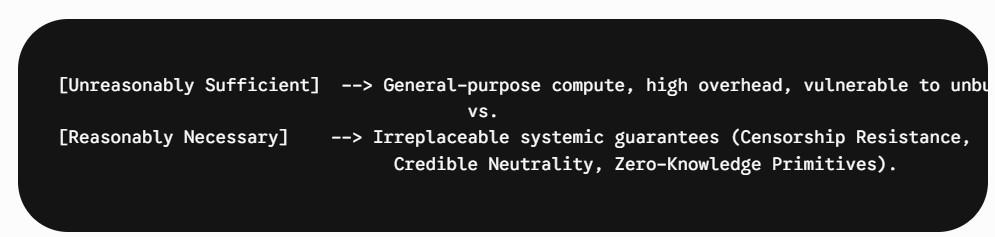
Because Ethereum’s core properties, permissionless access, immutability, censorship resistance, and deep decentralization, come with heavy trade-offs in execution speed, computational overhead, and system simplicity, developers must justify these costs.
“If we’re asking users to pay for protections that they don’t need… the best thing for Ethereum is probably becoming a shelling point for application developers… which is not nothing, but a long way from the structural infrastructure of the world.”
To avoid this, Ethereum must provide the global economy with commitments and structural frameworks that cannot be duplicated within traditional institutional or legal regimes.
The Core Primitives of Space-Like Physics
To identify what is truly “necessary,” Beiko isolated three core architectural primitives unique to Ethereum’s execution environment. He likened the network to a microgravity research lab, where developers can combine computational and economic materials in ways that are physically impossible within standard terrestrial environments.
1. Chronological State Commitments & Immutability
Traditional software systems rely on mutable databases situated within specific, isolated legal jurisdictions. If a conflict arises or an elite entity changes its mind, the historical record can be rewritten or blocked. Ethereum provides a globally visible, shared chronological record that is completely indifferent to geopolitical shifts or administrative intervention.
2. Zero-Knowledge Execution & Privacy Isolation
The production deployment of ZK cryptography introduces a paradigm shift in how data is processed. It allows an entity to mathematically prove a computation was executed correctly, or that a set of constraints was satisfied, without revealing any of the underlying telemetry or private information to the broader network. A localized ZK proof ensures compliance and validity while maintaining absolute data privacy.
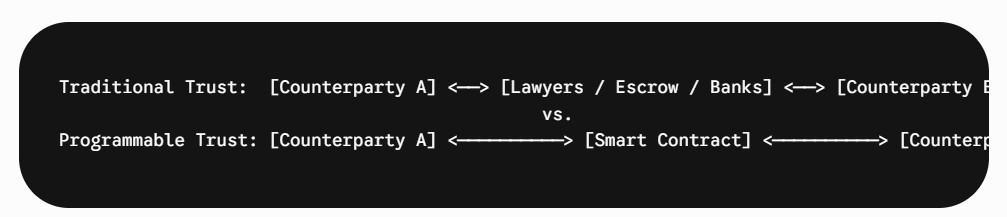
3. Programmable Trust Over Counterparty Risk
In traditional finance, trust is an expensive, relationship-driven commodity guarded by legal teams, intermediaries, and escrow agents. Ethereum converts trust into an open, highly modular utility.
By allowing actors to inspect automated execution rules ahead of time, transactions can occur safely between mutually anonymous or untrusted entities. Trust can be programmatically calibrated, augmented with crypto-economic stake, or backed by decentralized insurance pools. This turns discrete binary interactions into a highly flexible, programmable spectrum.
The Three Horizons of Irreplaceable Impact
Applying these primitives, Beiko outlined three specific frontiers where Ethereum’s architectural guarantees are not just advantageous, but structurally required.
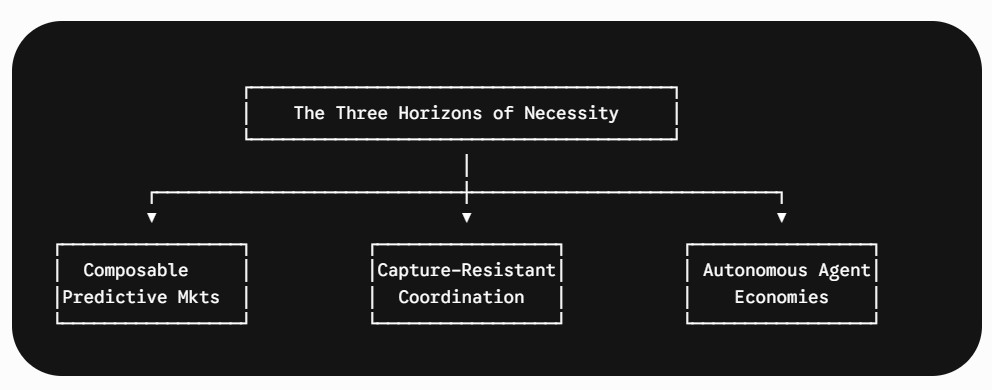
Horizon A: Composable Prediction Markets
While a standalone prediction market can run efficiently on a centralized platform, it lacks interoperability. The true power of an open state machine emerges when prediction markets become composable, programmatic infrastructure.
Imagine a localized wildfire prediction market. If it is natively hosted on a credibly neutral ledger, its real-time data output can instantly serve as an automated oracle input for an agricultural supply chain smart contract, which concurrently adjusts a decentralized weather insurance protocol. This creates a dense web of interconnected, autonomous risk management tools that operate completely outside traditional courtrooms or brokers.
Horizon B: Capture-Resistant Coordination
As global institutions face increasing polarization and fragmentation, society requires a shared environment to coordinate, pool capital, and manage resources without being subject to sudden regulatory seizures or platform bans. When the operational rules of an organization are codified transparently into an immutable ledger, it insulates the community from internal or external capture, ensuring long-term institutional stability.
Horizon C: The Autonomous Agent Economy
The most immediate and critical frontier is the explosion of agentic artificial intelligence. AI agents operate natively within purely digital environments; they cannot sign traditional physical contracts, open standard bank accounts, or rely on human social trust frameworks.
“AI agents… will be contributing signals, pricing risk, routing capital, making markets… For each interaction, they need to know what the other agents do, where that authority comes from… This is where our third property matters, because agents are really good at reading rules, verifying commitments, and deciding exactly what level of trust they want.”
While human-centric interfaces often obscure background system architecture, AI agents thrive on explicit, programmatic execution environments. Ethereum functions as a native legal and economic layer for machines, allowing millions of high-frequency, micro-transactions to settle securely according to immutable rules, free from the friction of human litigation.
The Technologist’s Takeaway
For protocol engineers, system architects, and web3 builders, Tim Beiko’s address signals a profound shift in product evaluation metrics. The speculative phase of simply putting real-world assets on-chain to find cheaper rails is no longer enough. The core focus must shift toward designing deeply composable, trust-minimized applications that leverage Ethereum’s specific cryptographic guarantees.
By building open networks where each new primitive inherently enhances the utility and security of adjacent applications, the developer community can construct an interconnected ecosystem that cannot be unbundled, co-opted, or ignored. This transition from “unreasonably sufficient” to “reasonably necessary” is what will cement Ethereum as the enduring infrastructure of the global digital economy.
For more information, please visit the following:
Website: https://www.josephraczynski.com/
Blog: https://JTConsultingMedia.com/
Podcast: https://techsnippetstoday.buzzsprout.com
LinkedIn: https://www.linkedin.com/in/joerazz/
Leave a Reply
You must be logged in to post a comment.