
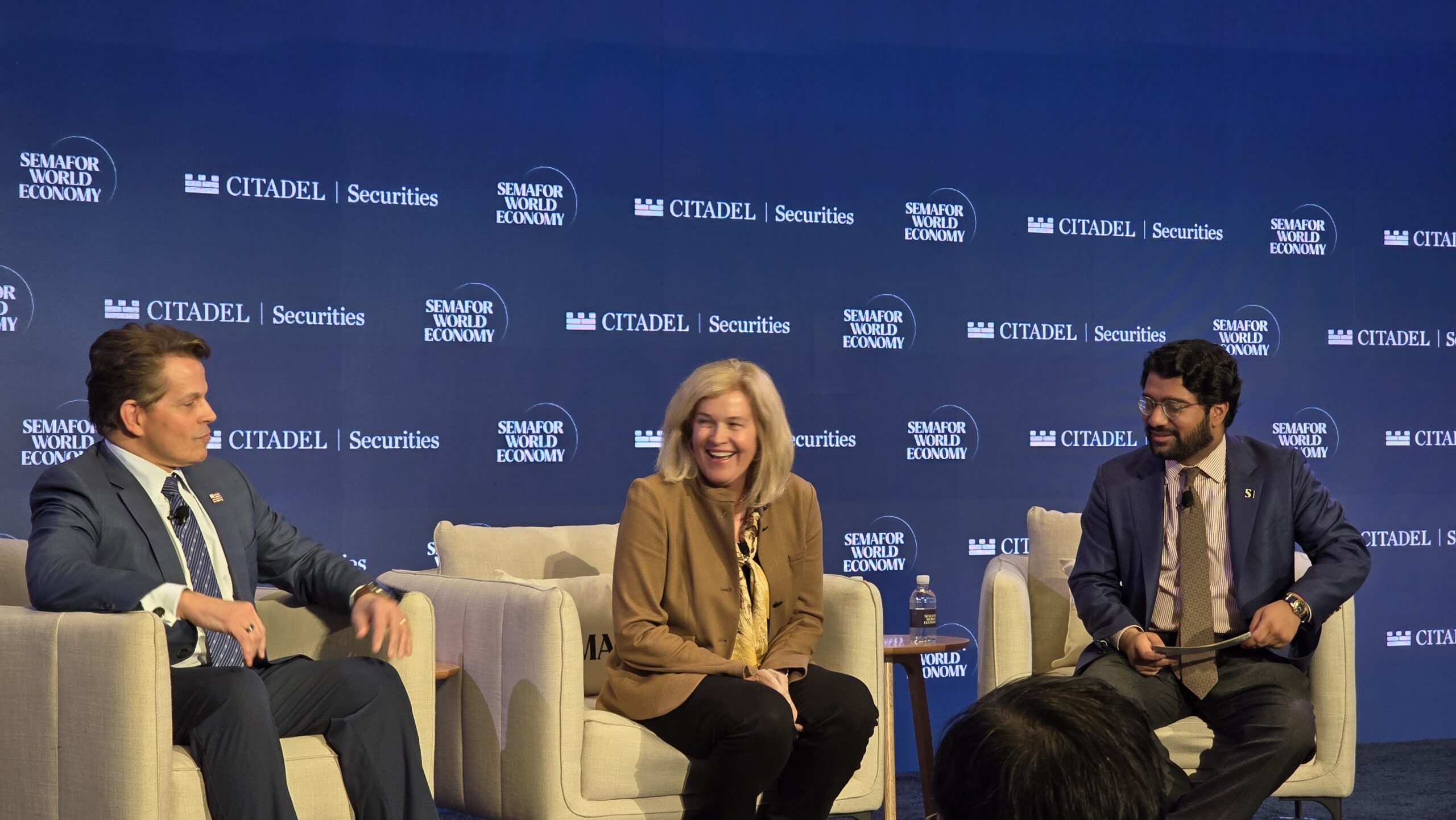
At the Semafor World Economy summit, the “Future of Capitalism” session offered a visceral look at the growing pains of a financial system in mid-transition. Featuring Anthony Scaramucci (SkyBridge Capital) and Jenny Johnson (CEO of Franklin Templeton), the discussion moved beyond the “if” of digital assets to the “how” of institutional integration.
From a technologist’s vantage point, the session was a masterclass in infrastructure pragmatism. While the macro-economic backdrop of 2026 remains defined by high U.S. debt and geopolitical tension, the micro-level reality is one of radical efficiency gains. We are moving from a world where we trust institutions to a world where we trust math, and the legacy players are finally starting to speak the language.
The Macro View: The Sovereignty of Digital Assets
Anthony Scaramucci framed the current state of crypto not as a retail speculative bubble, but as a “right or wrong” issue for American financial leadership. He argued that for the U.S. to maintain its mantle as the global reserve currency leader for the next century, it must integrate decentralized networks.
Jenny Johnson added a crucial layer of geopolitical context. For investors in the U.S., Bitcoin might seem like a “risk-on” asset. But for investors in the Middle East, Asia, or South America, it is a sovereignty hedge. Whether fleeing hyperinflation or the fear of localized bank seizures, the global demand for “keys” rather than just “ETFs” provides a structural floor for digital assets that Western analysts often overlook.
The Micro View: The $1.38 vs. the $1.15 total
The most “clever” insight of the session came from Jenny Johnson regarding Franklin Templeton’s Benji (BENJI) tokenized money market fund. This isn’t just a pilot project; it’s a natively on-chain fund that exposes the sheer inefficiency of legacy banking “plumbing.”
The Efficiency Delta:
- Legacy Triage: In a parallel test of 50,000 transactions, the traditional record-keeping system cost $1.38 per transaction.
- On-Chain Reality: The natively on-chain system cost $1.15 in total for all 50,000 transactions.
- Democratization through Math: Because the cost to manage an account is now effectively zero, Franklin Templeton can lower account minimums from $500 to $20, or even $5. This is the true meaning of “inclusive finance”: making it so cheap to operate that you no longer need “toll takers” to subsidize small accounts.
Notable Insights from the Panelists
“Nobody ever asked me what programming language our shareholder record system was on until it was on Blockchain. Nor should you care, as long as it’s following the rules of a money market fund.” , Jenny Johnson, CEO, Franklin Templeton
“The US dollar is made out of linen and cotton… if I pull it out right now, it’s basically worthless. We accept certain things because we trust certain things. Over 16 years, this decentralized network has created a trust system because no central authority has to be trusted.” , Anthony Scaramucci, Founder, SkyBridge Capital
“I don’t think this is a left or right issue. This is a right or wrong issue… we’ve got to maintain the mantle of financial leadership.” , Anthony Scaramucci, Founder, SkyBridge Capital
Private Credit: The Non-Systemic Domino
The discussion pivoted to the $1.7 trillion Private Credit market, which has surged as banks pull back due to capital requirements. Scaramucci warned of a “fiasco” brewing in underwriting standards, comparing it to the pre-2008 era. However, Johnson countered with a structural defense: unlike a bank, where poor loans create a systemic domino effect across the balance sheet, private credit risk is contained within the specific pool of assets in a fund.
The Technologist’s Take on Credit: The risk in private credit today isn’t just about debt; it’s about Operational Due Diligence. We are seeing a “fear-based” overreaction to enterprise software companies being “disrupted” by AI. Johnson argued that for companies with a strong installed base and cash flow, AI is an incremental tool, not an immediate debt killer. The “fiasco” is less about credit quality and more about the “clunky” way these loans are managed, a problem that tokenization is perfectly suited to solve.
The “Mona Lisa” of Money: Bitcoin as a Trust System
In a final, provocative metaphor, Scaramucci compared Bitcoin to the Mona Lisa, a piece of walnut and acrylic paint that holds value because of a collective agreement on its mastery and scarcity. He argued that Bitcoin has “checked every box” in Neil Ferguson’s The Ascent of Money. With Morgan Stanley and Goldman Sachs now filing for ETFs, Bitcoin is moving into the “model portfolio” phase of global finance.
Final Takeaway: Regulation as Scaffolding
The consensus from the Semafor stage was clear: the “War on Crypto” is ending, not because the politicians have changed their minds, but because the efficiency gains are too large to ignore. Whether through the Trump administration’s “transactional” friendliness or the institutional weight of firms like Franklin Templeton, the “plumbing” of capitalism is being replaced with code.
The session left no doubt: the future belongs to those who can bridge the gap between legacy fiduciary responsibility and the raw power of the blockchain. As Scaramucci noted, we are roughly months away from a world where “no central authority has to be trusted”, and that is a profound shift for the next 125 years of capitalism.
For more information, please visit the following:
Website: https://www.josephraczynski.com/
Blog: https://JTConsultingMedia.com/
Podcast: https://techsnippetstoday.buzzsprout.com
LinkedIn: https://www.linkedin.com/in/joerazz/
Leave a Reply
You must be logged in to post a comment.