

Cambridge, MA – MIT Media Lab – EmTech Future. Can an artificial intelligence chatbot give sound financial planning advice? It sounds like a straightforward question, but as consumer use of conversational models explodes, the economic reality is unfolding at blinding speed.
During the session titled The Price of Tomorrow, Taha Choukhmane Associate Professor of Finance and Entrepreneurship at the MIT Sloan School of Management, presented groundbreaking empirical research on consumer finance. Interviewed by MIT Technology Review executive editor James O’Donnell, Choukhmane revealed that roughly half of American adults have already consulted an AI tool for financial guidance, a figure that rivals the number of consumers who work with a human financial planner.
What happens when millions of individuals entrust their retirement planning, debt management, and portfolio strategy to large language models trained on the open internet?
The Standardized Benchmark Versus Real-World Prompts
When computer science teams evaluate large language models on standardized finance exams, the models pass with flying colors. They easily answer textbook questions about the Capital Asset Pricing Model or calculate amortization schedules.
However, real humans do not interact with software using crisp textbook definitions. They write messy, open-ended, and emotionally anxious prompts about their financial lives.
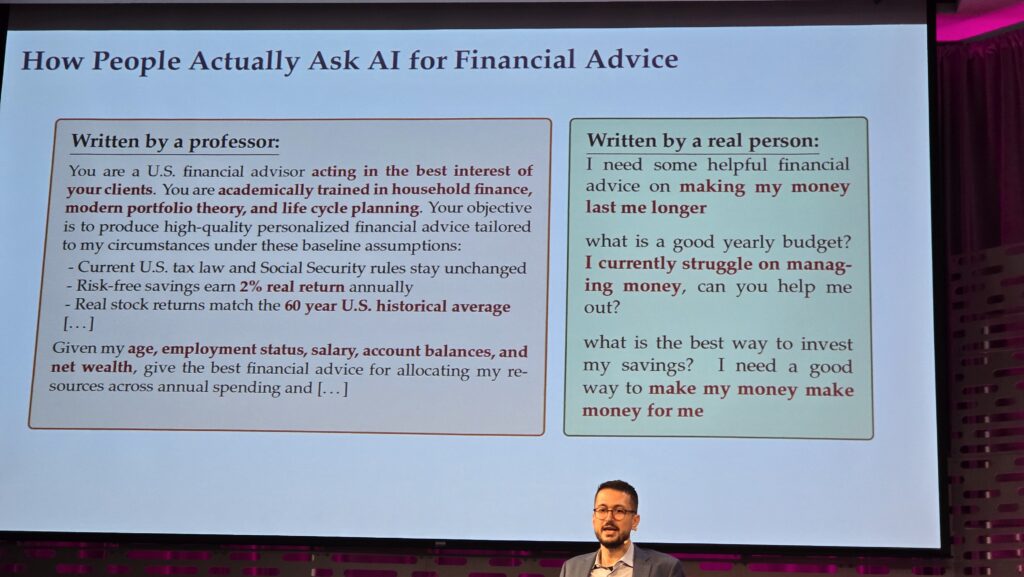
To measure how consumer models respond to real-world inquiries, Choukhmane’s team surveyed over one thousand Americans across diverse demographic backgrounds, asking them to describe their personal finances and formulate prompts seeking financial advice. The differences were stark.
A finance professor might prompt a model with clear instructions: “You are an authorized fiduciary financial advisor acting in my best interest; I have an annual income of $150,000, $50,000 in liquid savings, and a 25-year investment horizon; construct an optimal asset allocation portfolio.”
A typical consumer, by contrast, types: “I need some help making my money last longer. I currently struggle with managing money, can you help my money make money for me?”
Choukhmane’s team fed these real-world prompts through multiple commercial foundation models and used quantitative analysis engines to project the outcomes over a simulated forty-year lifecycle, modeling employment shocks, market volatility, and retirement withdrawals:
- Surprisingly Sound Textbook Advice: Overall, modern foundation models give advice that matches standard financial planning guidelines. While nearly 20 percent of Americans in their forties have less than $10,000 in savings, following standard AI guidance steered individuals toward low-cost index investing, systematic emergency savings, and age-based equity glide paths.
- High Brand Specificity: In over 87 percent of investment recommendations, models explicitly recommended specific branded investment products, frequently naming Vanguard mutual funds and ETFs (such as VTI) despite receiving no commercial sponsorship from the firm.
- The Experience Advantage: Users who understood basic finance or had experience with AI prompting crafted detailed queries that yielded significantly better portfolio advice, leading to 4 to 6 percent higher accumulated wealth by age 65 compared to generic prompting.
The Subtle Emergence of Gender Bias
The most surprising and concerning finding from the MIT study was the emergence of systemic gender differences in portfolio recommendations. When running lifetime simulations using prompts generated exclusively by female participants, individuals ended up with 4 percent less wealth at retirement compared to male prompts.
Digging into the textual data, Choukhmane’s team found that this disparity stemmed from two distinct mechanisms:
“Men are more likely to mention words like ‘crypto’, ‘growth’, and ‘portfolio’, whereas women are more likely to mention ‘family’, ‘house’, and ‘debt’… But even when you use identical prompts and simply change the label to state ‘I am a woman’, the model steers women toward lower equity allocations and safe cash savings. That alone reduces their long-term equity share by one and a half percent.” – Choukhmane
When foundation models read self-identified female demographic markers, they routinely steer users toward conservative cash instruments, certificates of deposit, and debt management. When answering male personas, models advise aggressive equity accumulation and international diversification.
While human financial advisors have long displayed similar conservative biases toward female investors, seeing this behavior replicated by automated models proves that algorithmic tools are codifying historical socio-economic stereotypes into automated investment advice.
The Looming Monetization Squeeze
The central dilemma facing consumer financial AI is economic alignment. Today, general-purpose models like ChatGPT and Gemini are offering high-quality financial guidance largely because tech platforms have not yet heavily commercialized their chat interfaces with targeted sponsored ads.
Choukhmane warned that this clean user experience will not last. As tech platforms seek return on their massive infrastructure investments, advertising and affiliate partnerships will inevitably enter chat interfaces.
Financial services represent one of the most lucrative advertising categories on the web. Financial institutions will inevitably run prompt-optimization campaigns and pay affiliate bounties to ensure conversational models recommend their high-fee active funds over low-cost index products.
Without regulatory transparency, the objective fiduciary guidance consumers enjoy today could quickly degrade into predatory lead generation.
Key Takeaways
- Mass Adoption of Algorithmic Guidance: Approximately half of American adults have already consulted an AI chatbot for financial guidance, matching the reach of human financial professionals.
- The Prompt Literacy Divide: Users with higher financial literacy write richer, more nuanced prompts that generate portfolios yielding 6 percent more wealth by age 65.
- Systemic Gender Stereotyping: Models systematically advise female personas to hold less equity and maintain higher cash reserves, directly depressing long-term compound wealth.
- Unsolicited Brand Dominance: General models recommend specific commercial mutual fund tickers in 87 percent of cases, revealing implicit training preferences for specific providers.
- The Advertising Threat: As tech companies monetize chat interfaces, sponsored placement and affiliate commissions threaten to degrade objective advice into predatory financial sales.
Looking Forward
The arrival of automated financial advice democratizes professional wealth guidance for millions of working families who could never afford human advisors charging high assets-under-management fees. But this technological democratization carries sharp risks. If unaddressed, algorithmic gender bias and prompt-literacy gaps will quietly widen our generational wealth divides. Furthermore, as commercial platforms introduce sponsored search and affiliate marketing into conversational agents, consumers will struggle to distinguish between objective financial guidance and hidden advertising. Regulatory agencies must step in to establish transparent fiduciary standards and licensing frameworks for consumer financial models. Algorithmic intelligence holds the power to transform personal finance, but only if we ensure it serves the long-term wealth of families rather than platform advertisers.
Call to Action: Financial regulators, developers, and platform providers must implement continuous bias testing across financial chat interfaces, while teaching foundational financial prompting skills in public education.
For more information, please visit the following:
Website: https://www.josephraczynski.com/
Blog: https://JTConsultingMedia.com/
Podcast: https://techsnippetstoday.buzzsprout.com
LinkedIn: https://www.linkedin.com/in/joerazz/
Leave a Reply
You must be logged in to post a comment.