
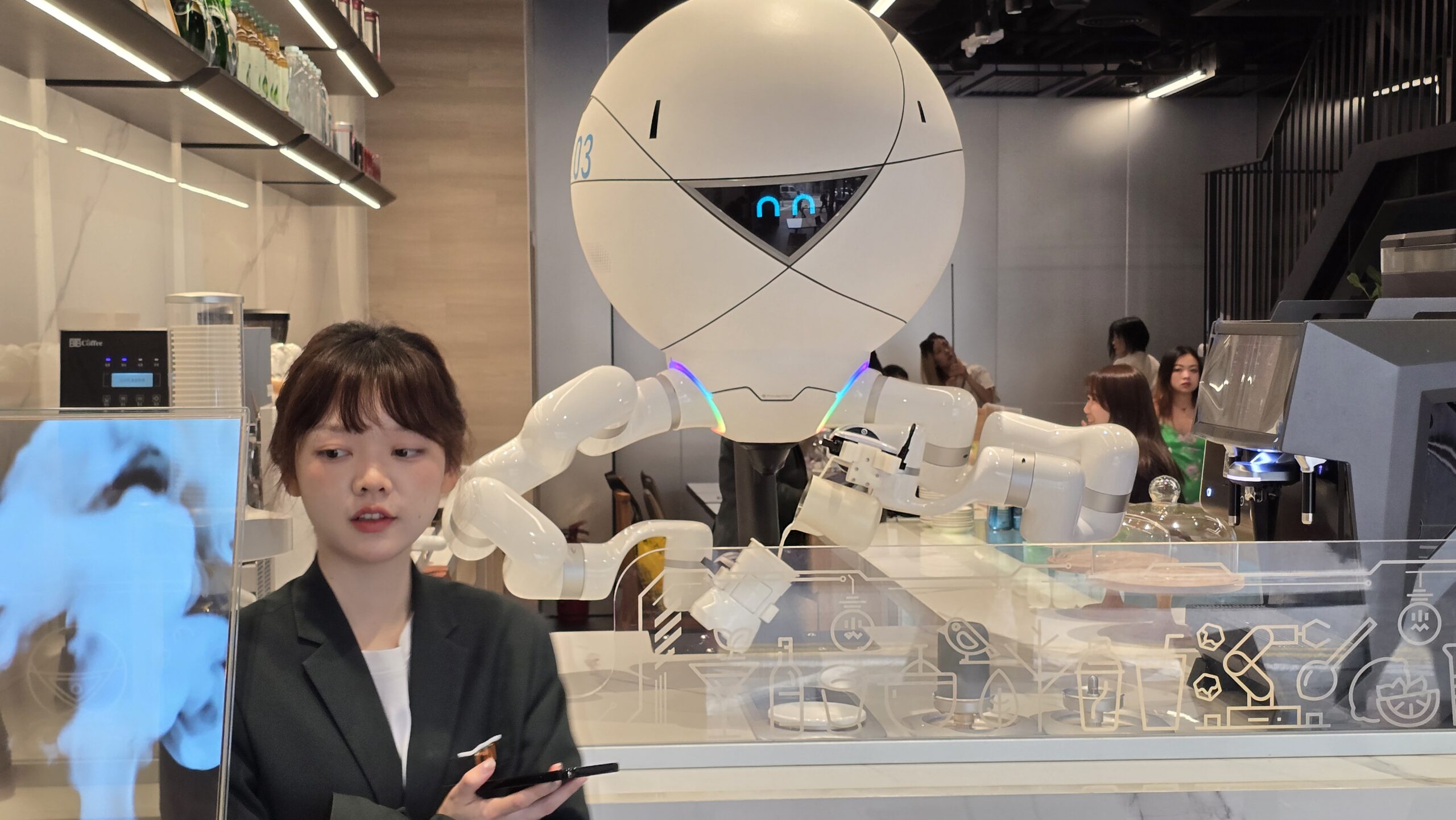
This is a different type of post for me. It’s a bit more personal, but still ties to my love of deep tech, culture and its impact on all of us both personally and professionally. There is A LOT going on in China which is very important, IMO.
Context and Rationale
In May I was scheduled to be in Dubai for a conference, but due to the ongoing conflict, that trip didn’t happen. When another conference invite rolled into my inbox, this time to Hong Kong, it launched an incredible adventure that tapped into my lifelong rabid thirst for technology and how it mixes with culture and geopolitics. I embarked as a solo tourist without a guide on what was an absolute epic trip to cover the enormous cites of China and their rural country sides. Yes, I would visit their most known cities, Beijing, Shanghai, and Hong Kong, but honestly, the real adventure, the real culture, falls outside of those behemoths. They have cities that are even larger and feel more authentic, i.e. less influenced by the West. I could go for days without seeing another person that looked like me. There wasn’t any English spoken. I would get stares all day long. Requests for pictures was common – but that’s understandable, I am a funny looking fella, TBH. The aim, to truly understand and see where the Middle Kingdom stands with technology right now and how their culture fits into it. My mind was open; I put what we read and see on screens aside. The focus was on observations, experiences, primarily on their tech and infrastructure, but I also wished to touch on its interconnected culture and what the future may eventually look like.
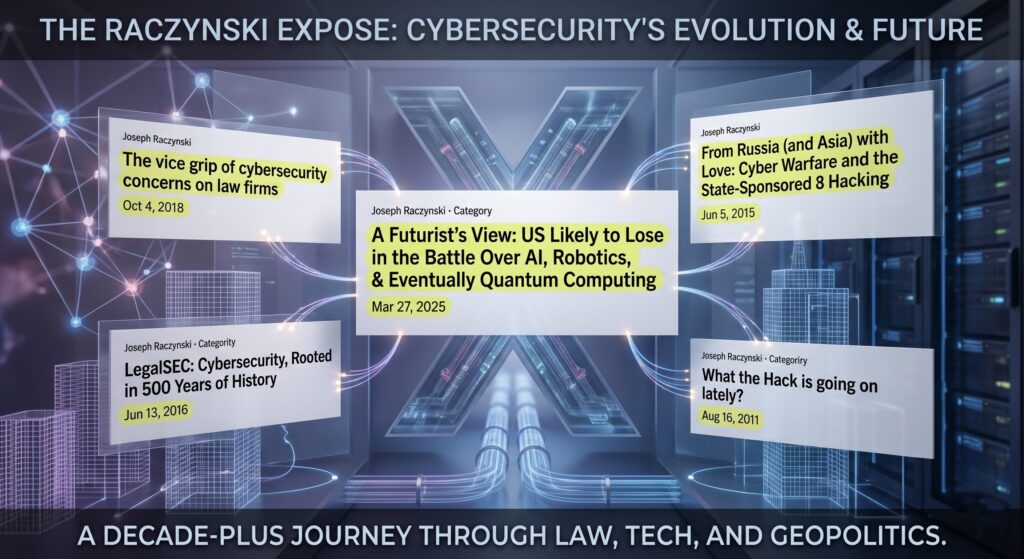
I have been writing and speaking publicly about China for over a decade. Based on papers and research, it was a fair approach to take; however, for such an important topic, it felt less authentic, perhaps less fair. Maybe I’m an empiricist at heart, I need to truly observe, hear, and interact to know it. Most of my talks, writing, and tech discussions are all based on hands on experience. They are based on my coding, developing, building, tinkering, managing and interacting with people, or building process, but also include the myriad conversations with people in and around tech and geopolitics. Ultimately, one of the important reasons for this trip was I think pushing on AI for over the last ten years has impacted my views on what is even real anymore, as has narratives. For context I was creating clones of my voice in 2017 (Lyrebird AI), publicly speaking about the potential of OpenAI in 2018, and used image generation in 2018 (Artbreeder – combine two images together). With AI, you can make anything look or sound real at this point, so it’s helpful to actually see things IRL. As billions of agents come online to do all sorts of things, some of this will push on our ability to distinguish between human versus machine. So, these sorts of jaunts, i.e. touch grass moments, are a helpful tool to leverage. It’s a privilege, I know, to put work aside and take a month-long solo sabbatical in a far-off land like this, but I felt like it would be an invaluable experience, especially during these times.
Overview
I hit eight cities in mainland China and visited Taipei, Taiwan. I felt it was important to experience both of the aforementioned, to get a broader perspective. One of the highlights back on mainland China was Shenzhen, their Silicon Valley, a city of 18 million people, and it alone got me very excited for the potential of where tech may go, but also deeply concerned, more on this later.

Chengdu, in the western portion of the country, also the center of the Sichuan province, felt like a cultural hub, almost like Kyoto in Japan. The food was incredible, the historical and religious sites beautiful, and of course, it’s home to the mecca for giant pandas (research and conservation facility).
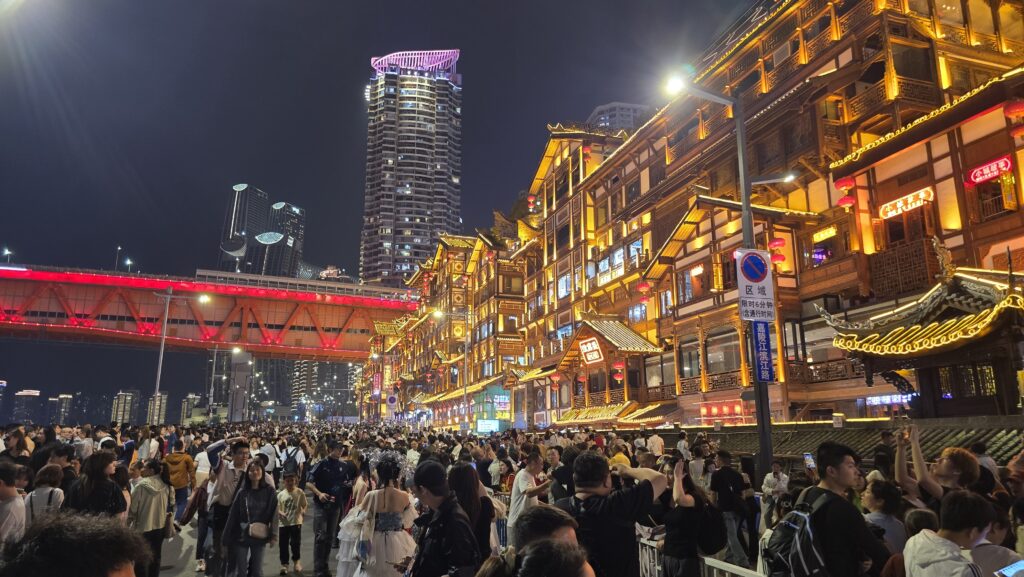
Chongqing, according to Google, is the largest city in the world, and it’s likely most have not heard of it, I hadn’t. It’s also known as the Cyberpunk City. Why? More on that shortly.

Zhangjiajie, Hunan province, is likely a name you haven’t seen before. Try pronouncing it… (June-jai-ja), but surely its landscape is silver screen familiar. It’s the inspiration for the movie Avatar. Their most grandiose national park, with 40 million visitors per year, it has dramatic quartz-sandstone pillar formations, which rise up to 1,000 feet from the ground. This ethereal “peak forest” features over 3,000 towering stone peaks blanketed in lush vegetation. Shanghai tangibly felt like its history. It’s a split mixture of British and French influence contrasted with modern China. Fashion seemed most prized and on display. Last, of my primary focused cities is Beijing, coming from Washington, DC, it’s a bit of a mirror, in some ways, but clearly Beijing has thousands of years of history still preserved, including the Great Wall and Hidden City.
Technology
QR Codes & Mini Apps: This is the seminal tech that weaves through all of China. I did not need cash the entire time and could not use credit card. Everything; menus, metro, buses, all payments, information, tickets, visa identification, as you gather everything leverages this tech. You want to buy bottled water from a convenience store, show them your WeChat or AliPay QR code. The woman selling fresh strawberries on the street, scan their QR code and pay her. Jump on the metro and scan your QR code. What most outside of Asia are less aware of is most everything you do routes through a few primary central apps. AliPay and WeChat are funnels.

You download either app, AliPay is way easier as an American, and anytime you go to a different city, restaurant, etc. you download a mini app, which might be a transit app for their metro. Simply agree that the mini app is okay to use and you have access. Head to a restaurant, snap their QR code and it pulls up their restaurant menu. When paying, it relies on AliPay’s secure payment system. It’s kinda brilliant and simple. Yes, you are reliant on one company to do all of this, but that’s not unfamiliar, hello, Amazon. It’s seamless and ubiquitous. As an American, your credit card is tied on the back end.
Drones: I’ve been flying drones since 2014. In the last few years drone tech has taken on a new form, unfortunate but predictable. DJI, a Chinese company, hands-down makes the best drones in the world. They are probably 2-3 generations better than anything else made. Unfortunately, this tech as become political, even in China. A week before I arrived in Beijing, they were outlawed in the city. Meaning, no drones, parts, or propellers were allowed within the city limits. Even their main flagship stores were not allowed to sell these hugely popular flying cameras. The concern around safety is what’s leading to this policy shift. Washington, DC, ten years ahead of its time, has had a no-fly zone within 15 miles of the White House since 2016. I started talking about drone swarms in 2019 and the potential for real harm, but also their utility – guiding cars to open parking spaces, and drone delivery! Speaking of drone delivery…
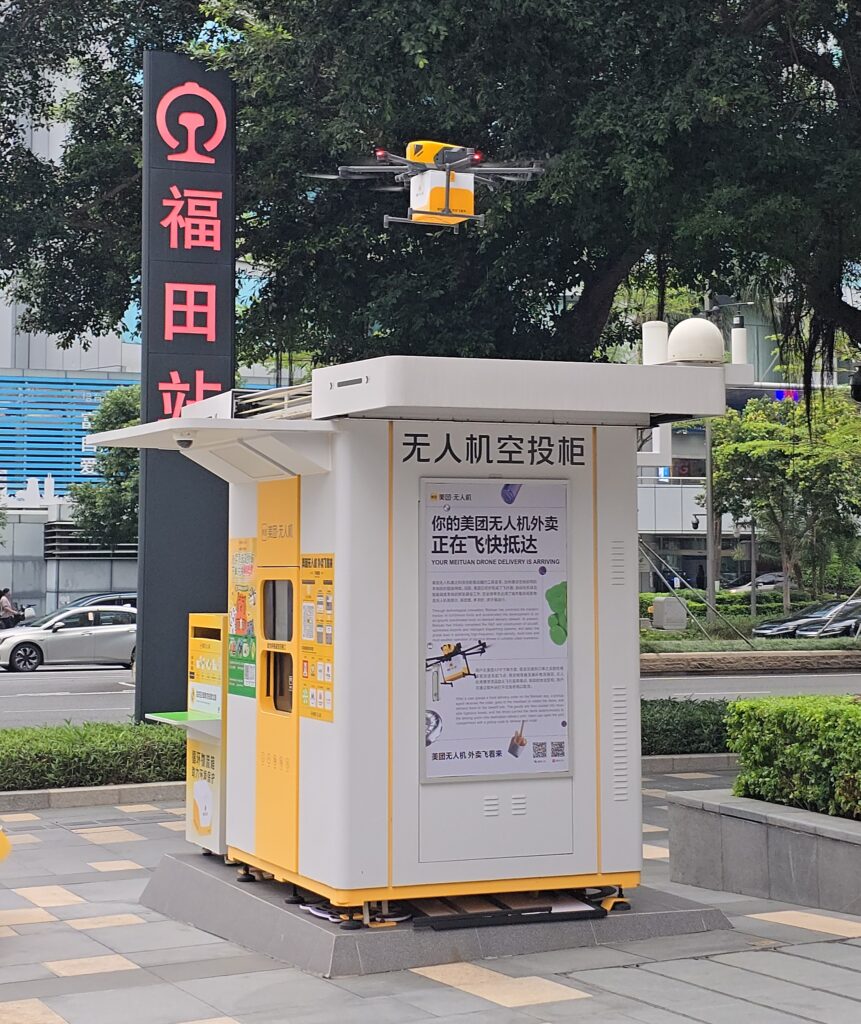
In Shenzhen, I got to witness something I have been talking about for years, drone delivery. The city has upwards of 200 kiosks throughout area where you can get food delivered to you via a QR code. You can see how this works from a video I captured here. It’s incredible! You choose your order via an app, e.g. a boba tea or KFC sandwich (yes, KFC is hugely popular in China), and in about 10 mins, high in the sky, along a drone highway, which tracks the same path as main streets only 200 feet up, you can see the drone approach, and land high atop of the kiosk. There it drops the box into a doorway and then the package is filed away until the person who ordered arrives to punch in their private code, and a separate door closer to the ground opens. Remove your boba tea from the delivery box and collapse the box and place it in the recyclable slit.
Battery Charging: On many street corners, in stores, and around the city they have rentable phone battery packs. You use a QR Code and check out the power bank. Use it and return it to one of several hundred other locations.
Part 2 will be release on the following day focused on electric cars, phones, bullet trains, security and living and some final thoughts.
Trip Videos
If you are curious about the sights and sounds of these locations, I pulled together some very informal travel videos that touch on technology, culture, and the logistics of each area in China and Taiwan. These are much less serious and more an overview of each city.
Chongqing (premiers 6/10/2026)
Zhangjiajie (premiers 6/18/2026)
Shanghai (premiers 6/24/2026)
Beijing (premiers 7/1/2026)
For more information, please visit the following:
Website: https://www.josephraczynski.com/
Blog: https://JTConsultingMedia.com/
Podcast: https://techsnippetstoday.buzzsprout.com
LinkedIn: https://www.linkedin.com/in/joerazz/
Leave a Reply
You must be logged in to post a comment.