
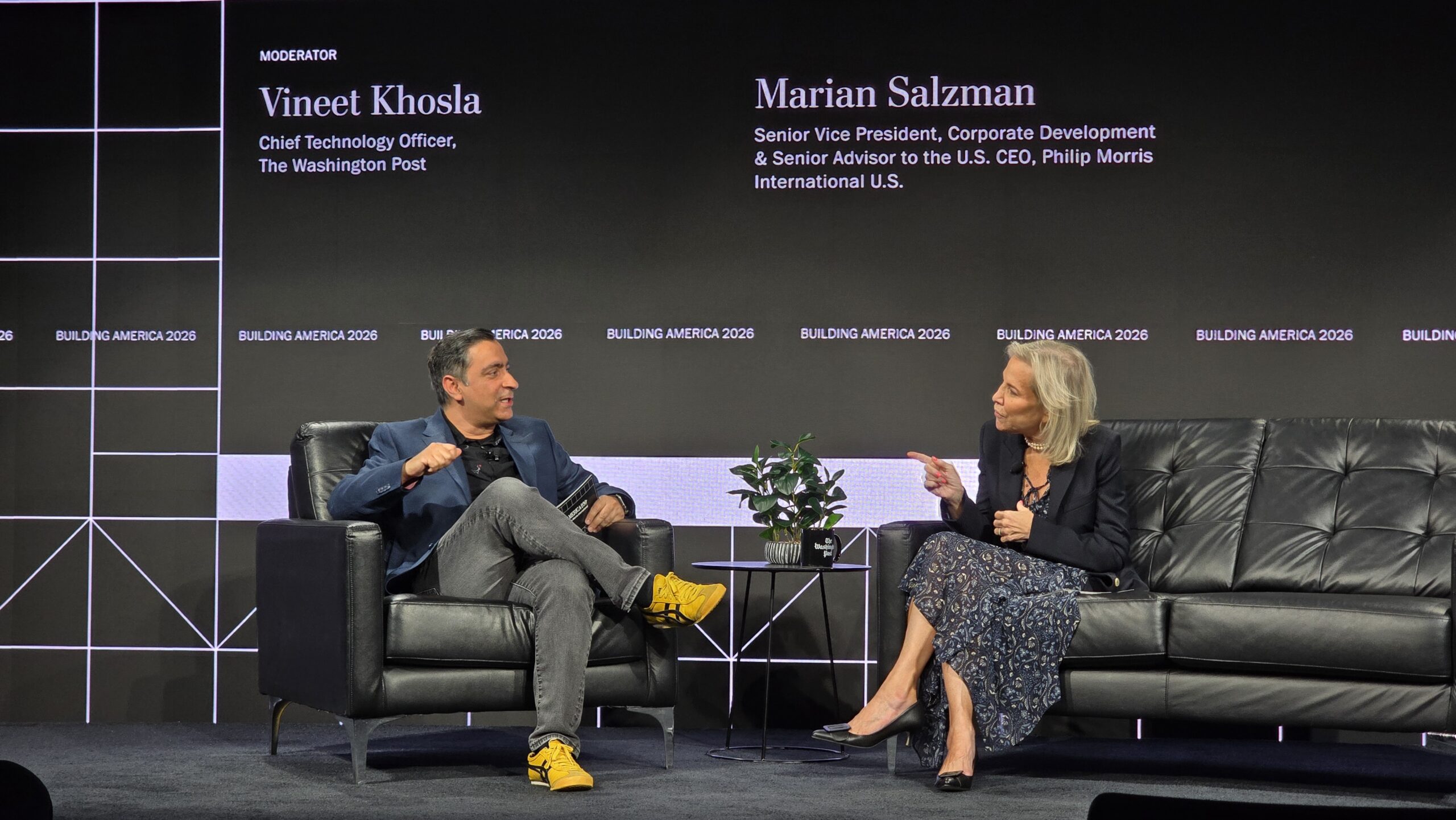
At The Washington Post’s Building America Summit in Washington, DC, an insightful dialogue took place between Vineet Khosla, Chief Technology Officer at The Washington Post, and Marian Salzman, Senior Vice President of Corporate Development and Senior Advisor to the US CEO at Philip Morris International (PMI). Salzman, a globally recognized trendspotter and corporate strategist, has built a career on identifying what comes next. From an engineering and technological perspective, her conversation with Khosla highlighted a profound architectural shift in how society surfaces, validates, and scales transformative ideas.
For decades, the technology sector has operated under a centralized paradigm. Innovation was viewed as a top-down, geographically concentrated phenomenon, with Silicon Valley, Austin, and Cambridge acting as the primary source repositories. However, Salzman’s thesis suggests that the structural layout of innovation is rapidly decentralizing. As the nation approaches its 250th anniversary, the mechanisms for finding the “next big thing” require a fundamental restructuring of our observational frameworks.
The Decentralization of Trendspotting: Moving Beyond the Tech Circuits
When technologists look for emerging trends, they often fall back on a predictable itinerary. They monitor the established hubs, track venture capital flows in specific ZIP codes, and assume that anything of consequence will emerge from an elite research lab or incubator. Salzman challenges this linear approach, arguing that we need to adjust our focus:
“I think everyone needs to rethink what innovation and progress means, and we probably need to flip the telescope… The future in many ways is now, but the future is also happening at the community level… It can bubble up from anywhere, they can be nurtured and supported, or they can be extinguished.”
This “flipped telescope” is an apt metaphor for a decentralized, edge-computed model of cultural and technological discovery. Rather than relying on a centralized core to push updates to the periphery, valuable insights are increasingly bubbling up from local, non-traditional nodes like Boise, Idaho; Tucson, Arizona; and Pittsburgh, Pennsylvania.
AI as an Equalizer for Regional Discovery
From a technologist’s point of view, this regional dispersion of viable ideas is heavily accelerated by advanced data tools and large language models. Historically, uncovering micro-trends required massive localized boots-on-the-ground infrastructure or expensive, lagging market research frameworks. Today, consumer-facing AI engines act as constant, analytical companions that can ingest, synthesize, and surface hyper-local data points in real time.
With platforms like ChatGPT and Perplexity acting as data synthesis layers, the friction required to unearth unique localized experiments has dropped to near zero. The challenge is no longer a scarcity of regional innovation, but rather building the visibility pipelines necessary to ensure these edge-computed ideas do not get extinguished before they reach global scale.
“Talkability” and Conversational Currency as the Ultimate Scaling Protocol
A compelling segment of the summit focused on the forensics of why certain ideas achieve hyper-scale while others fail to cross the chasm from the margins to Main Street. Salzman, who pioneered early online market research and famously identified the “metrosexual” cultural phenomenon in the early 2000s, pointed to a non-technical metric that functions as a critical scaling protocol: talkability.
“A lot of what it takes to succeed is conversational currency, does something have talkability. Can I explain it to you, more importantly, can you explain it to your wife, and can she explain it to the next-door neighbor? Because life is a game of telephone.”
In software development, we often prioritize elegant code, optimized system architecture, and robust APIs. Yet, when deploying consumer-facing products or platforms, the technical implementation is only half the battle. If an innovation lacks an intuitive, viral loop, a high degree of conversational currency, it cannot achieve the critical mass required for network effects to take hold.
The Anatomy of Network Effects: From Focus Groups to Social Feeds
Salzman recounted the origins of Giving Tuesday, a global movement she helped launch alongside Henry Timms. The initiative did not begin as a multi-million-dollar marketing campaign; it started at a small dinner party just three weeks prior to its public rollout. The underlying technical framework was remarkably lightweight, writing a press release and seeding it with targeted keywords to catalyze organic distribution.
The initiative achieved exponential growth because it tapped into an incredibly simple, human-centric value proposition. Salzman contextualized the consumer friction that Giving Tuesday solved:
“People recognized Thanksgiving is bluntness, Black Friday is mutiny, Cyber Monday, not so good. Suddenly, you could do something good in exchange for your Starbucks that morning… You could skip your Starbucks at that $6, $7 [and] could make a difference for something you cared about.”
This structural positioning transformed micro-philanthropy into a cultural trend. By lowering the financial barrier to entry and attaching the action to an easily shareable social component, the creators designed a viral loop. A trend is not fully realized until it is personified and carried forward by communities who adopt it as part of their identity.
Structural Reinvention and Strategic Optimism
As the conversation turned toward the upcoming U.S. semiquincentennial (the 250th anniversary), both Khosla and Salzman explored the concept of national and corporate reinvention. Salzman emphasized that milestone anniversaries offer a distinct operational window for organizations to stretch out a long-term vision rather than treating transformation as a single-day event.
This perspective is highly relevant for legacy enterprises facing the pressures of modern digital disruption. Sustained relevance requires an ongoing commitment to structural pivot points. Salzman pointed to her own presence at Philip Morris International as tangible proof of this corporate transformation. Traditionally known as a tobacco company, PMI is actively executing a long-term strategic pivot toward alternative, smoke-free technology platforms.
Maintaining operational agility during these massive pivots requires a baseline of institutional optimism. Sharing her perspective as a survivor of multiple brain tumors and stage-4 lymphoma, Salzman reframed challenges as opportunities to explore new structural efficiencies:
“Optimism is something that you either have it, you borrow it, you adopt it, or if you reject it, I feel really sorry for you… You can confront sometimes bad things happen… There’s almost always a silver lining in what you experience.”
During a period of pandemic isolation and medical recovery, she leveraged her screen to dive deep into digital media and consumer behaviors, proving that constraint often breeds deep analytical focus.
Launching the Edge Pipeline: The Community Futures Challenge
To actively bridge the gap between marginal innovation and mainstream visibility, Salzman announced that PMI is rolling out the Community Futures Challenge. Designed as a localized grant framework partnering with entrepreneurs, academics, and community leaders, the initiative aims to fund grassroots problem-solving.
“I am hoping to find that 32-year-old in Jackson, Mississippi with a dream that a little bit of cash is going to let them explore their creative idea and hopefully solve a problem for themselves, their family, their friends, their community. I don’t know what we’re going to find. That’s the most exciting part of it.”
By utilizing an independent panel of external judges to insulate the selection process from corporate bias, the challenge serves as an open-innovation pipeline. It acknowledges that the next major micro-philanthropy model or disruptive consumer trend will likely not originate inside a Fortune 500 boardroom.
The Technologist’s Takeaway
For technology leaders navigating an era defined by rapid AI integration and distributed workforces, the Building America Summit highlights a core truth: the edge is becoming the center.
True innovation is no longer confined to traditional tech corridors. By combining localized passion with clean data layers, modern AI tools, and an acute understanding of conversational currency, today’s edge-driven innovators can scale their impact globally. The technologists who succeed over the next decade will be those who design the pipelines to listen to, fund, and amplify these marginal voices.
For more information, please visit the following:
Website: https://www.josephraczynski.com/
Blog: https://JTConsultingMedia.com/
Podcast: https://techsnippetstoday.buzzsprout.com
LinkedIn: https://www.linkedin.com/in/joerazz/
Leave a Reply
You must be logged in to post a comment.