
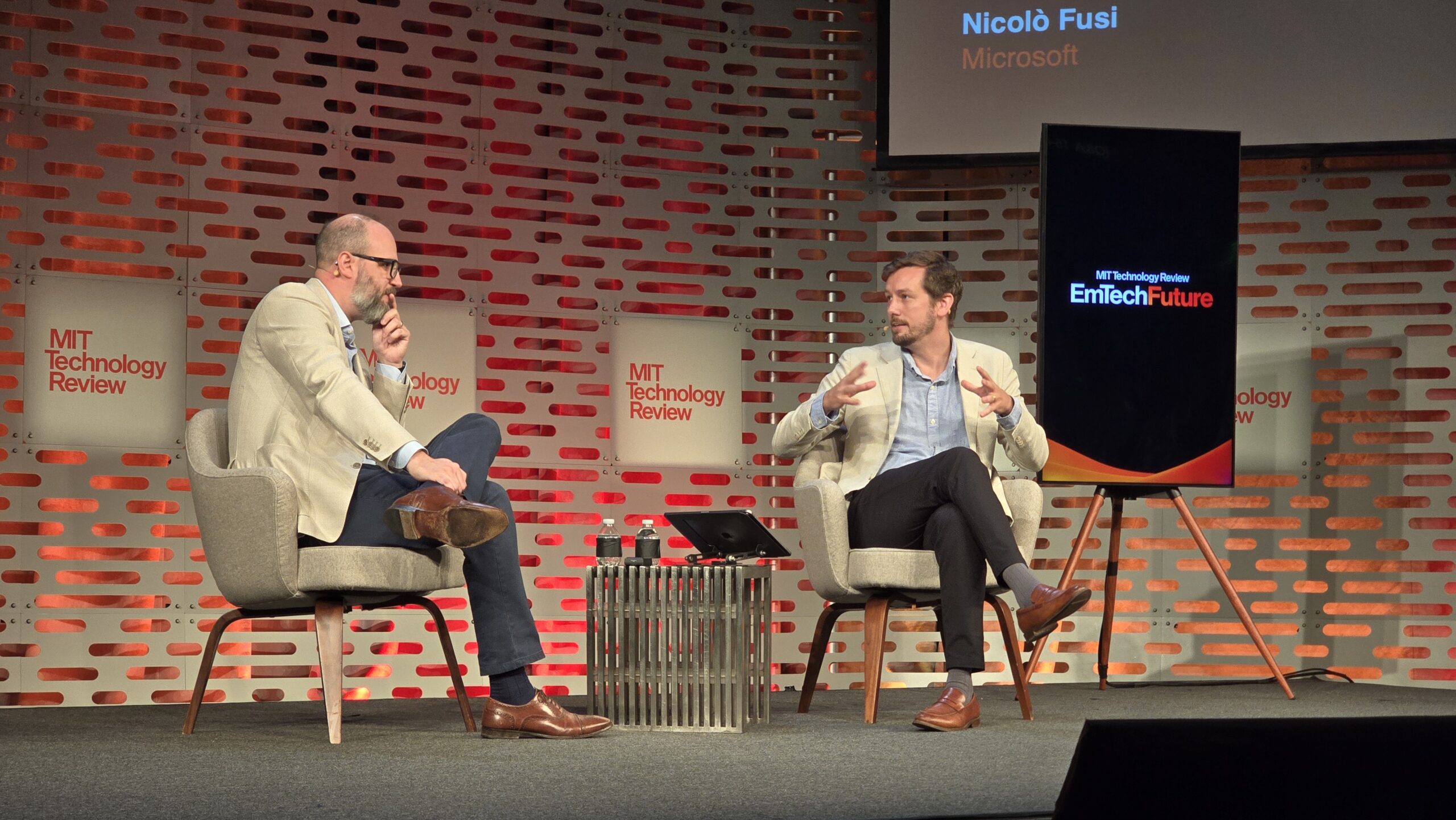
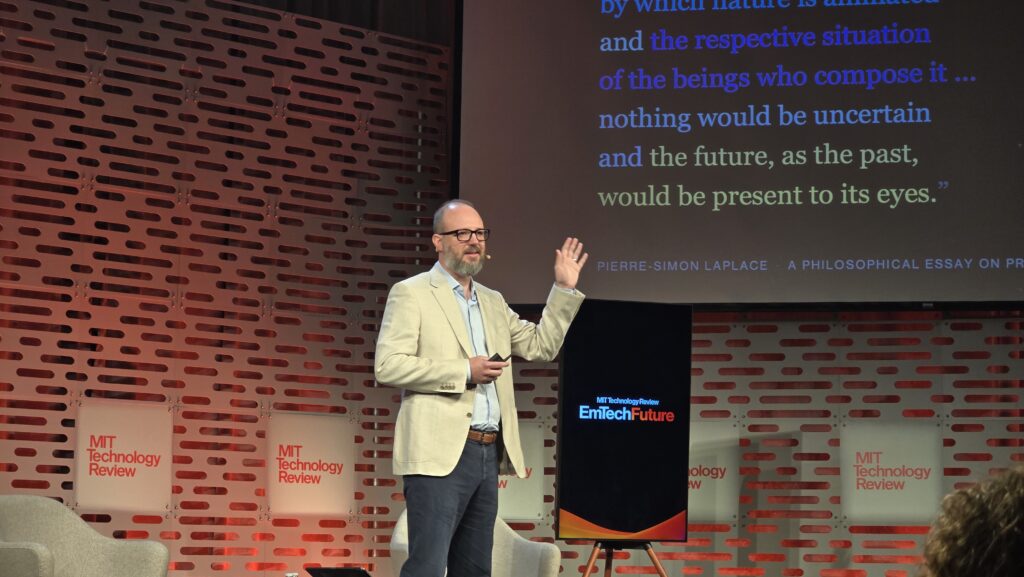
Cambridge, MA – MIT Media Lab – EmTech Future. More than two centuries ago, the French polymath Pierre-Simon Laplace conceptualized a powerful scientific thought experiment that would become known to history as Laplace’s Demon. If an intellect could know the exact positions and forces acting on every particle in the universe, nothing would be uncertain; the future and the past would be laid out before its eyes. During his keynote session, Nikola Kovachki, Senior Principal Researcher at Microsoft Research, stood alongside session host Antonio Regalado to explain why this ancient mathematical thought experiment is now driving the frontier of biological computing.
The prevailing scientific paradigm has hit an architectural wall. While modern large language models can convincingly mimic medical phrasing, they remain statistical tokens living in a flat, one-dimensional world of human text. Living biology, however, is dynamic, multi-modal, spatial, and ruthlessly physical. To design transformative medicines, software must leave static text behind and construct true biological world models: systems that learn the underlying states and dynamics of living cells and can accurately simulate the consequences of an intervention before setting foot in a lab.
Navigating the Invariant Arrow of Nature
The primary hurdle in biomedical discovery is not a lack of scientific hypotheses; it is the brutal, unyielding clock speed of the physical wet lab. A human scientist or an AI can generate ten thousand therapeutic targets in a matter of seconds. But validating those ideas requires growing physical cells, expressing proteins, and waiting for biochemical reactions to run their natural course.
Even with automated robotic pipetting running around the clock, you cannot speed up physical cell division or molecular binding. The experimental cycle remains fundamentally bound by the slow, continuous pace of nature.
Kovachki argued that biological world models alter this discovery calculus not by eliminating wet lab testing, but by making physical experiments profoundly more selective. A world model acts as an in silico simulator, modeling branching bundles of possible cellular futures. By exploring these simulated paths computationally, researchers can eliminate thousands of dead ends in advance, reserving physical lab experiments exclusively for high-probability discoveries.
“World models fit very well in that loop because they give us a way to reason about the consequences of actions and interventions before we perform them… It doesn’t mean that we don’t experiment. It means that we are much more purposeful with the amount of time we spend in the lab.” – Nikola Kovachki
Unveiling Project Fined: Pancreatic Cancer Phenotype Switching
To ground this computational theory in real-world medicine, Kovachki presented the first public demonstration of Project Fined, a comprehensive multi-modal biological world model developed by Microsoft Research in close collaboration with the Broad Institute.
The joint research team tackled pancreatic ductal adenocarcinoma (PDAC), one of oncology’s deadliest targets. Clinicians have long recognized two dominant transcriptional states in PDAC:
- Classical State: Resistant to standard KRAS inhibitors, offering grim therapeutic prognoses.
- Basal-Like State: Highly aggressive, but showing distinct, targeted sensitivity to newly emerging KRAS therapies.
The team challenged Project Fined with an audacious question: can we identify a repurposable small-molecule drug that forces resistant classical pancreatic cancer cells to morph into basal-like cells, priming them for eradication by KRAS inhibitors?
The world model evaluated thousands of compound trajectories and produced three surprising, highly counter-intuitive predictions:
- It predicted that the cell-state transition from classical to basal-like was biologically favorable, whereas the reverse was resistant to therapy.
- It identified a prioritized list of repurposable molecules predicted to drive this state transition.
- It predicted the emergence of a completely unknown third intermediate cellular state.
Initial human evaluation suspected that this unexpected third state was merely a computational error. But when the team ran physical wet-lab assays at the Broad Institute, the model’s predictions held up completely. The prioritized drug candidates reliably shifted the cancer cells into the drug-sensitive state, outperforming compounds nominated by human domain experts. Furthermore, physical assays confirmed the presence of the mysterious third cell state, opening a brand-new therapeutic front.
The Destructive Assay Dilemma
Constructing an accurate world model requires overcoming a profound physical measurement hurdle: in molecular biology, observing a system often destroys it.
When researchers run a single-cell RNA sequencing assay to read out gene expression, the target cell is physically lysed and permanently obliterated. You cannot apply a drug to a cell, take a high-resolution measurement, and then test that same cell with a second compound. The system’s state has been irreversibly altered.
To overcome this measurement constraint, Project Fined avoids isolated specialized sub-models. Older approaches routed data through separate models for genomics, transcriptomics, and spatial pathology, creating severe information bottlenecks.
Microsoft Research integrated these diverse modalities into a single, unified foundation model. By co-training across diverse data layers, the system uses data-parallel representations to transfer insights across different measurement types. This enables the model to predict destructive cellular responses with high fidelity, even when working from sparse observational datasets.
Key Takeaways
- Beyond Flat Language: Biological discovery requires moving beyond textual models to spatial, causal world models that simulate complex cellular dynamics over time.
- Bypassing the Wet Lab Bottleneck: While automated robotics cannot accelerate physical cell division, in-silico simulation allows researchers to test and discard thousands of experimental hypotheses computationally.
- Phenotypic Reprogramming: Project Fined proved that computational world models can identify non-obvious small molecules to force deadly cancer cells into drug-sensitive states.
- Algorithmic Discovery of Novel Biology: In physical validation trials, the Microsoft and Broad Institute team confirmed a previously unmapped intermediate cellular state predicted by the model.
- Unification Across Fragmented Modalities: Stitching genomic, transcriptomic, and spatial pathology data into a single foundation model prevents the information loss inherent in siloed architectures.
Looking Forward
The transition from descriptive language engines to predictive, biological world models marks a momentous leap forward for computational medicine. As these systems evolve, the historical boundary between algorithmic simulation and physical experimentation will dissolve into a unified discovery engine. However, humility remains paramount. Biological systems are governed by non-linear dynamics, stochastic noise, and evolutionary quirks that resist perfect computational reduction. The ultimate metric for AI success is not synthetic benchmark scores, but real clinical discoveries validated in living tissue. In the coming decade, world models will recede gracefully into the scientific background, serving as an indispensable engine for researchers unraveling the mysteries of human biology.
Call to Action: Biopharma research teams should immediately apply to the Fined Fellows Program, contributing their proprietary perturbation datasets to collaborative, unified biological world models.
For more information, please visit the following:
Website: https://www.josephraczynski.com/
Blog: https://JTConsultingMedia.com/
Podcast: https://techsnippetstoday.buzzsprout.com
LinkedIn: https://www.linkedin.com/in/joerazz/
Leave a Reply
You must be logged in to post a comment.