
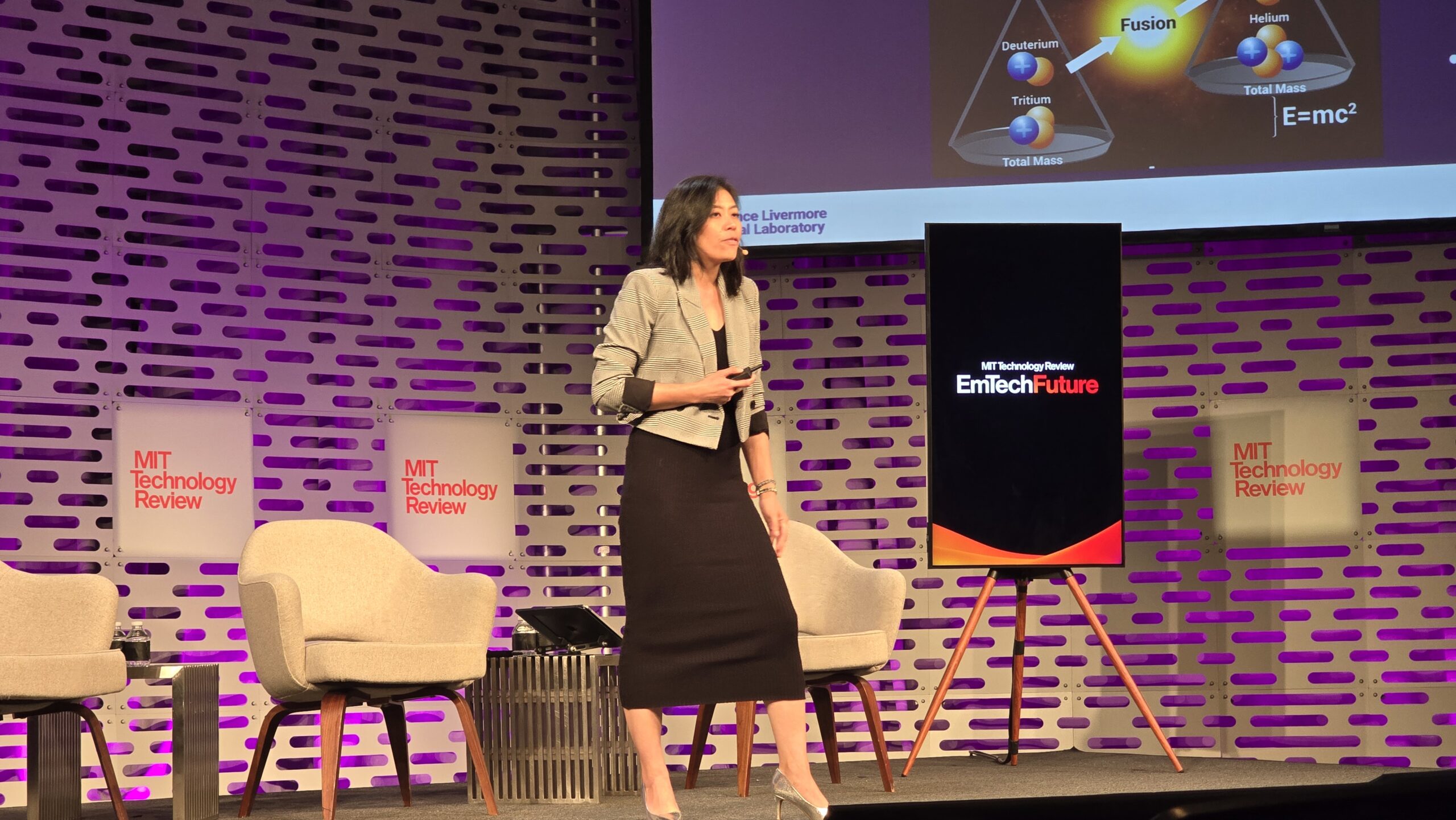
Cambridge, MA – MIT Media Lab – EmTech Future. Energy is the fundamental currency of human civilization. For centuries, access to energy has shaped geopolitical alliances, driven territorial conflicts, and dictated the economic wealth of nations. But what happens when energy becomes so clean, safe, and abundant that it ceases to be a scarce strategic commodity and becomes an accessible utility?
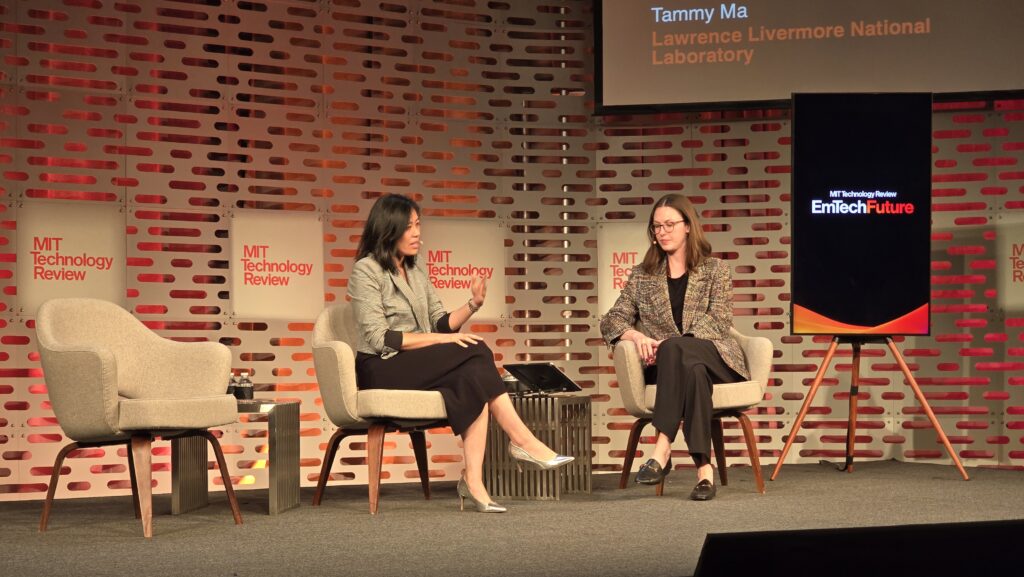
In her keynote address titled When Energy Becomes Abundant, Tammy Ma, Deputy Principal Associate Director for Science and Technology at Lawrence Livermore National Laboratory (LLNL), delivered a compelling briefing from the frontier of nuclear physics. Introduced by MIT Technology Review’s senior climate reporter Casey Crownhart, Ma reflected on the historic milestone achieved at the National Ignition Facility (NIF) and laid out the technological roadmap to commercial fusion energy.
The Historic Demonstration of Controlled Ignition
On December 5, 2022, researchers at LLNL accomplished a feat that had eluded physicists for over six decades: achieving controlled thermonuclear ignition in a laboratory setting. For the first time in history, a fusion experiment generated more energy than the laser energy delivered to start the reaction, crossing the long-sought threshold of scientific breakeven ().
Ma explained the underlying nuclear physics powering the sun and stars. By taking heavy isotopes of hydrogen, deuterium and tritium, and compressing them under immense temperatures and pressures, atomic nuclei fuse together.
The resulting products, a helium nucleus and a high-energy neutron, weigh slightly less than the initial reactants. That tiny mass difference is converted directly into energy according to Einstein’s iconic equation, .
The advantages of fusion energy over traditional fossil and fission power are immense:
- Limitless Natural Fuel: Deuterium occurs naturally in ordinary seawater, with one out of every 6,500 hydrogen atoms in ocean water existing as deuterium. Tritium can be bred within the reactor itself using lithium blankets. Earth’s oceans hold enough accessible fusion fuel to power human civilization for thirty billion years at current consumption rates.
- Zero Long-Lived Radioactive Waste: Unlike nuclear fission, fusion reactions generate no high-level radioactive waste or long-lived transuranic isotopes, eliminating the need for complex deep geologic repositories like Yucca Mountain.
- Absolute Inherent Safety: A fusion reaction requires precise, delicate conditions to operate; if containment is disturbed, the plasma instantly cools and the reaction stops, eliminating any risk of catastrophic meltdown.
The Long Climb from Scientific Breakeven to the Grid
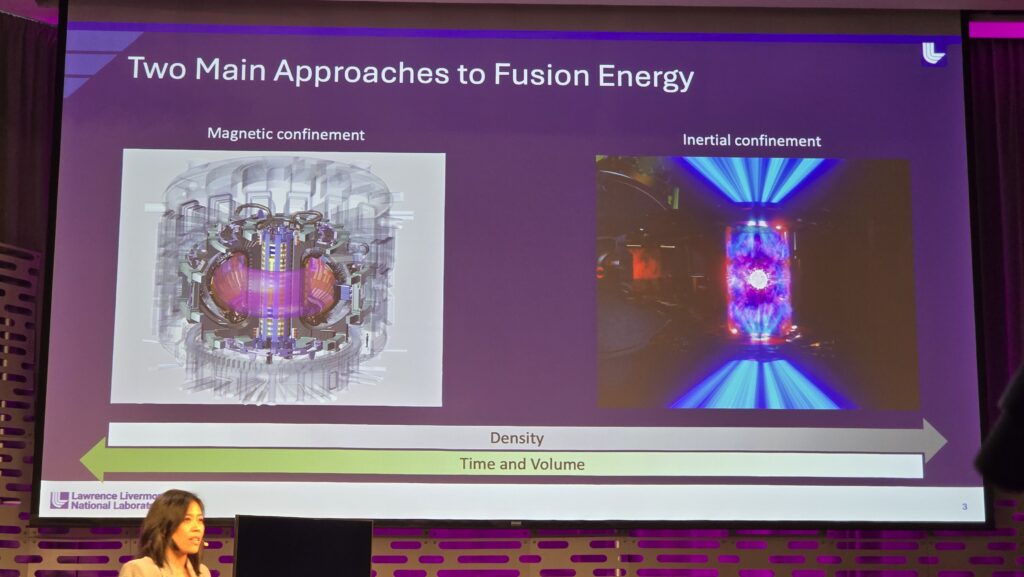
Achieving scientific ignition is a monumental milestone, but Ma was careful to emphasize the engineering gulf separating a research experiment from a functioning power plant.
Since that historic breakthrough in 2022, the team at the National Ignition Facility has repeated ignition eleven times, achieving a record energy gain of 4. Over the coming years, scheduled facility upgrades are designed to push that gain to 15, the threshold required to build a self-sustaining demonstration reactor that generates enough power to run its own systems without drawing from the grid.
However, powering homes and factories requires commercial breakeven, which demands total energy gains between 50 and 100.
Ma walked through the engineering specifications for a commercial inertial fusion plant:
- High Repetition Rate Targeting: The NIF laser currently fires once or twice a day because optics must cool and diagnostics must be repositioned manually. A commercial plant must inject cryogenic fuel pellets into a ten-meter reaction chamber and detonate them at a repetition rate of 10 Hz (ten times every second).
- Advanced Structural Materials: Reactor walls must withstand decades of continuous high-energy neutron bombardment without suffering structural degradation or embrittlement.
- High-Efficiency Laser Architectures: Commercial facilities must replace flashlamp-pumped research lasers with high-efficiency, diode-pumped solid-state laser systems designed for continuous operation.
- Closed Tritium Fuel Cycles: Plants must capture fusion neutrons within surrounding lithium blankets, breeding enough replacement tritium to fuel ongoing operations indefinitely.
The Convergence of Capital, Policy, and Geopolitics
Over the past few years, the fusion ecosystem has grown into a vibrant global industry. More than sixty commercial fusion startups have launched worldwide, securing over $14 billion in private capital. Over $4 billion of that investment arrived in the past year alone, with leading tech firms actively exploring advanced power purchase agreements to power future computing clusters.
At the same time, international competition is accelerating. Satellite imagery from China reveals rapid construction of a massive laser fusion facility estimated to be 50 percent larger than the National Ignition Facility.
Ma pointed out that the National Ignition Facility’s primary mission remains stockpile stewardship. Since the underground nuclear test moratorium in 1992, laser fusion facilities have provided the critical experimental data required to ensure the reliability and safety of the nuclear deterrent without conducting underground explosive tests.
The dual-use nature of fusion physics underscores its profound national security importance. Energy independence is national security. The nation that commercializes fusion power will reshape global geopolitical influence, manufacturing competitiveness, and energy security for centuries to come.
Key Takeaways
- The Reality of Scientific Ignition: The National Ignition Facility has achieved controlled thermonuclear ignition eleven times, proving that controlled laboratory fusion is physically viable.
- Limitless, Clean Fuel Reserves: Seawater deuterium reserves provide enough clean fuel to supply global energy needs for thirty billion years without carbon emissions or high-level radioactive waste.
- The Engineering Breakeven Challenge: Moving from research ignition (
) to commercial utility requires total system gains between 50 and 100, alongside continuous 10 Hz target firing rates.
- The Materials Bottleneck: Commercialization depends on developing new reactor chamber materials capable of withstanding intense, continuous neutron flux without degrading.
- Geopolitical Stakes: With China constructing massive laser installations, developing fusion technology remains a matter of global industrial competitiveness and national security.
Looking Forward
Tammy Ma’s presentation offered an inspiring, clear-eyed vision of a clean energy future. The technical hurdles standing between the laboratory and the electrical grid are immense, requiring major breakthroughs in materials science, manufacturing supply chains, and optical engineering. Fusion power will not solve our near-term grid challenges this decade. Yet for the first time in human history, the question surrounding fusion has shifted from whether it is physically possible to how quickly we can engineer it. If society commits the capital and engineering talent, as was done with the Apollo program, commercial fusion energy can become reality in the coming decades. When that happens, abundant, clean power will decouple human progress from fossil fuels forever, ushering in an era of global abundance.
Call to Action: Energy investors, technology executives, and national policymakers should form public-private consortiums to build the specialized component supply chains required for commercial fusion reactors.
For more information, please visit the following:
Website: https://www.josephraczynski.com/
Blog: https://JTConsultingMedia.com/
Podcast: https://techsnippetstoday.buzzsprout.com
LinkedIn: https://www.linkedin.com/in/joerazz/
Leave a Reply
You must be logged in to post a comment.