
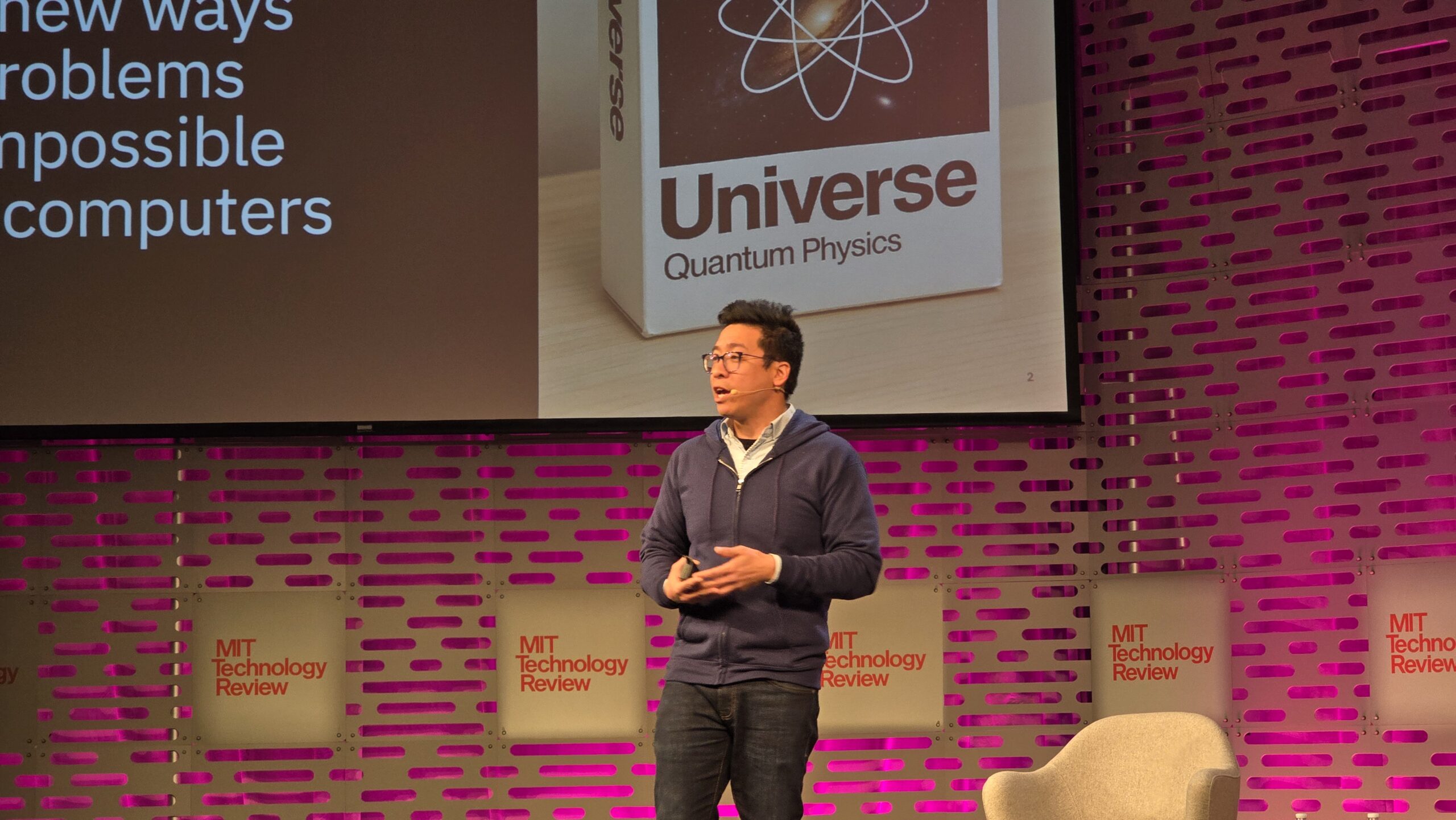
Cambridge, MA – MIT Media Lab – EmTech Future. Quantum computing has long suffered from an exhausting public relations cycle: on one side lies the distant theoretical promise of world-altering supremacy; on the other, the sobering reality of noisy, fragile hardware confined to academic cleanrooms. During the session titled Quantum Convergence, Jerry Chow, IBM Fellow and Chief Technology Officer for Quantum Centric Supercomputing, took the stage to present a practical path forward. Introduced by MIT Technology Review executive editor Gideon Lichfield, Chow made a compelling case that quantum computing has crossed an irreversible threshold.
The field must leave behind the binary obsession with finding a single magical moment where a isolated quantum processor beats an entire classical supercomputer. Instead, we have entered the era of quantum-centric supercomputing, where quantum processors (QPUs) integrate directly alongside CPUs and GPUs, functioning as specialized co-processors to solve molecular and mathematical challenges that classical architectures cannot tackle alone.
The Operating System of the Physical Universe
Digital computers, no matter how massively parallel, are fundamentally handicapped when simulating nature. Classical bits must approximate continuous quantum reality using discrete binary zeros and ones. Because nature operates under the non-intuitive rules of superposition, entanglement, and complex wave interference, running accurate molecular simulations on classical chips requires computational workarounds that scale exponentially.
As former IBM Fellow Charlie Bennett aptly framed it, classical digital computers are effectively handicapped quantum computers. Quantum systems compute using the native operating language of the universe. They are uniquely engineered to simulate molecular bonds, calculate ground-state electronic configurations, and navigate multi-dimensional optimization landscapes that overwhelm the largest classical data centers.
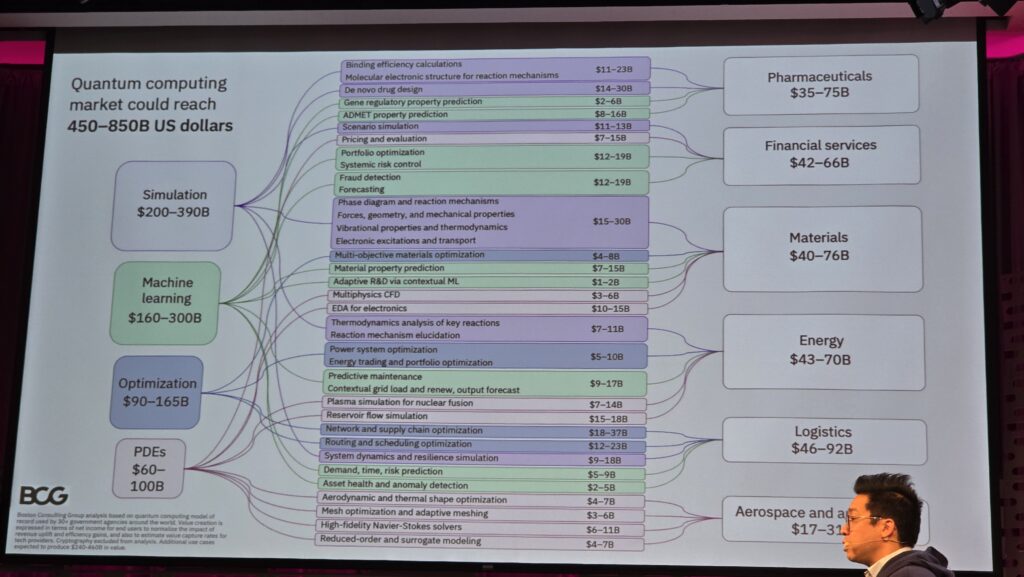
Independent economic analyses by firms like the Boston Consulting Group estimate that when quantum processing reaches industrial scale, its economic value will exceed hundreds of billions of dollars across battery chemistry, pharmaceutical design, logistics, and material science.

Exploring the Computational White Space
Rather than waiting for the arrival of fault-tolerant systems in the mid-2030s, IBM has designed its hardware roadmap to extract practical utility from current noisy, intermediate-scale quantum devices:
Today, utility-scale QPUs operate at hundreds of superconducting qubits, running deep quantum circuits spanning five to eight thousand logic gates. These circuit depths represent a clear computational white space: spaces where problems are too complex to simulate classically, yet small enough to execute on existing physical hardware.
Chow detailed real-world research partnerships successfully navigating this white space:
- RIKEN Fugaku Supercomputer Integration: In Japan, IBM integrated a physical quantum processor directly with Fugaku, one of the world’s most powerful classical supercomputers. Together, they modeled iron-sulfur molecular clusters, an essential step in understanding biological catalysis. By offloading complex quantum states to the QPU and handling iterative approximations on Fugaku, the joint system compressed the theoretical circuit depth from
gates down to a scale that runs on existing hardware.
- Cleveland Clinic Molecular Scaling: Modeling complex, water-solvated protein structures containing 10,000 to 12,000 atoms. High-performance GPUs first decompose the massive molecular system into localized computational fragments. The QPU then runs targeted quantum circuits across those fragments, calculating specialized energy subspaces that classical supercomputers recombine to determine total molecular binding energy within strict chemical accuracy.
- Oak Ridge National Laboratory Fusion Research: Simulating liquid molten-salt blankets (specifically fluorine-lithium-beryllium mixtures) for commercial nuclear fusion reactors. QPUs simulate tritium absorption dynamics, providing critical structural insights needed to develop next-generation containment materials for clean fusion energy.
The Industrial Physics of Superconducting Qubits
Addressing the ongoing debate surrounding various qubit modalities, Chow defended IBM’s long-term commitment to superconducting architectures over trapped-ion or neutral-atom alternatives. The deciding factor in commercial computing is not isolated physics bench-tests; it is industrial manufacturability, operational cycle times, and scaling speed.
Superconducting transmon circuits are manufactured using standard 300-millimeter semiconductor wafer fabrication lines. This enables quantum hardware to leverage decades of lithographic precision, packaging advances, and rapid iterative design developed by the classical semiconductor industry.
Furthermore, superconducting logic gates operate at nanosecond speeds. This rapid cycle time is essential for the hybrid quantum-centric model, where processors must execute hundreds of thousands of circuit iterations in tight, low-latency coordination with classical GPUs. To broaden its technological portfolio, IBM acquired Hughes Research Laboratories (HRL), adding silicon spin qubits to combine standard CMOS manufacturing techniques with high-speed quantum control.
Key Takeaways
- The Quantum-Centric Paradigm: The future of high-performance computing lies in the tight integration of classical CPUs, tensor-processing GPUs, and quantum QPUs working in concert.
- Unlocking Practical Utility Today: Utility-scale quantum processors running 5,000 to 8,000 gate operations can tackle real-world chemistry calculations that approximate classical supercomputers struggle to match.
- Industrial Semiconductor Manufacturing: Superconducting and silicon-spin qubits take direct advantage of established 300mm wafer fabrication processes, providing a clear path to scale qubit density and gate quality.
- Decoupling Molecular Complexity: Hybrid computational algorithms use GPUs to fragment massive 12,000-atom biomolecules into targeted pieces, offloading the core quantum states to QPUs for high-precision energy evaluation.
- Energy-Efficient Computation: While hyper-scale AI data centers require gigawatts of power, utility-scale quantum installations draw tens of kilowatts, delivering an exponentially more efficient path for complex physical simulations.
Looking Forward
The trajectory of quantum computing is moving away from speculative academic physics toward rigorous, systems-level supercomputing integration. The long-standing debate over reaching a single, winner-take-all quantum supremacy moment is giving way to an era of hybrid computational utility. In the coming years, computing centers will routinely link quantum chips directly to classical high-performance clusters via low-latency fabrics, hiding the underlying quantum mechanical complexity behind accessible software development kits like Qiskit. The technology still faces difficult error-mitigation hurdles, but the path toward utility-scale systems is well established. Organizations that integrate quantum workflows into their core research pipelines today will hold an insurmountable advantage in engineering the transformative materials, molecules, and chemical processes of tomorrow.
Call to Action: Forward-looking engineering organizations should immediately begin modernizing their computational pipelines, training developers on open-source quantum frameworks like Qiskit to run hybrid molecular workflows across public quantum clouds.
For more information, please visit the following:
Website: https://www.josephraczynski.com/
Blog: https://JTConsultingMedia.com/
Podcast: https://techsnippetstoday.buzzsprout.com
LinkedIn: https://www.linkedin.com/in/joerazz/
Leave a Reply
You must be logged in to post a comment.