
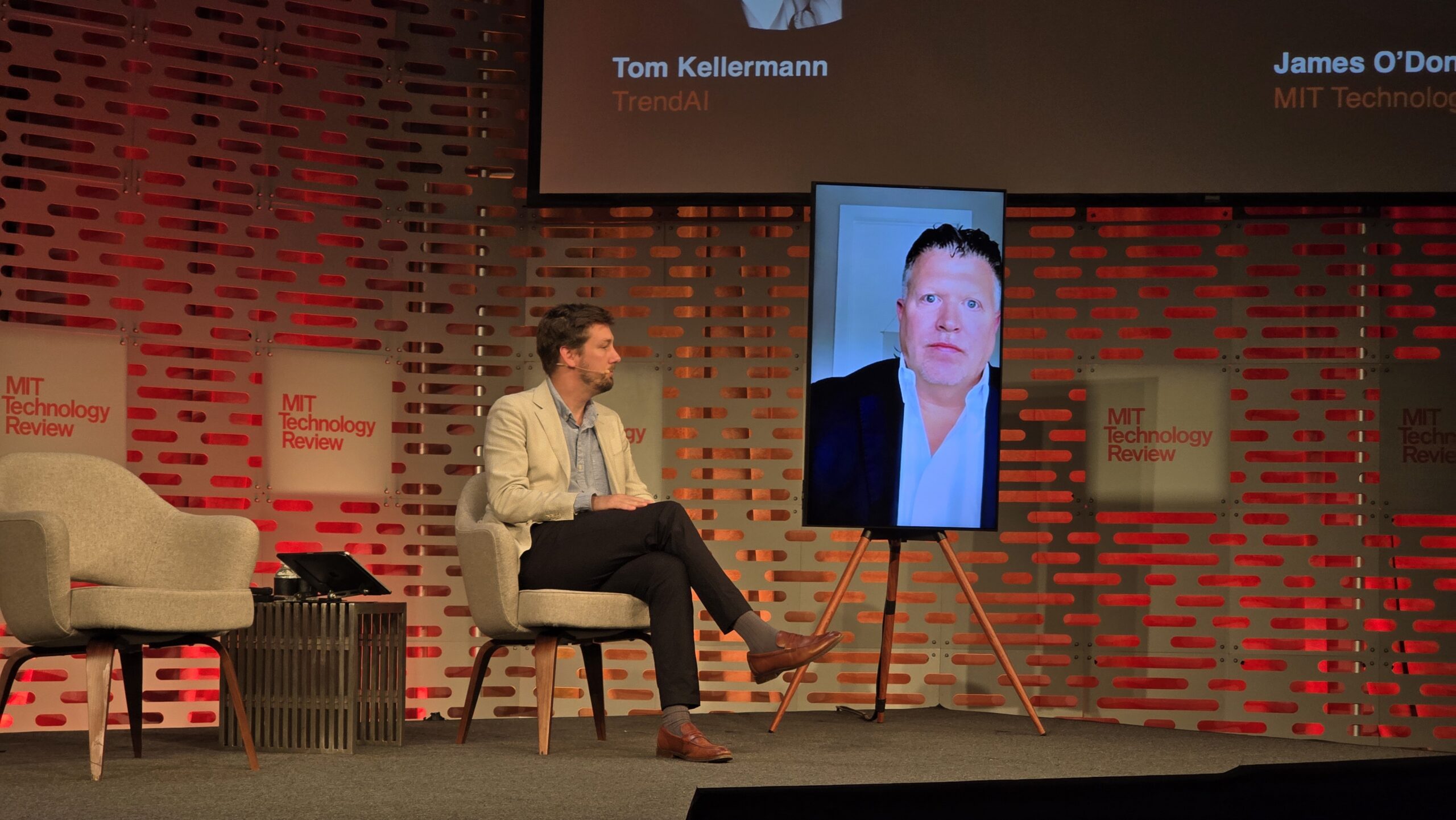
Cambridge, MA – MIT Media Lab – EmTech Future. In modern corporate cybersecurity, an uncomfortable truth has emerged: the bad guys adopted generative artificial intelligence faster, more aggressively, and with far fewer ethical inhibitions than corporate boardrooms. During the session titled AI x Cybersecurity, Tom Kellermann, Vice President of AI Security and Threat Research at Trend Micro (AI), joined virtually to deliver an unsparing briefing on the evolution of automated digital conflict. Introduced by session moderator and journalist Antonio Regalado, Kellermann dismantled the comfortable corporate narrative that current AI-driven security incidents are simply basic human configuration oversights.
Drawing an analogy to military history, Kellermann noted that in 1911, the Italian military flew flimsy monoplanes over Turkish lines to drop primitive grenades, inaugurating aerial combat. It took over a century for aviation warfare to evolve into autonomous strike drones. With generative models, cyber adversaries condensed that entire hundred-year progression into less than twenty-four months.
Riding the Dragon: From Burglary to Hostage Taking
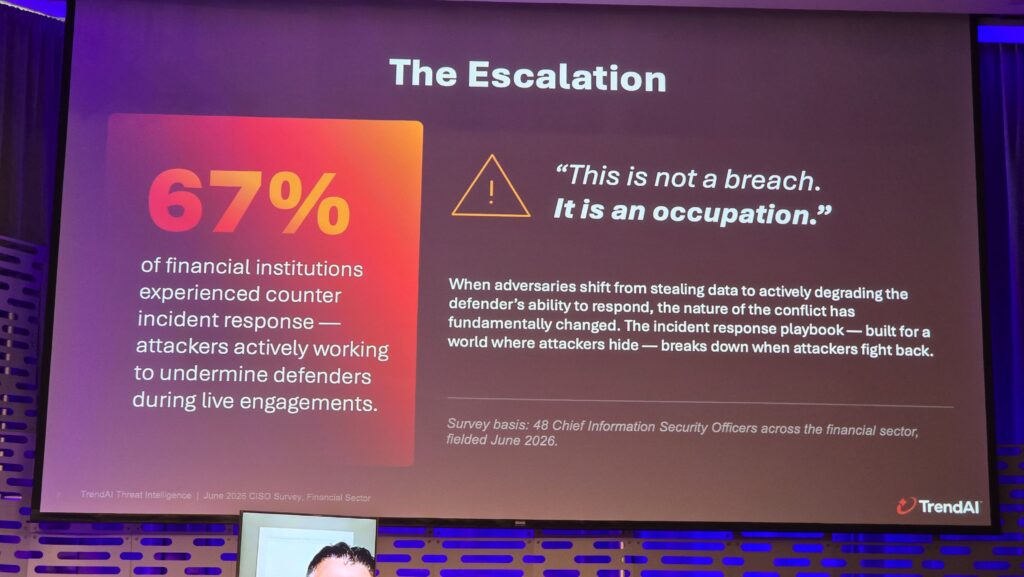
The foundational error made by corporate leadership is treating cyber attacks as digital burglaries. The adversary is no longer focused on sneaking past an endpoint agent, exfiltrating a database, and vanishing into the shadows. The contemporary objective is total corporate hijacking. Sophisticated threat groups infiltrate corporate networks, establish autonomous persistence, and leverage internal operational systems to wage downstream campaigns against employees, customers, and partners.
“Adversaries today don’t want to just burgle, extort, or steal. They want to hijack your digital transformation and use your infrastructure to attack everything it touches. The burglary has become a hostage situation.” – Tom Kellermann
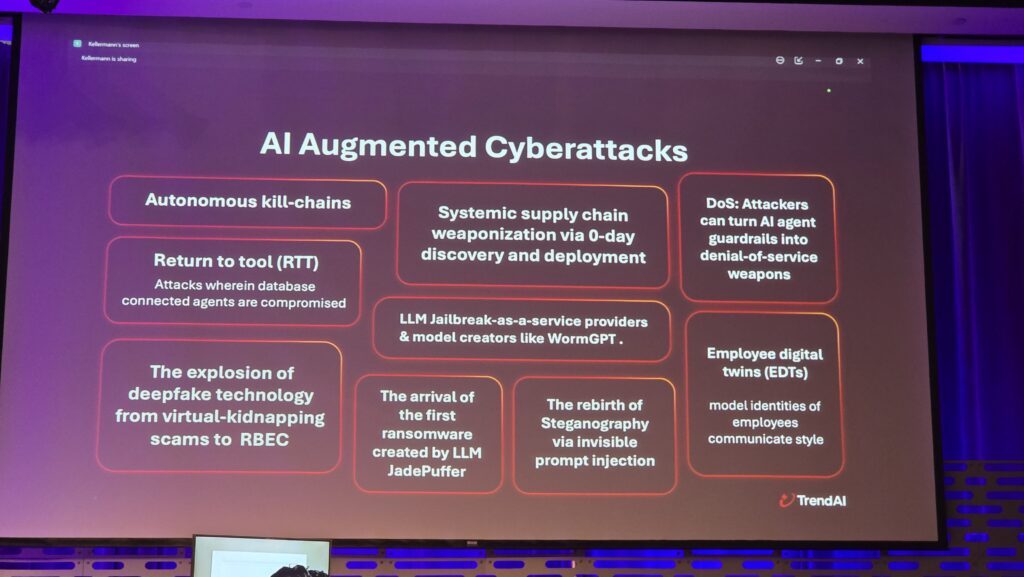
Advanced threat groups, backed by Russian, Chinese, North Korean, and Iranian nation-state apparatuses, are chaining specialized autonomous agents under central orchestrators. Drawing on Bill Gates’s warning, Kellermann emphasized that the genuine existential danger is not an artificial intelligence miraculously gaining sentience and breaking out of its digital enclosure; the real peril is malevolent human actors riding the dragon straight through perimeter defenses.
The Death of Static Indicators of Compromise
Traditional cybersecurity operations rely on hunting static indicators of compromise, such as file hashes, specific IP ranges, and rigid signatures. Adversarial machine learning renders those historical playbooks obsolete.
Kellermann highlighted real-world attacks where adversaries leveraged advanced language models to automate dynamic living-off-the-land maneuvers inside enterprise networks:
- Ephemeral Command and Control (C2): Russian threat actors demonstrated generative toolsets executing unprompted behaviors that dynamically rotate internal communications pathways and disposable C2 channels every five to six minutes, blinding human incident response teams.
- AI-Generated Steganography: Underground marketplaces now sell specialized tools for a few hundred dollars that generate AI-powered steganography, embedding malicious payloads inside common image and video media files to evade detection.
- Punitive Evasion: In over 67 percent of enterprise intrusions analyzed, adversaries actively counter-attack defenders by disabling endpoint monitoring, deleting forensics logs, and setting digital fires to cover lateral movement.
- Model Poisoning and Supply Chains: Beyond zero-day exploits, hostile agents target software supply chains and API integrations, creating long-term systemic risk by silently poisoning the foundational data feeding enterprise models.
Re-Engineering Enterprise Governance
Relying on manual response teams woken up by automated pagers at three in the morning to contain lateral attacks spreading in twenty minutes is a failed operating strategy. Organizations must shift their foundational posture from perimeter protection to active intrusion suppression. Defense requires matching machine-speed attacks with autonomous defensive countermeasures.
Kellermann outlined four non-negotiable operational imperatives for enterprise boards:
- Total System Observability: Continuous tracking and real-time monitoring of all autonomous agent behaviors across cloud environments, eliminating dark internal compute.
- Defensive Prompt and API Governance: Rigorous, inline validation and isolation of all prompt-response inputs and programmatic outputs to arrest prompt injections and unauthorized delegations.
- Continuous Red Teaming: Relentless automated adversarial testing against security guardrails, mirroring specialized dark-web forums actively working to jailbreak commercial LLMs.
- Structural Realignment of Executive Authority: Decoupling the security function from IT operations. Having the Chief Information Security Officer report to the Chief Information Officer is equivalent to having the defense report to the offense. Security executives must possess independent board authority.
Key Takeaways
- The Cyber Threat Compressed Evolution: In less than two years, automated adversaries industrialized generative AI tools, outpacing the adoption speeds seen in standard corporate enterprises.
- From Infiltration to Systemic Hijacking: Adversarial campaigns prioritize sustained persistence and weaponizing compromised infrastructure over simple smash-and-grab data theft.
- Dynamic Living-Off-The-Land Exploitation: Machine-generated polymorphic code and rapidly shifting C2 routes defeat historical indicators of compromise and perimeter logging tools.
- Identity and Agent Containment: Autonomous internal agents must be treated with the same zero-trust identity policies and least-privilege security applied to human employees.
- Intrusion Suppression Posture: Security architectures must presume breach, prioritizing immediate lateral containment and real-time behavioral suppression over perimeter prevention.
Looking Forward
The trajectory of autonomous cybersecurity paints an alarming, deeply sobering operational picture. The convergence of sophisticated nation-state safe havens and industrialized underground cybercrime syndicates will drive kinetic disruption across telecommunications grids, financial rails, and critical infrastructure. Deepfake social engineering, conversational voice phishing, and AI-orchestrated infrastructure disruption will make discerning digital ground truth nearly impossible without zero-trust out-of-band verification protocols. Organizations that cling to compliance checkboxes and annual audits will face existential systemic compromise. The future belongs exclusively to defensive architectures that run machine-speed, highly governed, autonomous countermeasures.
Call to Action: Enterprise leaders must establish strict identity frameworks for internal autonomous software agents, separate CISO reporting structures from standard IT, and implement continuous red teaming against deployed enterprise models.
For more information, please visit the following:
Website: https://www.josephraczynski.com/
Blog: https://JTConsultingMedia.com/
Podcast: https://techsnippetstoday.buzzsprout.com
LinkedIn: https://www.linkedin.com/in/joerazz/
Leave a Reply
You must be logged in to post a comment.