

At the Building America Summit hosted by The Washington Post in Washington, DC, a compelling conversation unfolded between David J. Lynch Global Economics Correspondent, The Washington Post, and Revathi Advaithi, the CEO of Flex. For technologists tracking the intersection of global supply chains, industrial operations, and artificial intelligence, the session offered a masterclass in how physical manufacturing is transitioning into an elite, software-driven discipline.
Advaithi, who spent her early career in traditional industrial hubs before moving to China and eventually helming Flex, a $28 billion contract manufacturing giant with 150,000 global employees, brought rare, boots-on-the-ground clarity to the “reindustrialization of America” narrative.
For decades, the manufacturing sector has been romanticized through the lens of hardware automation and robotics. However, a deeper look at the transcript reveals that the true transformation of the factory floor is fundamentally a software and data engineering challenge.
The Core Problem: The 50-Software-System Trap
Advaithi opened the session by contrasting her early days as a shop floor supervisor in Shawnee, Oklahoma, in 1995 with the modern digital factory. In 1995, shift handovers were conducted with a “book and pencil” and a large whiteboard to track 50 machinists making hydraulic pumps. If a machine went down, the contextual history of that event evaporated when the shift changed.
While modern factories have traded the whiteboard for enterprise software, technologists have inadvertently created a different kind of bottleneck. The modern plant floor is plagued by software fragmentation:
“An average factory probably has 50 software systems. Most factories will have like 100 to 200 software systems… Put them all together, none of them talk to each other, don’t work seamlessly, and we make sub-optimal decisions all the time on every factory floor.”
Outside of labor arbitrage (shifting production to countries with lower wages), true manufacturing productivity has remained remarkably flat over the past two decades. This stagnation is a direct result of these disconnected, siloed enterprise systems.
Resolving the Fragmentation with Unified Data Layers
As technologists, our standard response to operational inefficiency has often been to introduce yet another specialized tool, an Manufacturing Execution System (MES), an Enterprise Resource Planning (ERP) platform, or an Asset Performance Management (APM) suite. Advaithi’s core thesis turns this approach on its head. The future of manufacturing efficiency does not rely on introducing more complex software; it relies on building an agile data layer over existing infrastructure.
By decoupling data from proprietary software silos and normalizing it into a clean operational data layer, manufacturers can finally unlock real-time optimization. Consider factory utilization rates: while many companies claim 80% to 90% utilization by excluding scheduled downtime, Advaithi dropped a dose of reality, stating that true baseline utilization across the industry often hovers closer to 30% to 50%.
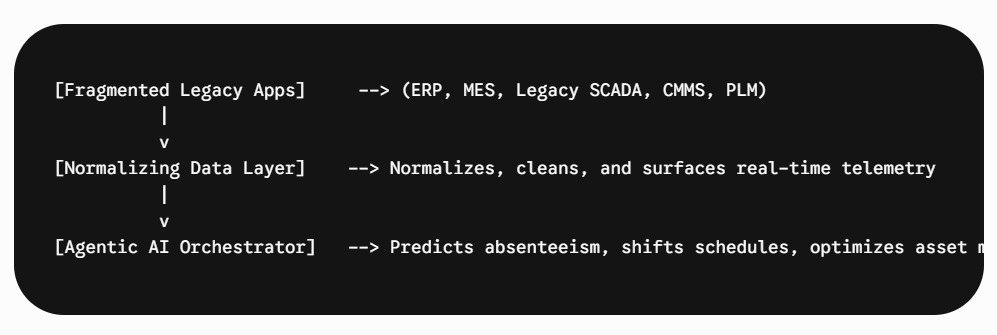
The application of AI at this layer yields immediate results. When an AI orchestrator has access to a clean data layer, it can analyze multi-variable operational inputs simultaneously: predicting a 5% spike in worker absenteeism due to an upcoming holiday, identifying a machine running at sub-optimal thermal thresholds, and dynamically shifting the product mix to maximize utilization by 10 to 20 points.
Smart Nearshoring and the AI Infrastructure Boom
A significant portion of the summit focused on the “onshoring” or “nearshoring” movement. Advaithi was clear that American factories cannot, and should not, try to compete for low-margin, high-volume commodities like basic printed circuit boards (PCBs) or consumer electronics. Western publicly traded companies carry capital allocations and margins that make competing with heavily subsidized low-cost ecosystems impossible.
Instead, the reindustrialization of America is being driven by high-complexity, high-value systems, specifically the infrastructure powering the artificial intelligence boom.
“If you have to put together like a computer integration rack right for what goes in [a] data center, you can’t put all that together and ship it from across the ocean. That’s very complex. There’s lots of changes that happen all the time… What’s best done close to home is setting up factories that put together those integrations.”
Flex recently signed a deal for a new facility near Austin (Georgetown, Texas) capable of drawing 50 megawatts of power. The facility was completely sold out before operations even began. This trend highlights a massive shift: the modern factory is evolving into an extension of the data center ecosystem itself.
The Staggering Telemetry of the Modern AI Rack
From an engineering perspective, the technical specifications of what these new American factories are producing are remarkable. The energy and thermal density demands of next-generation AI hardware are pushing structural engineering to its absolute limits.
| Metric | 5 Years Ago | Next-Generation Standard | Impact Equivalence |
| Data Center Rack Power Density | ~10 kW | 600 kW | A single 600 kW cabinet can pull enough power to support 1,000 homes. |
This massive leap in power requirements fundamentally alters the manufacturing process. You can no longer build these units in standard electronic assembly configurations. Testing a 600 kW rack requires an immense amount of localized power infrastructure, highly specialized mechanical engineering, and complex liquid cooling configurations to handle intense thermodynamic outputs.
Training vs. Inference: The Scale Shock
Advaithi dismissed any notions that the current capital expenditure boom in AI infrastructure is a speculative bubble, pointing directly to the structural transition from training to inference:
“The deployment today is going into training… But think about as inference takes off, right? Those agentic AIs we’re deploying… in factories, in corporate America… will be working at scale… It feels like it’s barely started.”
While model training requires a massive concentration of compute for a fixed period, agentic AI systems running continuous inference across global industries will demand sustained, distributed infrastructure.
This presents a unique challenge: the United States leads the world in algorithmic innovation, but lags significantly in the underlying physical infrastructure required to support it. Solving this bottleneck will require a multi-decade investment cycle focused on modernizing the electrical grid, optimizing thermal dynamics, and expanding power distribution.
Human Capital: Overcoming the 400,000-Vacancy Deficit
The grandest software systems and advanced assembly lines still require human orchestration. With over 400,000 vacancies currently impacting the domestic manufacturing sector, Advaithi highlighted two essential pillars required to close the gap:
- Public-Private Apprenticeship Models: Moving away from generalized degrees and focusing on targeted, localized skill retraining programs tailored for middle America.
- Cohesive Immigration Policies: Acknowledging that sustained technical growth requires a reliable influx of international engineering talent.
Closing the session with a personal note on her journey as an immigrant and a female executive in engineering, Advaithi offered an encouraging perspective for the next generation of women entering the STEM fields:
“A lot of young women think engineering is a daunting space to be in… I tell everybody I’m a bad engineer. The only reason I [went to] school, I knew it would give me a paycheck… If you have strategic thinking, if you have common sense, and the ability to put a vision together, you can go places.”
The Technologist’s Takeaway
The Building America Summit made one thing abundantly clear: the boundary between hardware manufacturing and software engineering has eroded entirely.
The companies that win the next era of industrial production will not be those who build the most complex, isolated automation systems. The winners will be the organizations that successfully clean their operational data layers, deploy agentic AI to solve real-time utilization challenges, and build the specialized infrastructure required to power the global AI revolution.
For more information, please visit the following:
Website: https://www.josephraczynski.com/
Blog: https://JTConsultingMedia.com/
Podcast: https://techsnippetstoday.buzzsprout.com
LinkedIn: https://www.linkedin.com/in/joerazz/
Leave a Reply
You must be logged in to post a comment.