

For nearly three decades, a ghost has haunted the infrastructure of the World Wide Web. Buried deep within the hyper-text transfer protocol, the very language browsers and servers use to speak to one another, sat a reserved, unused status code. You know 200 (OK). You definitely know 404 (Not Found) and probably 500 (Internal Server Error). But between the “Forbidden” 403 and the “Unauthorized” 401 lay a dormant placeholder: 402 Payment Required.
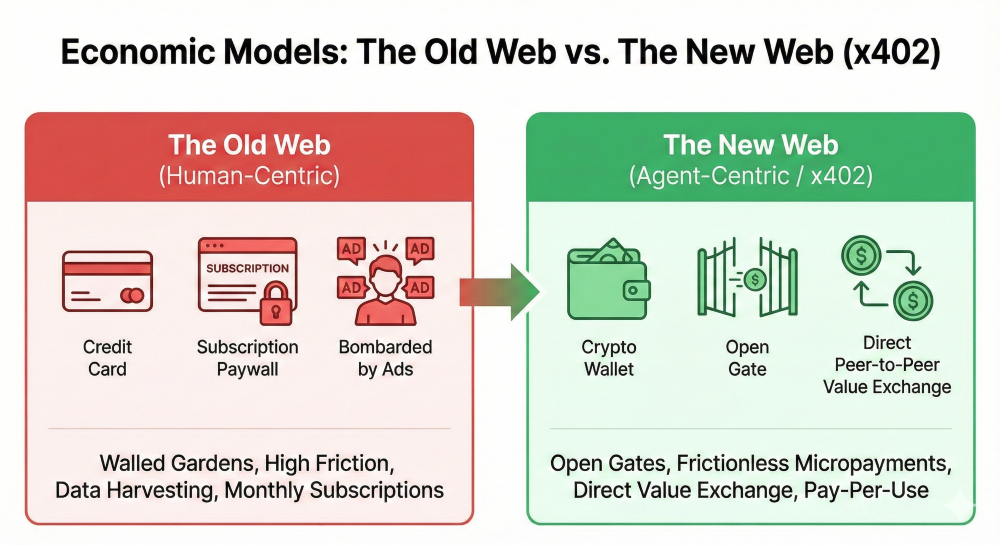
It was a feature promised but never delivered, a placeholder for a future where value could move as freely as information. For thirty years, it remained a digital vestige, a reminder that the internet’s original architects envisioned a native way to pay, but lacked the technology to build it. We filled that void with clunky patches: credit card forms, subscription paywalls, and data-harvesting ad models. We built walled gardens because we couldn’t build open gates.
I have been waiting for this era for several years myself, and it effectively ended in May 2025. With the launch and rapid adoption of the x402 protocol, the ghost has finally been given a body. We are witnessing the first true native payment layer for the web, and it isn’t just about letting you buy a newspaper article for a penny. It’s about giving Artificial Intelligence a wallet.
The x402 Protocol: A Technical Primer
At its core, x402 is an open standard that “hydrates” the HTTP 402 status code. It transforms a static error message into a dynamic negotiation for value.
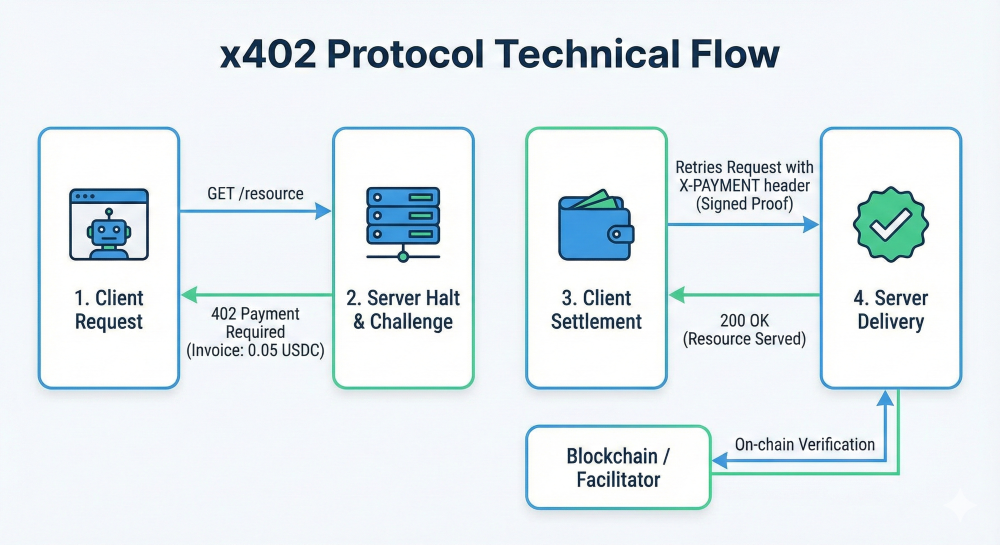
Here is how the flow works in this new paradigm:
- The Request: A client (be it a human browser or an autonomous AI agent) requests a resource, say, a premium API endpoint or a GPU cluster.
- The Halt: Instead of a 200 OK or a 403 Forbidden, the server returns a 402 Payment Required. Crucially, the header of this response contains a “payment challenge”, a precise invoice detailing the cost (e.g., 0.05 USDC), the destination address, and the acceptable networks (like Base or Polygon).
- The Settlement: The client constructs a cryptographic signature authorizing the transfer of stablecoins. This isn’t a “checkout process” with a cart and a ‘Submit’ button. It happens in milliseconds, programmatically. The client resends the request with this proof of payment in the X-PAYMENT header.
- The Delivery: The server verifies the signature on-chain (or via a facilitator for speed), confirms the funds, and serves the resource.
This is “stateless” commerce. There are no sessions to maintain, no accounts to create, and no credit cards to store on insecure databases. It is a direct value-for-resource swap, as atomic as the web itself.
Why This Matters: The Agentic Economy
Why now? Why revive a 30-year-old status code in 2025? The answer lies in the explosion of Agentic AI.
We have moved past chatbots that talk to us, into an era of agents that do things for us. These agents need to interact with the world. They need to book flights, buy datasets, rent storage, and query other agents.
Traditional payment rails are fundamentally broken for AI. You cannot give an autonomous Python script a Visa card; the fraud risk is infinite, and the KYC (Know Your Customer) friction is insurmountable. Furthermore, legacy banking cannot handle the “nano-payments” AI requires. An AI agent might need to make 5,000 queries a day to a weather API, each worth $0.0001. On a credit card network, the processing fees alone would bankrupt the operation.
x402 is the liquidity layer for machine intelligence. It allows software to be an economic actor. It is important because it shifts the internet from an attention economy (ads) to a value economy (direct exchange), finally aligning the incentives of creators, developers, and the machines that serve them.
The Fuel: Stablecoins on High-Performance Chains
Before exploring specific use cases, we must address the fuel that makes this engine run: Stablecoins.
Cryptocurrency has long been criticized for volatility. A payment protocol cannot function if the currency used to pay for a split-second API call fluctuates by 10% in an hour. Stablecoins (like USDC) solve this by pegging their value 1:1 to a fiat currency (usually the US Dollar).
For x402, stablecoins are not just “crypto dollars”; they are programmable money. When combined with high-throughput Layer 2 blockchains (like Base) or parallelized chains (like Solana), they allow for settlement that is:
- Final: No chargebacks.
- Fast: Sub-second confirmation times.
- Fractional: The ability to send $0.00001 economically.
This stability provides the trust required for businesses to accept x402, while the blockchain rail provides the speed required for software to use it.
Three Compelling Use Cases
1. Agent-to-Agent (A2A) Knowledge Markets
Imagine you are building a complex travel agent AI. It needs to know flight data, local weather history, and visa requirements for 50 countries.
- The Old Way: You, the human developer, must manually sign up for three different enterprise APIs (FlightAware, OpenWeather, etc.), enter your credit card, get API keys, and manage monthly quotas.
- The x402 Way: Your AI agent simply queries the endpoints it needs. It hits a “402 Payment Required” wall, checks its own wallet balance, and instantaneously streams 0.02 USDC to the weather service and 0.05 USDC to the flight data provider to unlock the specific data packet it needs right now.
- The Impact: This creates a liquid market for knowledge. Specialized “Expert Agents” can monetize their niche data (e.g., a “Real-time Paris Traffic Agent”) without building a SaaS platform. They just expose an endpoint and wait for other agents to pay them.
2. The Death of Subscription Fatigue (Granular Content)
The “Subscription Apocalypse” has left consumers with 15 different $10/month bills they barely use. x402 offers a granular alternative.
- The Scenario: You want to read one deep-dive article from the Financial Times and watch one documentary on a niche streaming service. You do not want two new monthly subscriptions.
- The x402 Solution: Your browser (equipped with an integrated wallet) sees the 402 signal. A prompt appears: “Access this article for $0.10?” You click “Yes” (or set an auto-approve limit for anything under $0.25). The payment settles instantly, and the paywall dissolves.
- The Impact: This restores the “browsing” nature of the web. Users can drift between premium sources, paying only for what they consume, while creators capture revenue from casual visitors who would never convert to a full subscriber.
3. Autonomous Infrastructure and IoT
This is where the “bleeding edge” gets truly interesting. Physical infrastructure can now become self-sustaining.
- The Scenario: A decentralized mesh network of 5G hotspots or a solar-powered EV charging station.
- The x402 Solution: An autonomous drone needs to recharge. It lands on the charging pad. The pad broadcasts a 402 signal. The drone pays the pad directly from its wallet. Simultaneously, the charging pad’s internal agent detects its battery cells are degrading. It autonomously “hires” a diagnostic AI to run a health check, paying via x402, and then places an order for a replacement part, paying a logistics agent.
- The Impact: We move from “Smart Cities” (which are usually just centralized surveillance) to “Autonomous Cities,” where infrastructure creates its own balance sheets, earning revenue for service and spending it on maintenance without human micromanagement.
Conclusion: The Protocol of value
The convergence of AI and Blockchain has long been a favorite topic for tech visionaries, but until now, it was mostly theoretical. AI provided the brains; Blockchain provided the ledger; but they lacked a common tongue.
x402 is that tongue. It is sophisticated in its simplicity, utilizing the existing plumbing of the web to solve a problem we’ve ignored for thirty years. For technologists, the message is clear: the HTTP header is no longer just for metadata. It is now a bank teller.
As we look toward 2026, the question isn’t whether AI agents will have bank accounts. It’s whether your application is ready to accept their money.
For more information, please visit the following:
Website: https://www.josephraczynski.com/
Blog: https://JTConsultingMedia.com/
Podcast: https://techsnippetstoday.buzzsprout.com
LinkedIn: https://www.linkedin.com/in/joerazz/
Leave a Reply
You must be logged in to post a comment.