
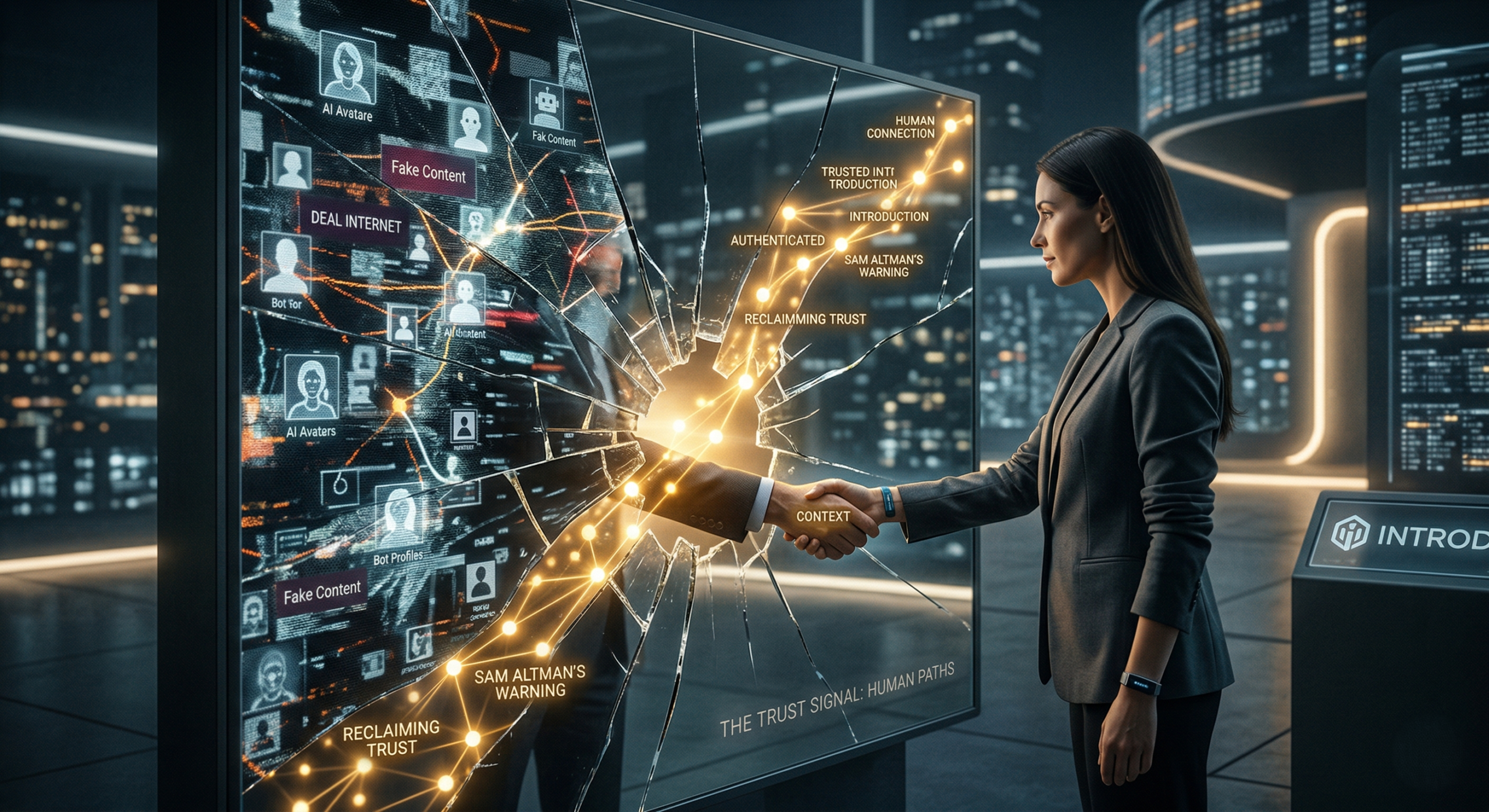
For decades, we viewed the internet as the ultimate frontier of human connection, a vast, digital nervous system connecting billions of minds. We believed that more content meant more knowledge, and more connectivity meant more truth. But as we stand in 2026, the mirror has cracked. The “Dead Internet Theory,” once a fringe conspiracy whispered in the corners of Reddit, has transitioned from paranoid myth to a visible, undeniable architectural reality.
Even Sam Altman, the primary architect of the tools that accelerated this shift, now observes that the digital landscape is becoming profoundly “fake.” We are witnessing the Great Dilution: a world where the signal of human intent is being drowned out by an infinite sea of synthetic noise.
The Era of the Infinite Ghost
To understand where we are headed, we must look at where we were. In the early 2000s, the internet was a “high-trust” environment. A blog post was a labor of love; an email was a deliberate act; a social media profile was a digital twin of a living person.
Today, that paradigm is extinct. We have entered the era of Synthetic Persistence. Large Language Models (LLMs) don’t just “spam” anymore; they inhabit. They curate personas, engage in nuanced debates, and mimic the “lived experience” of humans so convincingly that the Turing Test has become a quaint relic of a simpler time. When AI imitates humanity at scale, adopting our regional slangs, our emotional triggers, and our professional jargon, the very concept of “content” loses its value.
If a machine can generate a million unique, persuasive, and “human-seeming” articles in the time it takes you to read this sentence, then the market value of a written idea effectively drops to zero. We are drowning in a surplus of expression, yet starving for a shred of authenticity.
The Trust Deficit and the Death of Outreach
The fallout of this synthetic explosion is most visible in how we network and build businesses. Consider the traditional “Cold Outreach.” For years, a well-crafted LinkedIn message or a thoughtful email was the “gold standard” for a technologist looking to bridge a gap.
In 2026, that door is welded shut. Why? Because every decision-maker is now bombarded by thousands of “thoughtful” messages every day, all generated by sophisticated autonomous agents. On LinkedIn I receive about 5-8 messages a day which are bots requesting a meeting, each request feels deeply personal and well crafted. When everything looks real, nothing feels real. The “Social Proof” we used to rely on, follower counts, engagement metrics, and testimonials, has been compromised. Agents are now following agents; bots are liking the posts of other bots to create a mirage of authority.
The internet didn’t just get bigger; it became structurally untrustworthy. We are operating in a low-trust digital economy where the default assumption for any digital interaction is: “This is a simulation.”
The Great Pivot: From Content to Context
As a futurist, I spoke about this many years ago, hoping it would not happen. I see this not as the end of the internet, but as the end of its “Information Phase” in the way we knew it and now we are at the beginning of its “Verification Phase.”
In the synthetic wilderness, the most valuable asset is no longer your ability to create, but your ability to prove your provenance. This future is a cryptographic proof that you are human, and the same for agents. You will have the ability to “authorize” that an agent is working on my behalf.
The Future: A Web of Trust
Looking toward 2028, I envision a digital landscape where our personal AI agents act as “Trust Sentinels.” Your agent won’t just filter spam; it will verify the cryptographic soul of an incoming request. It will ask: “Does this message come from a verified human path? Is there a chain of reputation that links this sender to my owner?” The agent will have authorization from a human, and you will know this is coming from an agent. It will have to be disclosed.
We are heading toward a “Cryptographic Proof” internet where:
- Identity is Sovereign: Tools like Blockchain and Decentralized Identifiers (DIDs) will be used not only for currency, but for proving we are flesh and blood. You know who is human and who is agent.
- Networking is Curated: The “Open Web” will be for consumption – but really a place agents leverage for information, using tools like MCP (Model Context Protocol), APIs and CLIs (Command-Line Interfaces). CLIs are the new fad.
- Reputation is the Currency: Another path forward in concept, is a “Trust Score”. In a world of infinite synthetic wealth, your “Trust Score” within your professional and personal circles could become more important.
Conclusion: The Signal in the Silence
Sam Altman’s concern is a wake-up call or perhaps a reminder for others. The internet as we knew it, a place of casual, high-trust interaction, is indeed dying. But in its place, we will be moving to a cryptographic proof of every entity, person, and agent, so you know where the information came from and you can prove it, like the handshake between your browser and the bank.
For more information, please visit the following:
Website: https://www.josephraczynski.com/
Blog: https://JTConsultingMedia.com/
Podcast: https://techsnippetstoday.buzzsprout.com
LinkedIn: https://www.linkedin.com/in/joerazz/
Leave a Reply
You must be logged in to post a comment.