
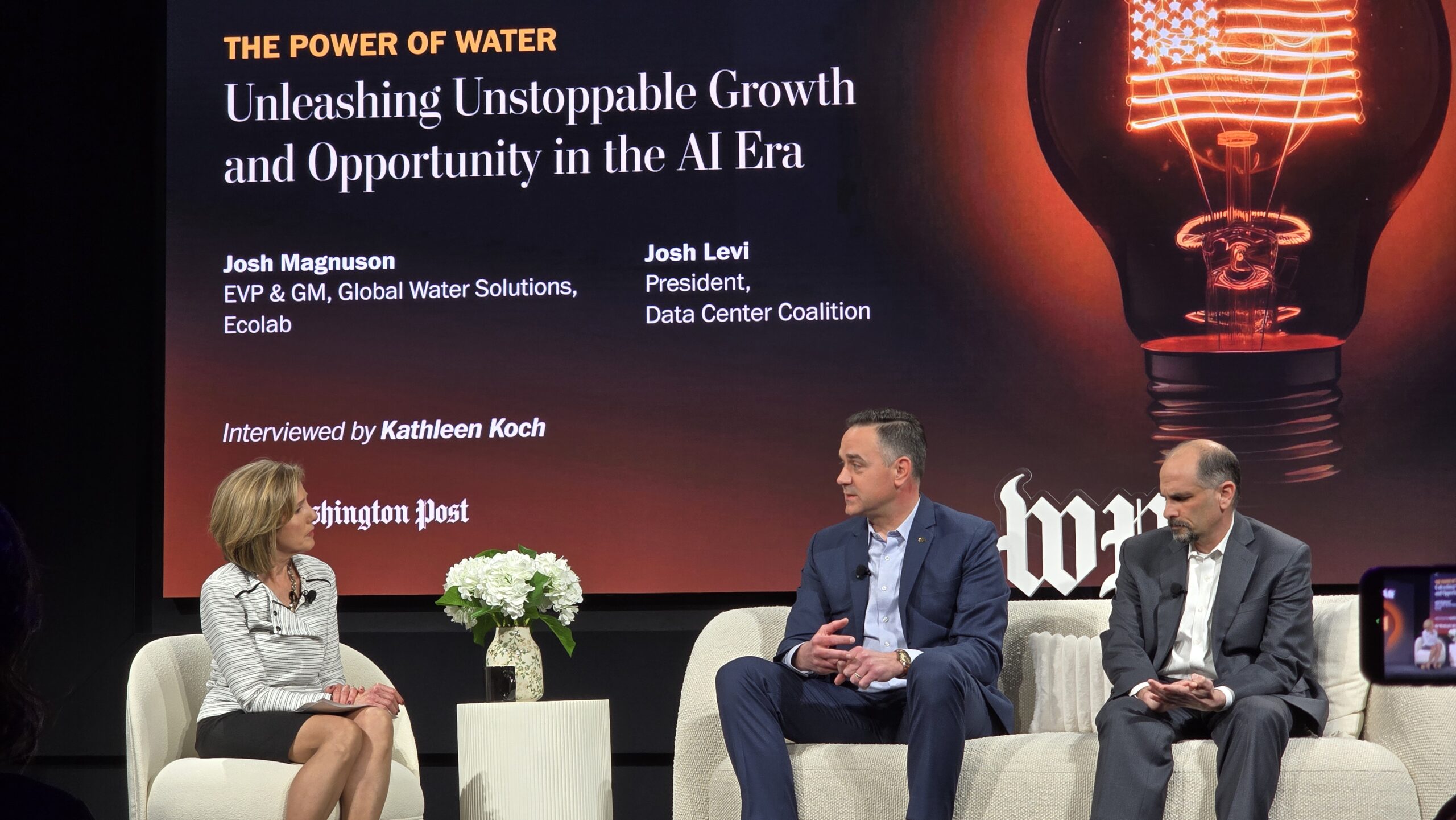
When we discuss the infrastructural demands of the artificial intelligence boom, the conversation almost immediately defaults to the electrical grid. We talk in gigawatts and megawatt-hours. But behind every headline about AI’s power hunger lies an equally critical, yet vastly under-discussed, resource challenge: water.
At The Washington Post’s Building America: Powering the AI Age summit, moderator Kathleen Koch sat down with Josh Magnuson, EVP of Global Water Solutions at Ecolab, and Josh Levi, President of the Data Center Coalition. Their session, “The Power of Water,” offered a sobering but fiercely innovative look at the liquid lifeblood of the AI revolution.
From a technologist’s perspective, this conversation was a masterclass in physical infrastructure catching up to software acceleration. As we push the boundaries of compute, the thermal dynamics of our hardware are forcing a complete rewrite of how we manage, consume, and recycle Earth’s most precious resource.
The Thirsty AI Value Chain
To understand the scale of the challenge, we have to look beyond the server rack. As Josh Magnuson pointed out, AI demand is projected to increase “roughly 4-fold over the next 4 to 5 years.” Fulfilling that demand requires a massive expansion across the entire technological value chain, and every single link is highly water-dependent:
- Chip Manufacturing: Before an AI model is even trained, the silicon must be fabricated. Advanced AI chips require significantly more water, and specifically, ultra-pure, highly refined water, during the manufacturing process than previous generations of hardware.
- Power Generation: The electricity powering these chips largely comes from traditional power plants (natural gas, nuclear, coal), which require massive amounts of water for their own turbine cooling systems.
- Data Center Operations: Finally, the servers themselves generate immense heat as they turn “electrons into zeros and ones,” as Josh Levi aptly described it. Removing that heat prevents catastrophic equipment failure, and historically, water has been the primary thermal transport mechanism.
Mythbusting: Water “Use” vs. Water “Consumption”
While the headlines surrounding data center water usage are often alarming, Josh Levi highlighted a crucial data literacy problem in how these metrics are reported and perceived. From an engineering standpoint, there is a massive difference between using water and consuming it.
“Water use is water that may be utilized by the data center, and some portion of that will be returned back into the watershed,” Levi explained. “Water consumption is water that might be evaporated or otherwise not returned into the system.”
Furthermore, public alarm is often driven by worst-case-scenario permitting. When developers file for permits, they must calculate the absolute maximum daily water pull for the hottest day of the year under a maximum compute load. “You’ll typically see that daily maximum use number multiplied times 365, and providing these huge, inflated numbers,” Levi noted.
In reality, efficient data centers are not the water drains they are often made out to be. Levi cited a year-long study by the Virginia General Assembly, the largest data center market in the world, which found that 83% of data centers in the state use the same amount of water, or less, than a large commercial office property.
From Windbreakers to Bathtubs: The Thermal Evolution
For decades, cooling a data center was a brute-force exercise in HVAC engineering: blasting massive amounts of chilled air through raised floors to keep ambient temperatures frigid. “I went through my first data center 18 years ago, and I basically needed to wear a windbreaker,” Levi joked.
Today, you can break a sweat standing in a modern AI data center. Because modern servers are designed to run safely at much higher temperatures, facilities can operate much more efficiently. But as server density increases, air cooling is hitting its physical limits. Air is simply a poor thermal conductor compared to liquid.
This is driving a fascinating hardware evolution:
- Dry Chillers & Closed Loops: Moving away from evaporative cooling towers, facilities are increasingly using closed-loop systems where water is treated and recycled rather than evaporated into the atmosphere.
- Direct-to-Chip Cooling: Running microscopic liquid cooling tubes directly to the GPU or CPU plates to pull heat exactly from the source.
- Liquid Immersion: As Levi noted, “I grew up in an environment where you learned not to put electronics near the bathtub or the swimming pool.” Yet, the bleeding edge of AI hardware involves physically dunking entire server blades into specialized, non-conductive dielectric fluids for maximum thermal efficiency.
The Technologist’s Takeaway: A Circular Water Economy
Perhaps the most profound insight from the session came from Magnuson regarding how the tech industry must view its byproducts. With global projections suggesting a 50% deficit in potable drinking water by 2030, the linear model of water usage is dead.
“This old concept of end of pipe, you just send water off to be discharged and the concept of wastewater has to go away,” Magnuson stated. “Water’s not waste. And it shouldn’t be wasted.”
The ultimate irony, and optimism, of the AI age is that the very technology consuming these resources is also our best tool for optimizing them. Magnuson highlighted how Ecolab partnered with Digital Realty to deploy an AI solution that optimized their water systems, yielding a 15% reduction in total water usage in a single year. Furthermore, AI’s ability to instantly disseminate specialized engineering knowledge globally means a water-saving breakthrough in a facility in Chile can be instantly deployed to a data center in Virginia.
We are entering an era where data centers must strive not just for water neutrality, but for “water positivity”, restoring more to the watershed than they take. It is a staggering engineering challenge, but as this session proved, the technology sector is already building the plumbing for the future.
For more information, please visit the following:
Website: https://www.josephraczynski.com/
Blog: https://JTConsultingMedia.com/
Podcast: https://techsnippetstoday.buzzsprout.com
LinkedIn: https://www.linkedin.com/in/joerazz/
Leave a Reply
You must be logged in to post a comment.