
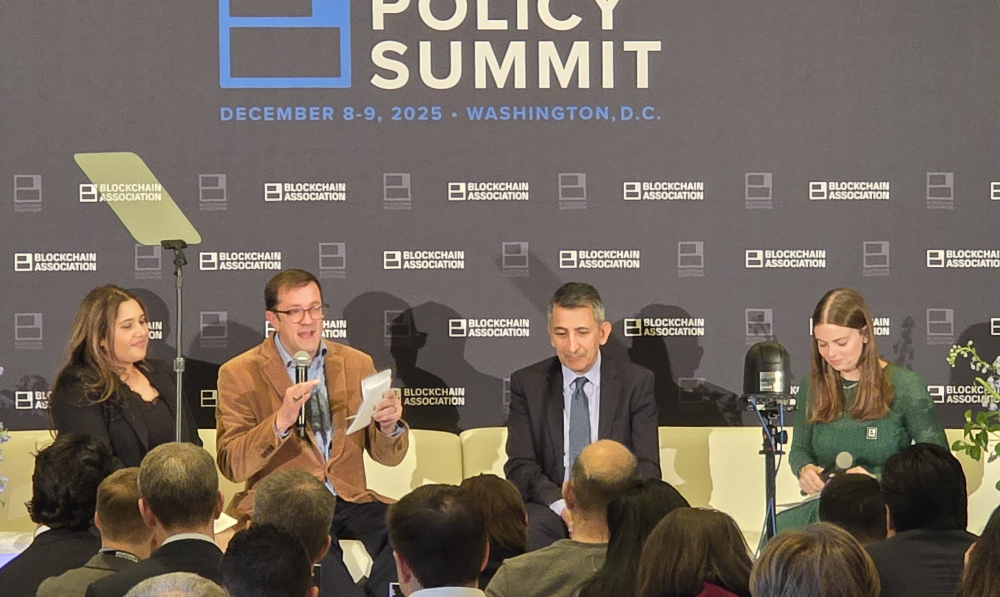
Blockchain Association Policy Summit 2025, Washington, DC: The title of this session could’ve been lifted straight from a sci‑fi screenplay: “So It Begins: Big Banks’ War on Crypto.” But as moderator Lindsay Fraser, Chief Policy Officer at the Blockchain Association, reminded the audience, this was no fiction. Traditional financial institutions, fortified by regulatory allies and legacy infrastructure, are fighting to constrain the technologies that challenge their dominance.
Joining her on stage were three experts with insider perspectives: Faryar Shirzad, Chief Policy Officer at Coinbase; J.W. Verret, Associate Professor of Law at George Mason University; and Angelena Bradfield, Head of Policy at the Financial Technology Association (FTA). What unfolded was a candid conversation that dissected how major banks are executing a coordinated strategy, one part policy, one part narrative warfare, to slow crypto’s advance.
The Duality of Wall Street’s Strategy
Shirzad opened with an observation that struck a chord: “The banks are of two minds.” On one hand, financial institutions are experimenting with tokenization internally, exploring blockchain rails for payments, settlements, and deposits. On the other, their lobbyists in Washington are orchestrating efforts to slow down industry adoption, what Shirzad called “a full-scale defensive campaign to protect the legacy system.”
Policymakers, he argued, must see through this split personality. “The President has said he wants the U.S. to be the crypto capital of the world,” Shirzad noted, but big banks’ policy arms “are strategically working to delay” that vision. In other words, this isn’t a debate about technology readiness; it’s a battle over market power.
For technologists, this dynamic is familiar: incumbents exploit innovation internally while resisting openness externally. In software terms, it’s the difference between using open-source code and supporting the open-source community. Banks want the efficiency of crypto rails without ceding control of the financial protocols that define economic participation.
The ‘Joint Trades’ Offensive
Verret, who serves on the Monetary Policy Advisory Board and frequently contributes to legislative comment letters, described the banks’ coordinated lobbying push, what he called “the first salvo in a prolonged war.” Central to that campaign is the Joint Trades Letter, a coalition document signed by multiple banking associations that advocates asset‑based regulation of digital assets and restrictions on stablecoin activity.
“They’re trying to preserve the franchise,” he said, “and they’re good at it. They’ve got top lawyers crafting an argument that makes every crypto‑related activity look like a regulated banking function.”
Verret warned that this approach, defining broad categories of on‑chain actions as “regulated activity”, could ensnare everything from DeFi protocols to wallet providers. “They’re coming after validators, they’re coming after yield programs, they’re coming after DeFi,” he said bluntly.
Under the surface, this isn’t just regulatory positioning; it’s structural repositioning. If successful, it would transform permissionless financial interfaces into permissioned conduits controlled by banking intermediaries, effectively reversing twenty years of fintech progress.
Open Banking Under Siege
For Bradfield, the fight goes beyond crypto. She described how the FTA, which represents leading Fintechs, is defending open banking, the framework that allows consumers to share their financial data across apps and services. “Open banking is the ability for a consumer to permission the secure sharing of their financial data,” she explained, an essential foundation for innovation, lending, and payments.
But that foundation is now under assault. The Consumer Financial Protection Bureau (CFPB) recently finalized a long‑awaited rule under Section 1033 of the Dodd‑Frank Act, intended to codify open banking rights. On the same day, the Bank Policy Institute filed suit challenging the rule, arguing for a narrow definition of “consumer data” and the right to impose fees for access.
If the banks prevail, Bradfield cautioned, “it will have severe impacts for all the uses open banking supports, whether that’s paying your friend through a fintech app or connecting your crypto wallet.”
In other words, what looks like a procedural administrative fight is, at root, a struggle over data sovereignty. For technologists and builders, it’s the continuation of an old theme: who owns the interface, the user or the institution?
Stablecoins and the ‘Rewards’ Controversy
The discussion then turned to the Genius Act, the sweeping digital-assets law designed to regulate stablecoin issuance. Shirzad recounted how banks lobbied aggressively to prohibit stablecoin issuers from sharing interest earned on reserves with users, effectively banning yield or “rewards” programs that could increase competition for consumer deposits.
“It was a bitter pill for the industry,” he admitted. “But the real overreach came next.” After losing the legislative battle, banks began petitioning the OCC to reinterpret the law, arguing that even third-party rewards paid by exchanges or wallet providers should be treated as illegal indirect interest payments.
“It’s a Soviet argument,” Verret said dryly. “They’re claiming ‘direct means indirect.’” He detailed how the banks are engaging in “linguistic gymnastics,” reversing decades of precedent about the separation of banking and commerce to fabricate a new standard that conveniently stifles innovation.
Shirzad added that fear, not prudence, drives this strategy: “We’re talking about $200 billion a year in institutional transfer fees. Stablecoins make payments faster and cheaper. The banks see that franchise evaporating.”
For technologists, the economic stakes are staggering. Stablecoins have already proven they can settle global transfers in seconds for fractions of a cent, meeting the G20’s 2035 cross‑border payments goals today. As Shirzad put it, “The question for U.S. policymakers is whether they want to enshrine those obsolete fees by law or unlock the future of global payments.”
Building the Counteroffensive
If banks’ strategy is to freeze innovation through regulatory re‑interpretation, the industry’s response is multi‑layered. Shirzad urged three tactics: consumer adoption, policy engagement, and coalition building.
“The most powerful thing the industry can do,” he said, “is get consumers using the technology.” He cited over a hundred new stablecoin projects announced since the Genius Act’s passage, many involving partnerships between Fintechs, payment processors, and even progressive banks. “Adoption makes these rear‑guard efforts to defend the status quo more absurd,” he said. “When people are using this tech in their daily lives, fear‑mongering stories lose force.”
Verret emphasized legal engagement, “write comment letters”, and not just perfunctory ones. Strategic, evidence‑driven commentary can force regulators to clarify positions and expose contradictions in the banks’ arguments. His advice: make them choose between inconsistent precedents. “They can’t argue both that direct means indirect and that the law has always meant the opposite,” he quipped.
Bradfield underscored grassroots advocacy. The open‑banking coalition she helped lead united Fintechs, crypto firms, and even small community banks. “Three separate letters,” she said proudly, “joined by over a hundred CEOs reminding policymakers that competition and consumer choice are at stake.”
This convergence, Fintechs, crypto startups, and smaller banks aligning against monolithic incumbents, might be the most important outcome of this period. It suggests a future where “open finance” isn’t just a technical standard but a political coalition.
Why This Fight Matters
From a technologist’s vantage point, the conflict between big banks and crypto is not simply about market share; it’s about control of the financial interface, the protocols, data rights, and access layers through which economic innovation happens.
The irony, as several panelists noted, is that many banks are simultaneously investing in blockchain technology while lobbying to hobble competitors who use it. It’s not anti‑crypto in principle; it’s anti‑competition in practice.
The takeaway is clear: the coming year will be defined not by whether blockchain survives regulation, but by who writes the rules that govern its implementation. Open protocols threaten closed franchises, and those franchises are now fighting with the same tools, lobbying, legislation, and litigation, that once defended central banking itself.
The Road Ahead
The panel closed with a call to action that blended realism with optimism. Shirzad urged builders to “get on the Hill”, to humanize the industry in front of legislators who mostly encounter crypto through headlines. “Every time founders show up,” he said, “it stops being abstract and starts being real.”
Verret’s closing advice was simpler: “Write comment letters. Breathe in the afternoon. Defend the future in the morning.”
In the end, Big Banks’ War on Crypto is less about technology and more about the eternal tension between incumbency and innovation. But if the energy in that Washington ballroom was any indication, this won’t be a one‑sided war. The open financial system, like the open internet before it, has its defenders, and they are gathering in force.
For more information, please visit the following:
Website: https://www.josephraczynski.com/
Blog: https://JTConsultingMedia.com/
Podcast: https://techsnippetstoday.buzzsprout.com
LinkedIn: https://www.linkedin.com/in/joerazz/
Leave a Reply
You must be logged in to post a comment.