
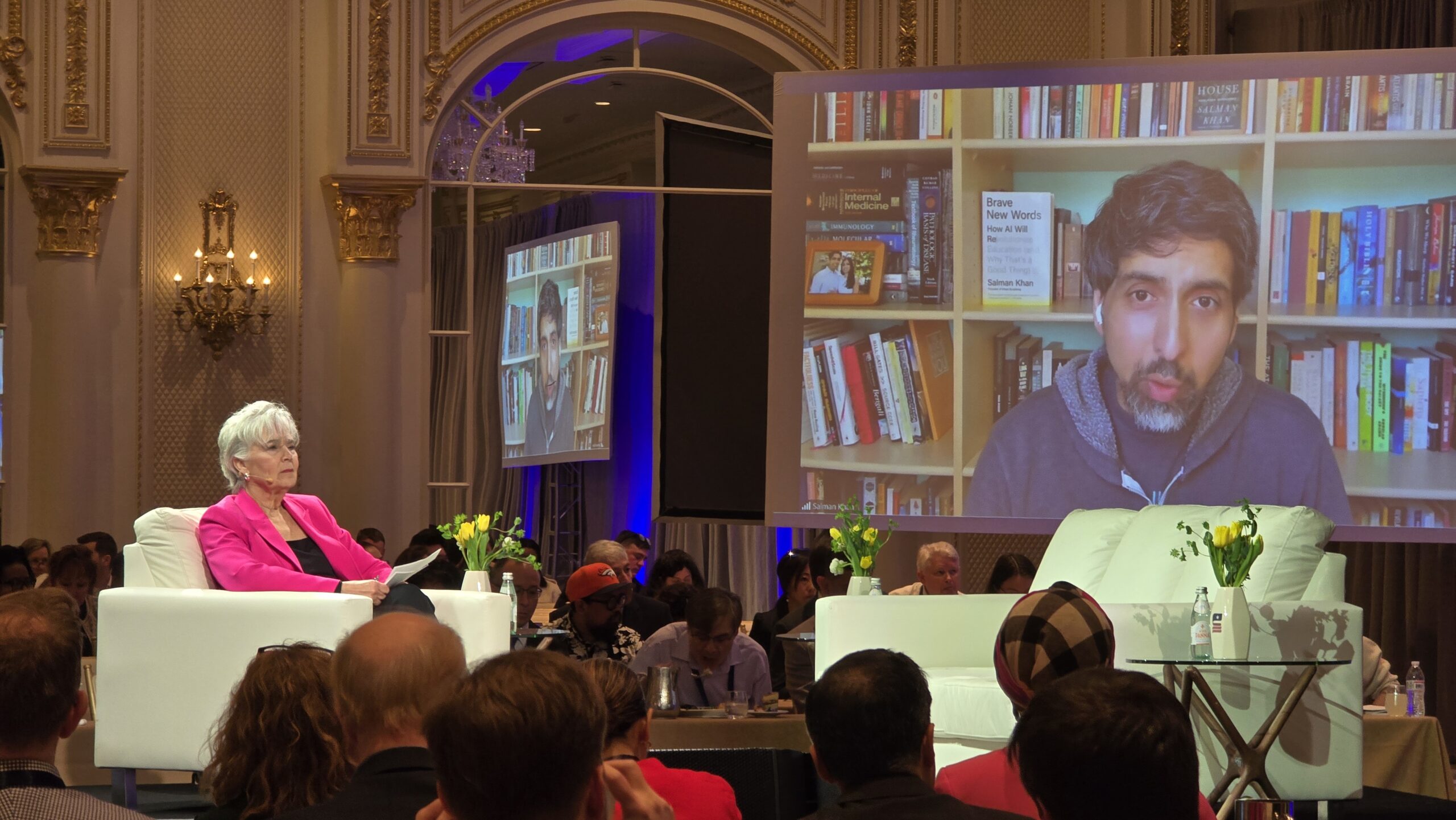
The halls of the Special Competitive Studies Project (SCSP) AI+Education conference in Washington, DC, were buzzing with a distinct mix of urgency and optimism. Nowhere was this more palpable than during the fireside chat with Sal Khan, the founder of Khan Academy. As a technologist, watching Khan’s evolution from producing simple YouTube math videos to deploying sophisticated AI tutors like Khanmigo is like watching the “Model T” moment for personalized learning.
The conversation, moderated by Jeanne Meserve, didn’t just focus on the “cool factor” of Generative AI. Instead, it provided a grounded, strategic blueprint for how we can use large language models (LLMs) to solve the “2-Sigma Problem”, the educational theory that a student tutored one-on-one performs two standard deviations better than a student in a traditional classroom.
The Technologist’s Perspective: AI as the Universal Teaching Assistant
From a technical standpoint, the most insightful takeaway from Khan is his shift in focus from content delivery to process transparency. In the early days of EdTech, the goal was simply to digitize the textbook. Khan is doing something much more radical: he is using AI to instrument the learning process itself.
Khan addressed the “cheating elephant” in the room, the fear that AI will simply write every student’s essay. His response was a masterclass in product design. Instead of building better “detectors” (which he noted have a 40% false-positive rate), Khan Academy built Writing Coach. This tool doesn’t just give the answer; it collaborates with the student within a “glass box” environment.
“The teacher doesn’t just get the final paper; they can get the process. The AI can tell the teacher… ‘we worked on this together for four hours.’ … That’s the type of transparency that could undermine cheating.”
By recording the interaction between the student and the AI, the technology provides a “proof of work” that a final PDF never could. For technologists, this is a shift toward provenance, valuing the journey of data (or thought) as much as the output.
Redefining the “Elite” Signal: The $10,000 Degree
Perhaps the most disruptive segment of the chat involved Khan’s vision for higher education. Currently, the “prestige” of universities like Harvard or Stanford is built on artificial scarcity, accepting only 4% of applicants while 70% are qualified.
Khan is proposing a radical alternative: a high-scale, high-signal degree for under $10,000.
| Feature | Traditional Elite University | Khan’s Proposed Model |
| Cost | ~$340,000+ | <$10,000 |
| Admission | Scarcity-based (4% acceptance) | Competency-based (High scale) |
| Primary Value | Networking & Prestige Signal | Verified Skill & Employer Trust |
| Delivery | Residential/Physical | AI-Augmented / Peer-to-Peer |
As a technologist, I find this compelling because it treats “prestige” as a data problem. If you can prove, through rigorous AI-proctored assessments and peer-reviewed projects, that a student has the same cognitive load capacity as an MIT grad, the “brand” of the school becomes secondary to the verified competency of the individual.
The “Durable Skills” Defense
In a world where AI can write Python code and draft legal briefs, the definition of a “marketable skill” is shifting. Khan was candid about the “tectonic shift” currently freezing the junior software engineering market. His advice to students (and his own 17-year-old son) is to double down on Durable Skills.
“You have to be prepared to constantly create… develop what’s often known as these durable skills or soft skills: communication, etc.”
He isn’t suggesting we abandon STEM. On the contrary, he views a rigorous degree (like Physics or Philosophy) as a “signal” of hard work and critical thinking. However, the “plus” factor in the AI age will be the ability to humanize technology. Khan envisions a degree program where students use Zoom to debate diametrically opposite points of view on tough issues like the Middle East or gun control. The AI’s role? Providing feedback on how well they listened and represented the other side.
Saving the Teacher, Not Replacing Them
A recurring fear is that AI will make teachers obsolete. Khan countered this by framing AI as a “Resilience Effort” for the profession. He cited data showing that Khanmigo is already saving teachers 5 to 10 hours a week by drafting lesson plans, progress reports, and Individualized Education Programs (IEPs).
By automating the “drudgery” of administration, AI allows the human teacher to return to their core purpose: motivation and mentorship.
“I told every teacher… ‘You are safe. Please use the technology to engage.’”
From a systems-design perspective, this is “Human-in-the-loop” (HITL) at its best. The AI handles the high-volume, low-context data (grading, scheduling, initial tutoring), while the human teacher handles the low-volume, high-context emotional and motivational support.
Final Thoughts: The Tsunami is Coming
Sal Khan’s message was a clarion call. We are 2-3 years away from a “tsunami” of job dislocation. The solution isn’t to ban the tools or retreat to old models, but to build new “clearinghouses” of talent.
Whether it’s his proposal that companies donate 1% of profits to “resilience efforts” or his push for a $10,000 degree, Khan is betting that democratized intelligence is the only way to stay ahead of the curve. For those of us in the tech sector, the challenge is clear: stop building “shiny” objects and start building the infrastructure for a more resilient, educated humanity.
For more information, please visit the following:
Website: https://www.josephraczynski.com/
Blog: https://JTConsultingMedia.com/
Podcast: https://techsnippetstoday.buzzsprout.com
LinkedIn: https://www.linkedin.com/in/joerazz/
Leave a Reply
You must be logged in to post a comment.