
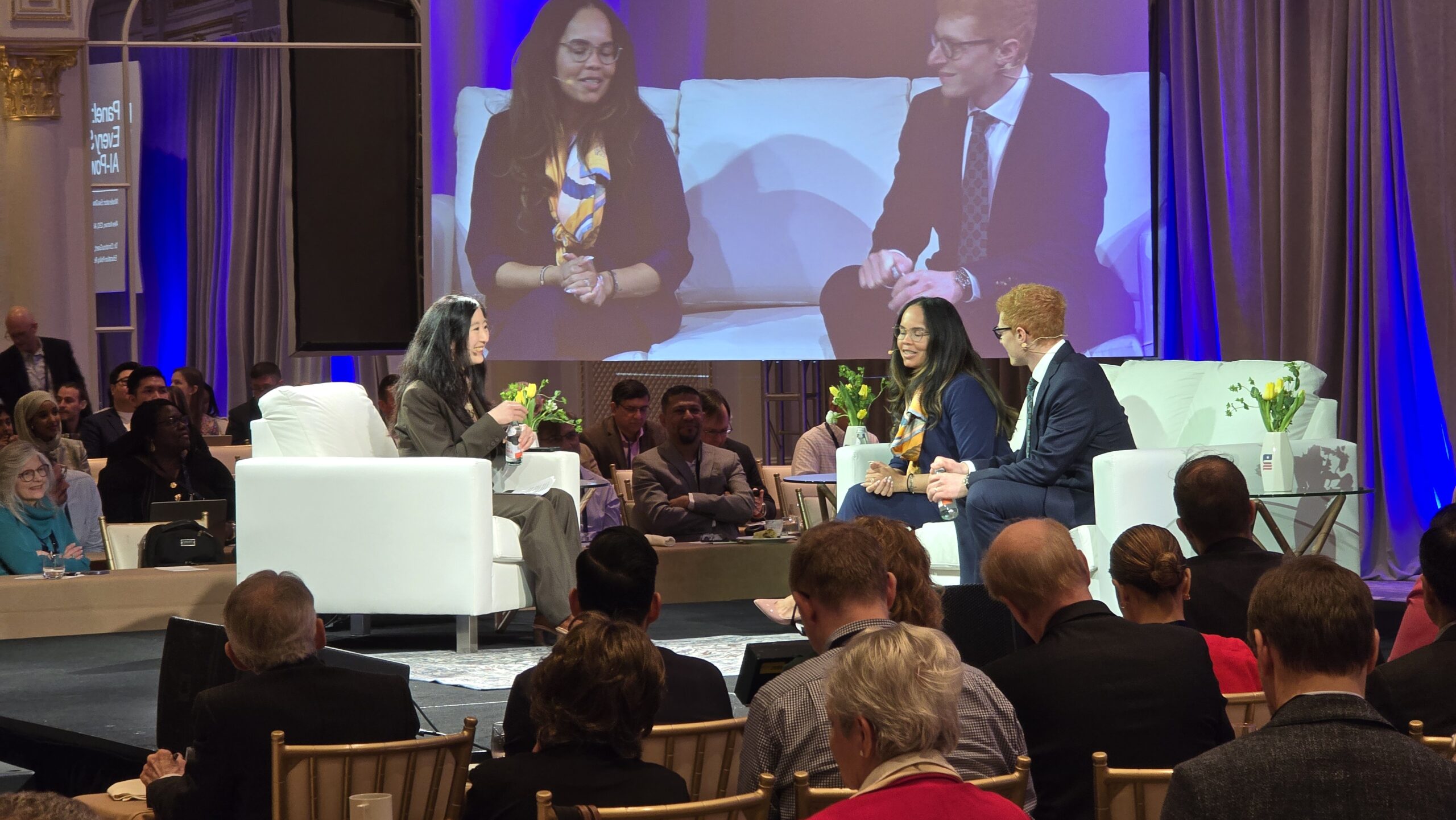
The rapid onset of generative AI has left the American education system in a state of “reactive whiplash.” At the recent SCSP AI+Education conference in Washington, DC, a panel featuring Alex Kotran (CEO of AiEDU), Dr. Christina Grant (Executive Director at Harvard’s CEPR), and moderator Eva Doug explored a critical pivot: we must move past simple “AI literacy” and toward a fundamental redesign of how we measure human intelligence and student readiness.
From a technologist’s perspective, the discussion wasn’t just about putting tablets and LLMs in classrooms; it was about change management at a civilizational scale.
Beyond Literacy: The Shift to Agentic Capabilities
Early in the conversation, Alex Kotran made a provocative point that resonates with anyone watching the trajectory of Silicon Valley. We are already moving past the “prompt engineering” phase. As AI moves toward agentic capabilities, where models don’t just answer questions but execute complex, multi-step goals, the traditional definition of technical literacy becomes obsolete.
“We don’t talk about cell phone literacy… AI skills to us felt like, is that really going to be it? So, we made this bet on, well, what is the human advantage actually going to be?” – Alex Kotran
For the technologist, this is the “Abstraction Layer” argument. Just as we no longer need to know assembly language to build a website, students won’t need to be “AI experts” to use AI. Instead, they need durable skills: communication, collaboration, and high-level computational thinking.
The Teacher as a “Facilitator of Knowledge”
One of the most inspiring visions came from Dr. Christina Grant, who addressed the dwindling satisfaction of teachers. She argued that AI shouldn’t replace the teacher but act as a co-pilot that offloads the administrative and diagnostic “noise” that leads to burnout.
Imagine an English teacher in a classroom where an AI is “listening” in real-time, not to surveil, but to provide immediate feedback on how to pivot a lesson based on student questions.
“The tools could really create teachers… a facilitator of knowledge to do something that humans do well. How do you think? How do we collaborate?” – Dr. Christina Grant
In this model, the classroom becomes a “fluid environment” where the loop between school and home is closed. No more “Johnny saying there’s no homework,” because the data flow is transparent and continuous.
The Assessment Crisis: Measuring What Matters
The panel hit a significant nerve regarding standardized testing. As a technologist, I see a massive data mismatch: we are using industrial-era metrics (multiple-choice tests) to measure students entering an era of infinite information.
Kotran noted that while AI can now solve most math and writing tasks, this doesn’t make those subjects irrelevant, it actually raises the bar. If the AI can provide the answer, the student must now possess the “meta-cognitive” skills to understand the why and the how.
The challenge is that our current incentive structures, school funding tied to test scores, actively discourage the project-based learning that builds these durable skills. We need a “wholesale system alignment” that rewards innovation rather than rote memorization.
| Old Paradigm | AI-Powered Paradigm |
| Content Mastery | Cognitive Learning |
| Standardized Tests | Continuous Assessment |
| Individual Silos | Collaborative Agents |
| Static Curriculum | Adaptive Learning Paths |
A New Compass for Parents: “Do Hard Things”
For parents worried about which career paths remain “safe,” the panel offered a refreshing, if challenging, perspective. The “doctor, lawyer, engineer” trifecta is no longer a guaranteed ticket to the middle class.
Instead, the panel suggested three pillars for the modern student:
- Accomplish Hard Things: Whether it’s sports, a trade, or a difficult project, the ability to persevere through friction is a signal that AI cannot replicate.
- Become an Expert Learner: In a world where tools change every six months, “lifelong learning” isn’t a cliché; it’s a survival requirement.
- Master Human Friction: As AI reduces friction in technical tasks, the ability to navigate office politics, lead a team, and manage human emotions becomes the ultimate differentiator.
“The children of the future will need to be durable. They will need to know how to pivot. They will need to know how to stay ahead of the learning curve.” – Dr. Christina Grant
The Technologist’s Takeaway
We are entering an era where human capacity is the only true differentiator, for now. As software stocks fluctuate and technology becomes a commodity accessible to everyone from Goldman Sachs to a rural high schooler, the “winner” isn’t the one with the best model. It’s the one with the best-trained humans capable of leveraging that model.
For policymakers, the “low-hanging fruit” is clear: stop treating AI as a threat to be managed and start treating education as the primary engine of national competitiveness. We cannot afford to be afraid; we were, as Dr. Grant put it, “designed to be in this moment.”
For more information, please visit the following:
Website: https://www.josephraczynski.com/
Blog: https://JTConsultingMedia.com/
Podcast: https://techsnippetstoday.buzzsprout.com
LinkedIn: https://www.linkedin.com/in/joerazz/
Leave a Reply
You must be logged in to post a comment.