
If hardware and software are the engines of the artificial intelligence revolution, government policy is the track they run on. Without the right permitting, infrastructure investments, and regulatory frameworks, even the most advanced technological breakthroughs will stall.
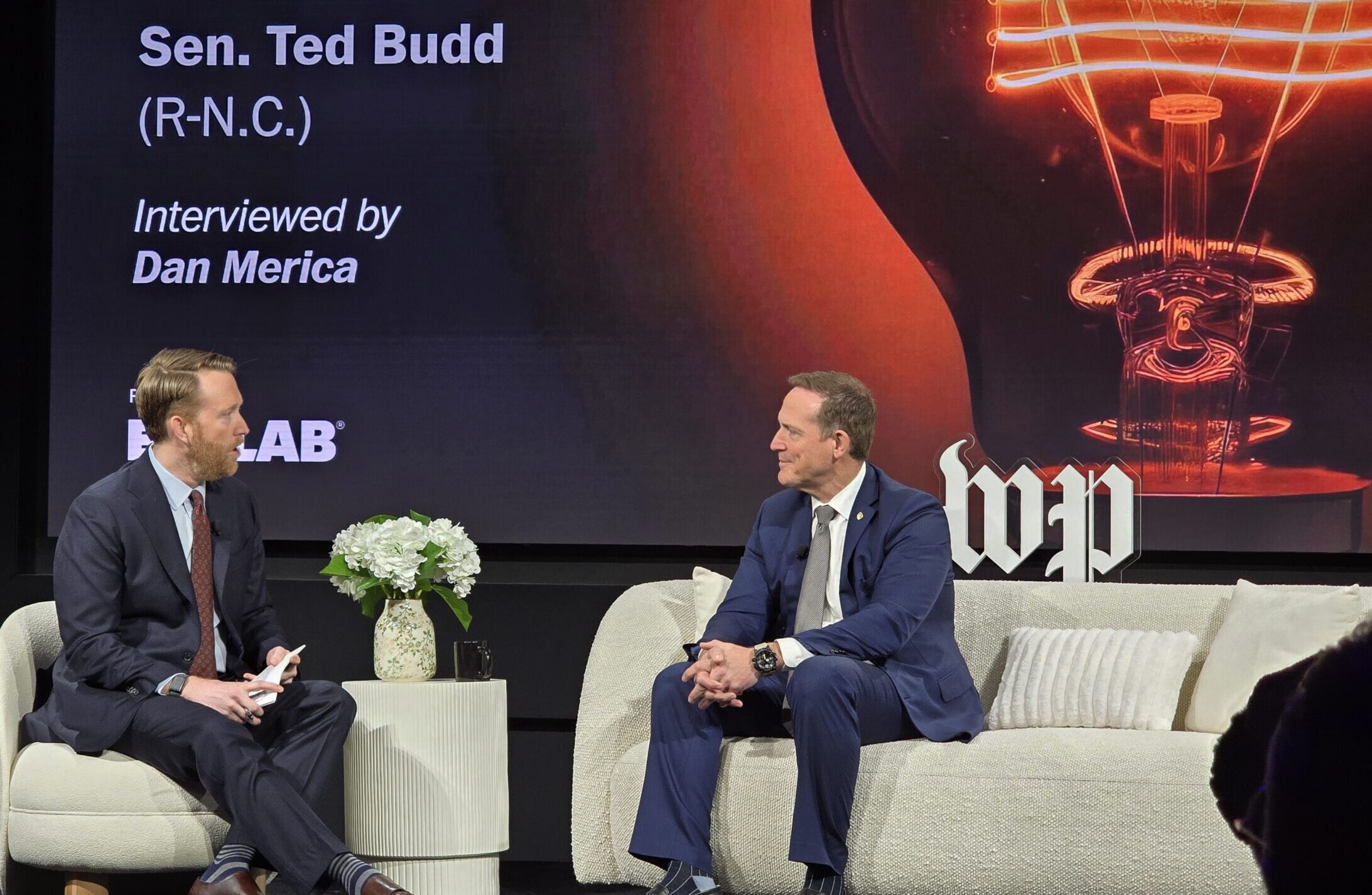
At The Washington Post’s Building America: Powering the AI Age summit, Dan Merica, Co-Anchor of the Early Brief, sat down with Senator Ted Budd (R-NC) to discuss the legislative realities of the AI boom. Their session, “Policy Push,” offered a candid look at how Washington and local municipalities are grappling with the unprecedented physical and economic footprint of AI.
From the vantage point of a technologist, this conversation highlighted a fascinating disconnect: while Silicon Valley moves at the speed of light, Capitol Hill is designed to move slowly. Bridging that gap requires massive investments in energy, a shift in public perception, and a renewed focus on local infrastructure.
Here are the key takeaways from their discussion.
The Human Element: Education Over Fear
Before addressing the physical infrastructure of AI, Senator Budd addressed the psychological hurdles. Polling indicates significant apprehension among voters regarding AI, with Merica noting that a recent survey found 40% of Republican voters would even support a ban on AI data center construction.
For a technologist, this resistance is a familiar historical pattern, every major industrial shift brings fears of obsolescence. Senator Budd argued that overcoming this requires framing AI as a tool for empowerment rather than a replacement for human labor.
“I do not worry about being replaced by [AI], I believe we’re going to be collaborating with AI,” Budd stated, emphasizing that “AI exists inside of human ingenuity.”
He noted that public fear largely stems from a lack of understanding, quoting the adage that people are “down on what they’re not up on.” Whether it’s a small business owner panicking over automated financial statements or an elderly citizen learning to prompt a language model for recipes, the tech industry has a massive mandate: we must aggressively educate the public on the tangible, everyday benefits of AI to prevent a social and political backlash.
The Global Energy Race
The most pressing policy issue surrounding AI is not data privacy or algorithmic bias, it is raw, unadulterated electrical power. The geopolitical stakes of this energy race cannot be overstated.
During the session, the stark contrast between the United States and China’s energy infrastructure was brought into sharp focus.
To provide some concrete statistics on this disparity: As of recent reporting, China’s total installed power generation capacity has reached roughly 3.89 terawatts (TW), with the country adding a staggering 540 gigawatts (GW) of new capacity in a single year across renewables, coal, and nuclear. By contrast, the US baseline sits significantly lower.
Senator Budd contextualized this challenge perfectly: “They’re about 3.3, 3.5 terawatts, we’re at about 1.3. And they’re adding more so we need to add about 85 gigawatts a year in order to keep pace with our demand.”
To meet this demand, Budd argued that the U.S. cannot afford to sideline any energy sources. He highlighted the need to utilize existing grid capacity in rural areas, such as former furniture manufacturing hubs in North Carolina that now have excess power availability, and stressed the importance of domestic energy production to maintain national security and economic competitiveness.
The NIMBY Problem and Local Value
While the energy race is a federal and international issue, the actual construction of AI infrastructure is intensely local. The friction point for data center expansion is often NIMBYism (“Not In My Back Yard”).
When citizens see massive, windowless buildings going up in their communities, concerns about electricity prices, water usage, and aesthetic disruption naturally follow.
Senator Budd emphasized that the decision to build these centers shouldn’t be a top-down federal mandate, but rather a localized choice. However, he also pointed out that communities often fail to see the invisible benefits these facilities bring.
While data centers are not heavily labor-intensive once operational, they bring massive economic windfalls to rural and transitioning counties. “They do provide for the local taxes, so in essence the value of those buildings and the property taxes are supporting local schools, departments of law enforcement, first responders,” Budd explained. They also generate a robust secondary economy for technical trades, including HVAC technicians, electricians, and plumbers.
Regulatory Lag as a Feature, Not a Bug
When pressed on why Congress hasn’t passed sweeping, bipartisan AI permitting reform or regulation, Senator Budd offered a sobering reminder of how the American legislative system is built.
“It’s meant to move slowly,” Budd said with a smile. “If you look at crypto, if you look at privacy… we’ve been wrestling with [these] for years, they’re not solved yet and I think it’s meant to take a long time.”
For technologists used to “moving fast and breaking things,” this regulatory friction can be frustrating. However, in the context of critical infrastructure, this deliberate pacing prevents patchwork, state-by-state laws that could fracture the national tech ecosystem.
Ultimately, the overarching message of the “Policy Push” session was one of fundamental physics and economics. Quoting a recent conversation with OpenAI CEO Sam Altman, Budd distilled the entire AI policy debate down to its core: “An electron is an electron is an electron… if we are so constrained and so protective and we don’t build energy, it not only holds back technology, it holds back all sorts of production: airports, hospitals. I think that’s our main constraint right now.”
If America wants to lead the next 250 years of innovation, we have to start building the power plants, the transmission lines, and the local workforce to plug it all in.
For more information, please visit the following:
Website: https://www.josephraczynski.com/
Blog: https://JTConsultingMedia.com/
Podcast: https://techsnippetstoday.buzzsprout.com
LinkedIn: https://www.linkedin.com/in/joerazz/
Leave a Reply
You must be logged in to post a comment.