
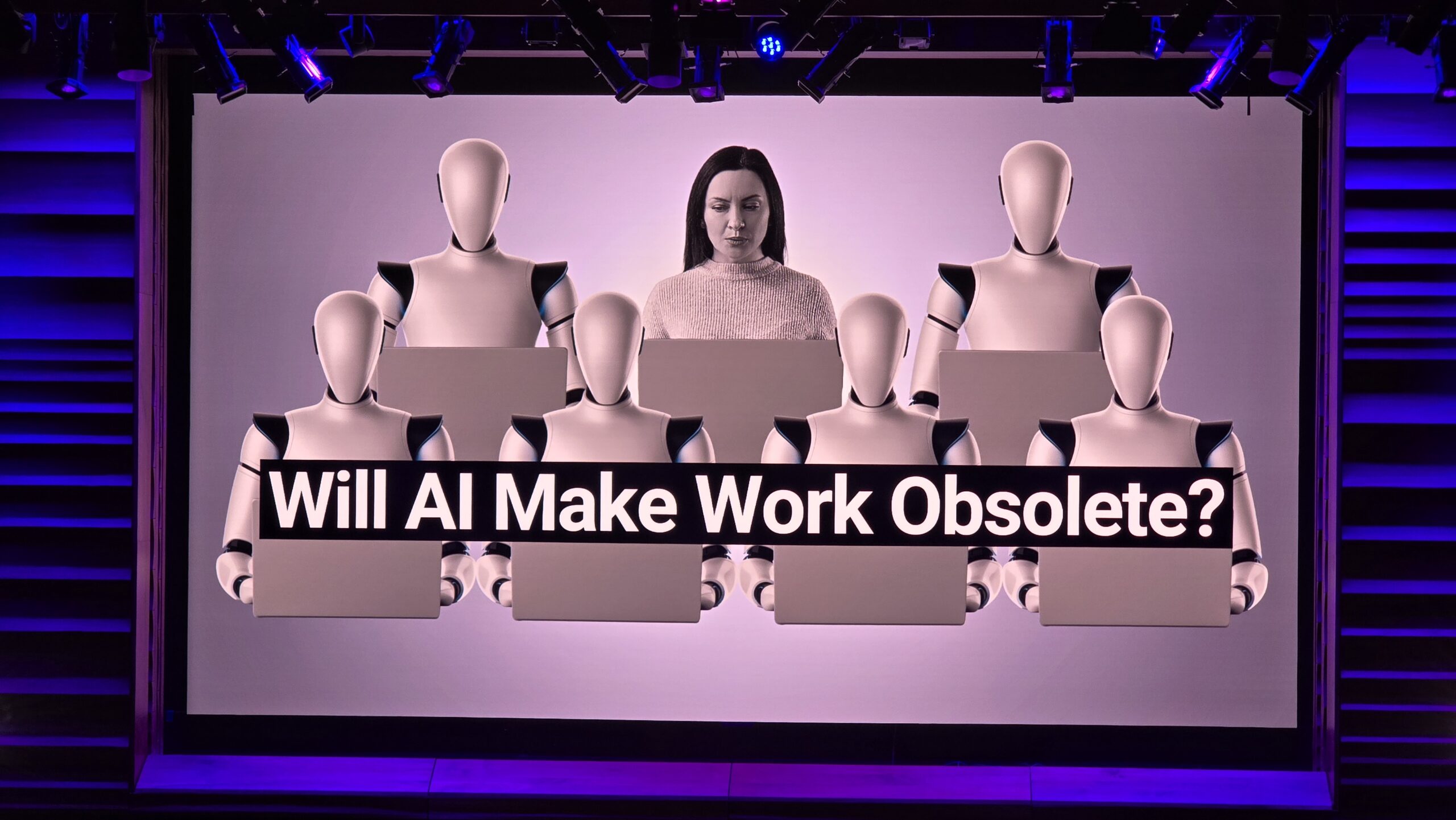
Preface: This is my report out about what these debaters said at John Hopkins tonight. I will author a recap of what is most likely going to happen in this space soon, based on my over ten years hands-on with the tech and my weekly meetings with CEOs and technologists from around the world.
At Johns Hopkins University in Washington, DC, the Open to Debate forum tackled the most pressing anxiety of the modern technological age: Will AI Make Work Obsolete? Moderated by John Donvan, the stage featured a heavyweight clash of economists, technologists, and policymakers.

Arguing “Yes” were Andrew Yang, CEO and former presidential candidate, alongside Simon Johnson, a Nobel Prize-winning Economist at MIT. Arguing “No” were Chris Hughes, Co-founder of Facebook, and Rumman Chowdhury, CEO of Humane Intelligence and US State Department AI Science Envoy.
From the vantage point of a technologist, this debate stripped away the standard tech utopianism and forced a hard look at the data. While both sides ultimately agreed that an economic transition is coming, they fiercely disagreed on whether that transition ends in an apocalypse for human labor or a renaissance of new industries.
Here are the key insights and data points from the clash.
The “Yes” Case: The White-Collar Extinction Event
Andrew Yang and Simon Johnson did not pull any punches. Their core argument was that the current iteration of AI is fundamentally different from past industrial revolutions. Past technology automated physical muscle; AI automates cognitive capability.
Johnson argued that today’s C-suite is driven by a dangerous “obsession with automation.” Unlike past innovations that complemented human labor, current AI is actively designed and deployed to replicate and replace it.

Yang painted a bleak picture of the immediate future for the 70 million white-collar workers in the United States. He shared anecdotes of tech CEOs quietly planning rolling layoffs of 15% to 20% of their workforces over the next few years. For the first time in American history, Yang noted, the educational premium is vanishing, with unemployment rates for recent college graduates matching or exceeding those of non-graduates.
Furthermore, the threat isn’t just to coders and copywriters. The “Yes” side pointed to the impending decimation of the transportation sector.
- There are roughly 3.5 million full-time delivery and truck drivers in the US, and up to 5 million when accounting for gig-economy drivers like Uber and Lyft.
- As autonomous vehicles like Waymo (which already commands a 20% market share in San Francisco) scale, Johnson warned we could lose up to a million transportation jobs in short order.
The “No” Case: The Lesson of the Robot Cashier
Chris Hughes and Rumman Chowdhury countered the doomsday narrative with a mix of historical economic precedent and a sobering dose of current technical reality.

Hughes leaned heavily on the historical pattern of induced demand. When the cost of a service plummets due to automation, demand for that service (and related services) skyrockets. To illustrate this, Hughes brought up the introduction of the Automated Teller Machine (ATM) in the 1970s.
When the ATM was introduced, tellers panicked. Yet, in 1970, there were 300,000 bank tellers in the US. Forty years later, despite the ubiquity of ATMs, there were 600,000 bank tellers. Because ATMs made operating branches cheaper, banks opened more branches, ultimately hiring more humans. Hughes also pointed out that 60% of people employed in the United States today work in jobs that didn’t exist in 1940.
The Technical Reality Check
As a technologist, the most compelling argument came from Rumman Chowdhury, who punctured the hype surrounding Large Language Models (LLMs) and Artificial General Intelligence (AGI).

Chowdhury argued that the “dirty secret of Silicon Valley” is that current generative AI models are hitting diminishing marginal returns. They are becoming exponentially more expensive to train, and we are running out of high-quality human data to train them on.
She pointed out that AGI—defined by the industry as the automation of all tasks of economic value—cannot be achieved with current LLM architectures. Current models excel at two-dimensional text generation but fail spectacularly at physical world navigation or complex, novel reasoning.
Furthermore, the impact of AI won’t be evenly distributed. Pointing to a recent NBER paper, Chowdhury highlighted the demographic reality of the impending shift. The disruption won’t primarily destroy the livelihoods of highly mobile, wealthy software engineers. Instead, the immediate threat is to administrative and clerical roles. Specifically, she noted that this impact will be concentrated in a sector comprising 16% of the labor force that is 88% women.
The Consensus: A Brutal Transition
Despite being on opposite sides of the proposition, the debaters reached a surprising consensus: the short-term transition is going to be incredibly painful.
The disagreement lies in the endpoint. Hughes and Chowdhury believe the labor market will adapt, birthing new industries in the skilled trades, healthcare, and roles requiring deep human empathy. Yang and Johnson believe the displacement will be so rapid and complete that traditional labor markets will break, necessitating heavy taxation of AI companies and the implementation of Universal Basic Income (UBI).
Ultimately, the audience at Johns Hopkins remained skeptical of the doom-sayers. The pre-debate vote stood at 20% Yes, 62.7% No, and 17.3% Undecided. After the debate, the “Yes” side swayed a tiny margin of the audience, moving to 21.8% Yes, allowing them to technically win the debate metric of “minds changed,” even though the vast majority of the room firmly believed human work will endure.

The debate proved one thing definitively: AI won’t end work tomorrow, but the work of figuring out how we integrate it safely has only just begun.
For more information, please visit the following:
Website: https://www.josephraczynski.com/
Blog: https://JTConsultingMedia.com/
Podcast: https://techsnippetstoday.buzzsprout.com
LinkedIn: https://www.linkedin.com/in/joerazz/
Leave a Reply
You must be logged in to post a comment.