
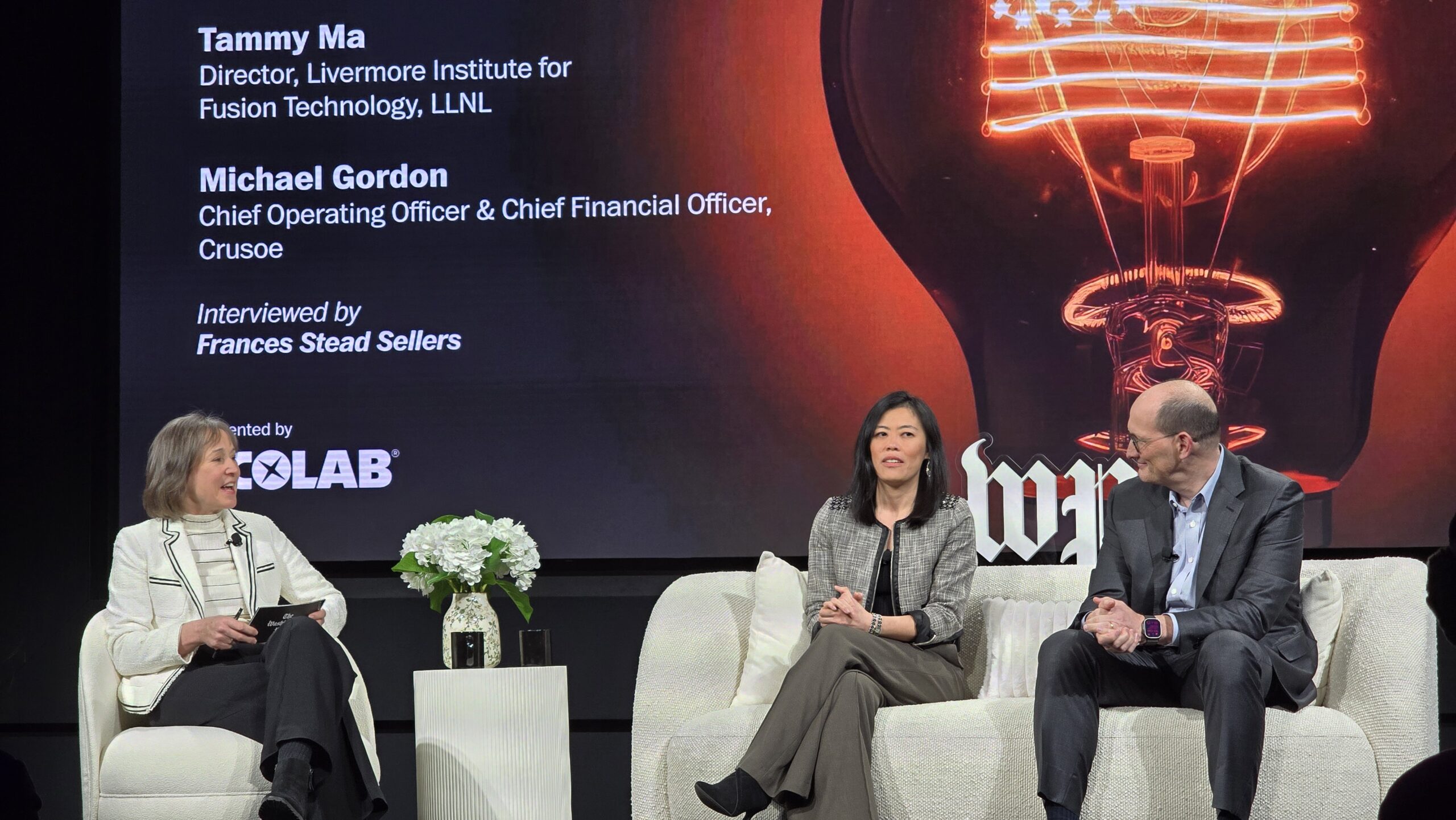
The explosion of artificial intelligence is no longer just a software revolution; it is rapidly becoming an industrial and infrastructural challenge of unprecedented scale. At The Washington Post’s Building America: Powering the AI Age summit in Washington, DC, Associate Editor Frances Stead Sellers sat down with two leaders at the absolute forefront of this energy puzzle: Tammy Ma, Director of the Livermore Institute for Fusion Technology, and Michael Gordon, COO and CFO of Crusoe.
From the vantage point of a technologist, this conversation highlighted a critical tension in our industry: the software capabilities of AI are advancing faster than our physical grid can support them. Solving this requires a dual-track approach, brilliant, immediate stopgaps to power today’s models, and moonshot scientific breakthroughs to power tomorrow.
Here are the key insights from their discussion on how we bridge the gap between AI’s voracious energy appetite and a sustainable future.
The Immediate Challenge: Rethinking the Data Center
Before the generative AI boom, data center energy requirements were relatively predictable. Today, the calculus has fundamentally changed. As Michael Gordon pointed out, the shift from standard cloud computing to accelerated AI computing requires a complete reimagining of scale.
“The quantum of compute power is just so different, and the energy intensity of that is very different than what we’re used to prior to the explosions in AI,” Gordon explained. “If you were talking about a data center, you would be talking in megawatts… Now we’re building gigawatt-scale campuses.”
To meet this demand, Crusoe has taken a remarkably pragmatic approach. Originally founded to harness “stranded energy”, such as flared methane gas in oil fields, to power Bitcoin mining, the company has pivoted its vast, decentralized energy infrastructure to power AI.
When the grid isn’t ready or available to support a gigawatt campus, technologists have to get creative. For Crusoe’s operations in Abilene, Texas, which ultimately serves end-users like OpenAI, this means building on-site natural gas plants as a cleaner, more reliable backup than traditional diesel generators.
Furthermore, Gordon addressed a major environmental concern regarding modern data centers: water consumption. As AI chips run hotter, traditional evaporative cooling strains local water supplies.
Crusoe is mitigating this by pioneering closed-loop systems. “We’re not having evaporation,” Gordon noted, explaining that the system uses a finite amount of water, roughly 12,000 gallons, or just over 10% of what an average American household uses annually, and recirculates it continuously.
The Long-Term Horizon: The Promise of Fusion
While Crusoe is finding ingenious ways to optimize today’s energy sources, Tammy Ma and her team at Lawrence Livermore National Laboratory are working on the holy grail of clean energy: fusion.
As AI adoption drives energy demand so high that the US is currently forced to lean back on carbon-producing sources like coal and natural gas just to keep up, fusion offers a vision of true energy sovereignty. “If we can harness it, it is clean, abundant, reliable, safe energy that can be kind of put out all over the world,” Ma stated.
The scientific feasibility of this is no longer just theoretical. Ma highlighted the historic 2022 breakthrough at the National Ignition Facility (NIF), where they achieved ignition, producing “more energy out of a fusion reaction than the energy that went into start it.” Not only was this milestone achieved, but it has since been repeated and amplified.
However, the leap from a laboratory breakthrough to a commercially viable grid source is steep. From a systems engineering perspective, the hurdles are immense. Technologists must now solve for:
- Material Science: Developing containment materials capable of withstanding the extreme conditions of a fusion reaction.
- Systems Integration: Harmonizing the fuel cycle, reactor walls, thermal extraction, and power conversion into a single, seamless plant.
- Supply Chain Scaling: Building a global supply chain for incredibly specialized, nascent technologies.
Bridging the Gap: The Technologist’s Takeaway
To successfully navigate the “Innovation Era,” we need both Crusoe’s immediate ingenuity and Livermore’s long-term vision.
| Strategy Focus | Crusoe (Michael Gordon) | Livermore Institute (Tammy Ma) |
| Time Horizon | Immediate to Near-term (0-10 years) | Long-term (10-20+ years) |
| Primary Methodology | Utilizing “stranded energy” and off-grid innovations | Commercializing nuclear fusion technology |
| Environmental Focus | Closed-loop water cooling, efficient natural gas bridges | Zero-carbon, universally abundant clean energy |
| Key Hurdle | Navigating zoning and scaling physical infrastructure | Material science, technology transfer, and ecosystem building |
Both leaders agreed that technology alone cannot solve the energy crisis; it requires robust public-private partnerships, international collaboration, and above all, regulatory consistency.
Gordon argued for a paradigm shift in how we view these massive AI campuses: “Defining or contemplating or considering sort of this AI structure as critical infrastructure… I think understanding the mission criticality, if you will, of the infrastructure is probably the most important thing.”
Meanwhile, Ma emphasized that technology transfer, moving research from government labs into the hands of the 55+ private fusion startups currently holding over $11 billion in funding—is a strategic imperative. “It will take committed continual public investment,” Ma warned, but she remains resolutely hopeful. “Science really helps to bring the world together… we can continue to strengthen our bonds over pushing society forward through technology.”
Despite the massive, gigawatt-sized hurdles ahead, the session concluded with a shared sentiment from both the public and private sectors: unwavering optimism. The brilliant minds flocking to both the AI and energy spaces suggest that while the challenges of the AI age are unprecedented, our capacity for innovation is more than ready to meet them.
For more information, please visit the following:
Website: https://www.josephraczynski.com/
Blog: https://JTConsultingMedia.com/
Podcast: https://techsnippetstoday.buzzsprout.com
LinkedIn: https://www.linkedin.com/in/joerazz/
Leave a Reply
You must be logged in to post a comment.