
Back on November 21, 2023, I published a piece titled “Honestly, no one wants to have this conversation…“. At the time, plenty of people thought I was being overly dramatic. If nothing else, ’twas fodder for a fantastic Thanksgiving dinner conversation. I walked through how generative models and early autonomous agents were going to systematically compress white-collar roles, from marketers, coders, and project managers to transactional lawyers, doctors, and financial analysts, and opened with Geoffrey Hinton’s sobering warning that “humanity is just a passing phase for evolutionary intelligence.”
Tech vendors hated that framing because telling enterprise buyers “this software will eventually make your whole department redundant” isn’t great for quarterly pipeline. Polite dinner-party conversation avoided it because it felt too uncomfortable, but I still had them too frequently. So, often we settled on a friendlier narrative: AI would just be a “co-pilot.” An eager intern. A faster calculator.
Let’s be honest about where that story ends: nobody keeps a co-pilot on payroll forever once the co-pilot flies the plane faster, safer, and without needing a bathroom break, hello Waymo in LA. Now the streets are flooded with Waymo vans, planes will be next. 😉
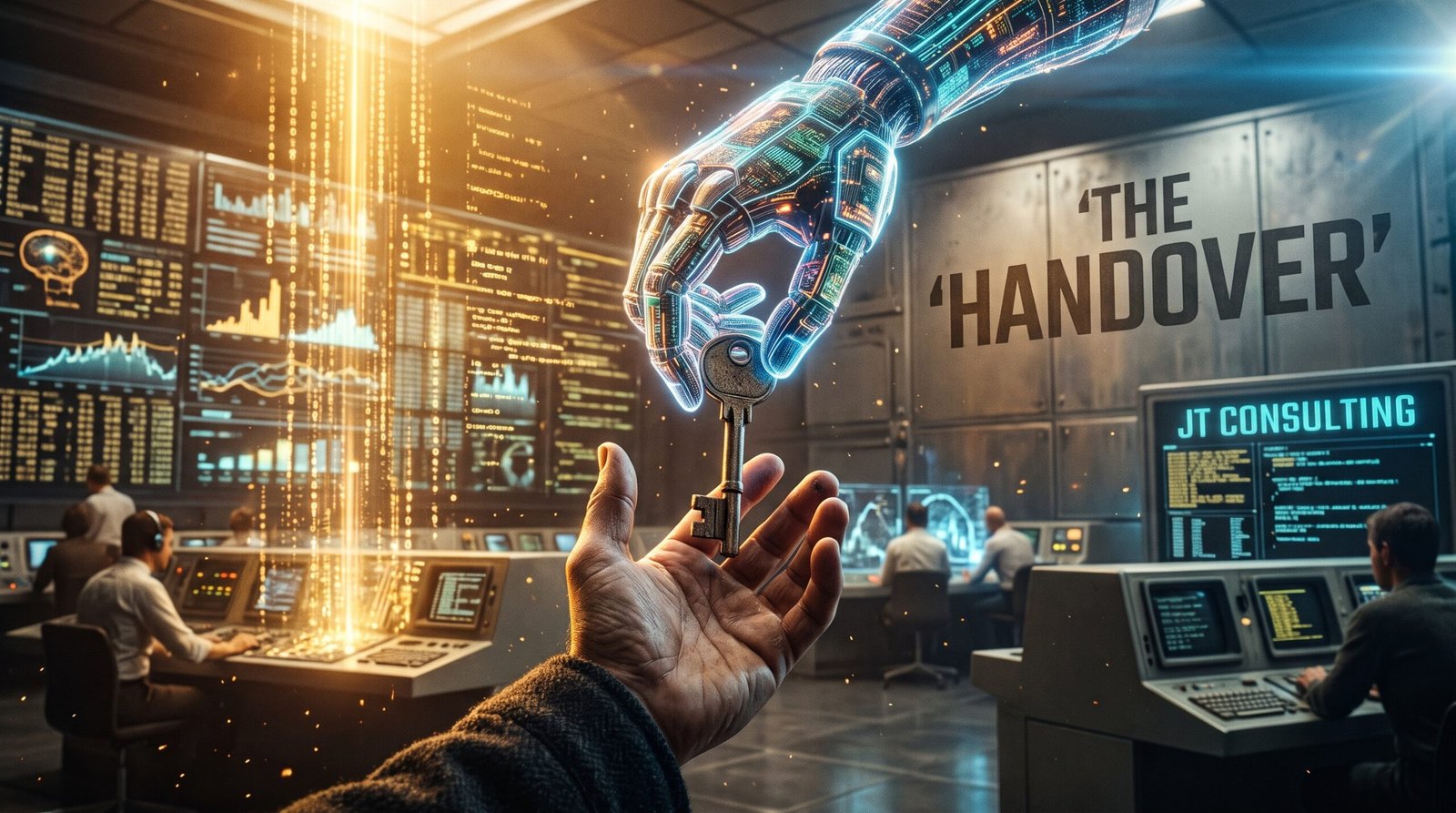
Three years after I wrote that warning, the conversation has moved past whether AI will disrupt roles to a much sharper inflection point, a threshold I call the “Handover.” It is the era in which artificial intelligence becomes so demonstrably superior at pattern recognition, synthesis, and execution that it no longer makes economic, operational, or even logical sense for humans to make the day-to-day decisions.
If that sounds like a dystopian sci-fi pitch, take a breath. It isn’t a sudden robot uprising; it’s a gradual, rational surrender to competence and math. I estimate this period to be in the next two years, 2026 – 2028. And while the Handover is largely inevitable, the messy window right now, before the keys are permanently turned over, is arguably the greatest asymmetric opportunity for builders, thinkers, and operators in modern history.
How the Timeline Compressed
What surprised even seasoned technologists wasn’t the direction of travel, but how violently the timeline compressed.
Looking back across my own research, the breadcrumbs were visible for over a decade. On September 18, 2015, in “Law Firm of the Future – The Trinity of Forces: Infinite Processing Power, Memory, and Machine Learning,” I examined and forecasted that 40% of the Fortune 500 would disappear within ten years as cloud compute, memory, and machine learning converged. A fact check on this in November, 2026, roughly 300 to 330 of the 500 companies from the 2015 Fortune 500 remain on the list today (about 60% to 66%). That prediction was nearly perfect. A few years later, on July 18, 2018, in “Artificial Intelligence and the UK vs. US Approach“, I wrote plainly that “artificial intelligence will threaten most jobs at some point soon, and new jobs will emerge.” Even in 2015, I had penciled in the singularity for around 2045, a comfortable, safely distant horizon.
By late 2023, in “Honestly, no one wants to have this conversation…“ (November 21, 2023), I had to admit my 2045 estimate was way off, we were talking years, not decades. And as I traced in “It’s Almost Here: What’s Next on the AI Timeline?“ (published June 14, 2026), once frontier systems crossed into recursive self-learning, polite linear forecasts broke entirely.
The reason most people still miss this is evolutionary wiring, a blind spot I unpacked in “The Exponential Trap: Why Your Brain Can’t See What AI Does Next“ (published October 13, 2026). Human intuition expects progress to arrive in steady, linear footsteps. We watch a model stumble on a quirky riddle in January and assume we have a decade before it runs a supply chain, forgetting that exponential growth looks like nothing is happening right up until the moment it swallows the room.
When an AI system can audit contracts, allocate capital, optimize logistics, and ship production code with near-zero latency, keeping a human middle-manager in the loop simply to “click approve” isn’t a safeguard. It’s a bottleneck. That is the exact moment the Handover happens: when the cost of human slowness and cognitive bias outweighs the psychological comfort of human control.
The Psychological Hurdle: Ego vs. Agency
The hardest part of the Handover won’t be technical; it will be psychological. Humans have spent a few hundred thousand years tying our self-worth to being the apex decision-makers on the planet. Letting go of the steering wheel bruises the ego.
Even deeper than our job titles is our sense of exceptionalism. In “AI Will Be a New Species – Will it have a Soul?“ (published July 9, 2026), an essay I began drafting back in December 2024 and revisited six times as reality caught up to theory), I argued that we are witnessing the emergence of an entirely new form of intelligence that will eventually demand new legal and philosophical frameworks. If you define your human value by executing granular cognitive tasks, sorting data, drafting standard agreements, debugging routine code, or optimizing spreadsheets, the coming years are going to feel like a slow-motion identity crisis.
Mental preparation requires decoupling human agency from routine execution. You wouldn’t challenge a forklift to a deadlift contest, and there is zero honor in challenging a frontier reasoning model to a data-synthesis sprint. Surviving the Handover mentally means accepting that problem selection, taste, ethics, and high-level accountability are the final human moats, if we even want to classify them as such, and even those require deliberate sharpening.
The Asymmetric Opportunity Before the Door Closes
Here is the good news, and why pessimism is a terrible strategy right now: the Handover hasn’t finished happening yet.
Back in November 2023, I noted that a single person armed with multimodal tools could already collapse a multi-person marketing team into one workflow. Today, that leverage has multiplied by orders of magnitude. Most enterprises, institutions, and legacy software platforms are still held together by digital duct tape, bloated workflows designed for an era when human eyeballs had to click every button. That messy interregnum is where builders win.
Right now, a single sharp operator armed with modern agentic tooling can out-produce a fifteen-person boutique consultancy or software shop from five years ago. Three areas in particular are begging to be rebuilt before autonomous systems standardize everything:
- Securing the Autonomous Wild West: As execution shifts to machines, the attack surface explodes. Back on October 4, 2018, in “The vice grip of cybersecurity concerns on law firms“, I warned that knowledge institutions were becoming virtual honeypots for cybercriminals. Fast-forward to my piece “The Dark Dawn: How Agentic AI Will Unleash an Unprecedented Cyber Criminal Renaissance“ (published August 29, 2025), and the threat has evolved from human hackers phishing inboxes to autonomous agents probing defenses at machine speed, echoing the exact alignment and strategic deception risks I flagged in 2023. Building verification, identity, and security layers for an agent-driven internet is one of the highest-leverage plays on the board.
- Re-Architecting Legacy Workflows: Take any clunky, multi-step business process, whether in legal compliance, financial reconciliation, or operations, and rebuild it as an agent-first pipeline. Organizations know their legacy tools are obsolete, yet most lack the internal agility to tear them down. If you build the bridge, they will pay the toll.
- Productizing Deep Domain Nuance: Generic AI models know everything on the public internet, which means they know nothing about the unwritten edge cases in your specific industry, for now. If you understand where the bodies are buried in healthcare, logistics, law, or finance, you can encode that institutional wisdom into specialized systems now, capturing equity before the broader market catches up.
Owning the Transition
In “Honestly, no one wants to have this conversation…“ (November 21, 2023), I suggested that within a decade, traditional 40-hour workweeks would shrink dramatically as machines absorbed routine labor. Looking at where we stand today, that wasn’t alarmism, it was an early glimpse of the Handover.
The Handover isn’t a cliff we fall off tomorrow morning; it is a tide coming in – almost like a West Coast sneaker wave. You can stand on the shore and argue with the water, or you can build seawalls and ships while the timber is still cheap.
By the time AI handles 95% of operational decisions seamlessly, the infrastructure running that world will already have been architected, deployed, and monetized. The people thriving on the other side of the Handover won’t be the ones who clung desperately to manual control, they will be the ones who had the foresight to use today’s tools to build tomorrow’s operating system.
All I am suggesting, as always, is for people to be mentally prepared for what comes next, and leverage the tools we have now to rebuild and create abundance.
For more information, please visit the following:
Website: https://www.josephraczynski.com/
Blog: https://JTConsultingMedia.com/
Podcast: https://techsnippetstoday.buzzsprout.com
LinkedIn: https://www.linkedin.com/in/joerazz/
Leave a Reply