
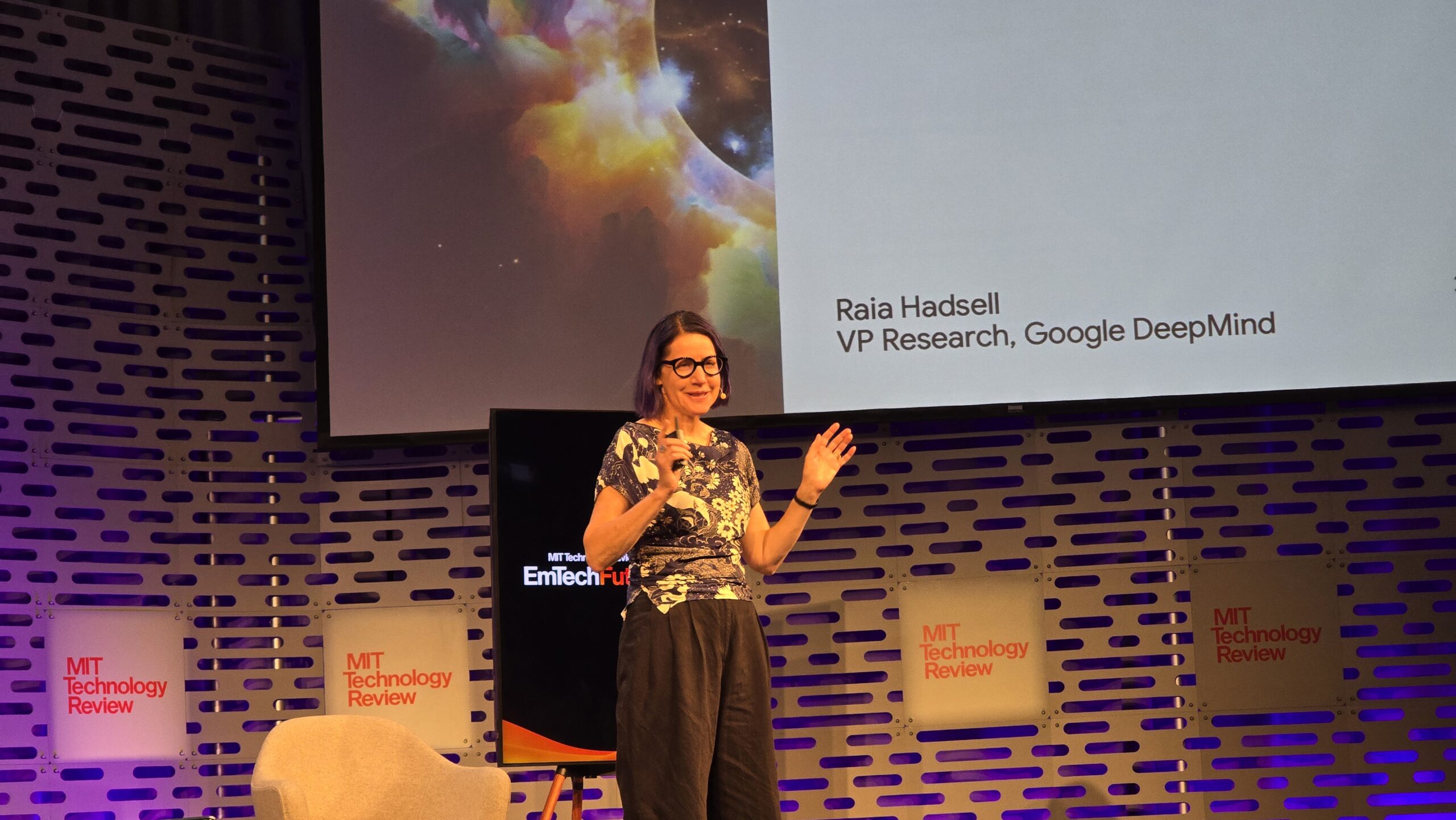
Cambridge, MA – MIT Media Lab – EmTech Future. For all the cultural excitement surrounding generative text and conversational chatbots, modern language models remain fundamentally tethered to human prose. They predict the next token based on things humans have already written down. But nature does not write memos. The atmospheric circulation driving supercells, the delicate migration pathways of endangered ecosystems, and the kinetic physics of a robot moving through a cluttered room operate under physical laws that flat text cannot capture.
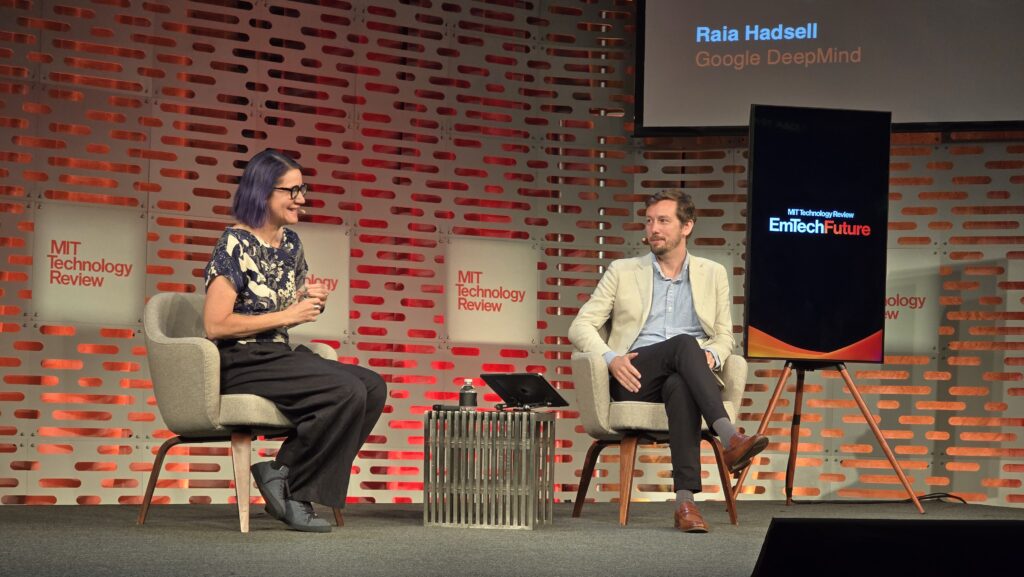
In the keynote session titled The Industrialization of Intelligence, Raia Hadsell, Vice President of Research at Google DeepMind, made the case that computing has outgrown simple text prediction. Introduced by MIT Technology Review executive editor Gideon Lichfield, Hadsell, who directs over a thousand researchers across the globe, outlined DeepMind’s push into two frontier fields: planetary-scale graph neural networks and interactive, physics-grounded world models.
Modeling the Living Earth with Spherical Graph Networks
Predicting planetary weather patterns is one of the most complex computational problems in human history, directly driving billions of economic decisions across global agriculture, aviation logistics, renewable power grids, and disaster relief. For over half a century, meteorology relied entirely on numerical physics models run on massive supercomputers, taking real-time sensor updates every six hours to calculate fluid equations across atmospheric grids.
Hadsell unveiled the internal architecture of DeepMind’s latest breakthrough: WeatherNext 3. Moving beyond standard numerical grids, WeatherNext 3 uses a massive graph neural network (GNN) structured as a spherical 3D mesh enclosing the planet, with multi-layer nodes spanning the Earth’s surface up to the edge of the stratosphere.
By coupling ground station telemetry with real-time multi-spectral satellite imagery, the model reads cloud formations that classical physics models struggle to incorporate.
The operational leap over older benchmarks is stark:
- Hourly Forecast Updates: Unlike traditional models that recalculate every six hours, WeatherNext 3 generates fresh global forecasts on an hourly basis, delivering fine-grained regional predictions across fifteen-day horizons.
- Hyper-Local Precipitation: Predicting rainfall has historically been a major meteorological blind spot. WeatherNext 3 improved precipitation forecast accuracy by up to 50 percent, resolving micro-fronts that drive severe urban flash flooding.
- Unprecedented Hurricane Lead Times: During Hurricane Melissa, WeatherNext 3 accurately predicted that the storm would rapidly intensify into a devastating Category 5 system prior to its Jamaica landfall five days in advance, giving emergency authorities critical preparation time that saved lives.
DeepMind is expanding this graph architecture beyond meteorology into a comprehensive digital model of Earth’s ecosystems. Hadsell demonstrated a planetary biodiversity model that processes millions of environmental, botanical, and climate variables simultaneously to predict localized species distributions for birds, plants, and insects across the United Kingdom, achieving spatial accuracy far beyond traditional ecological surveys.
Genie 3: Interactive World Models and Synthetic Physics
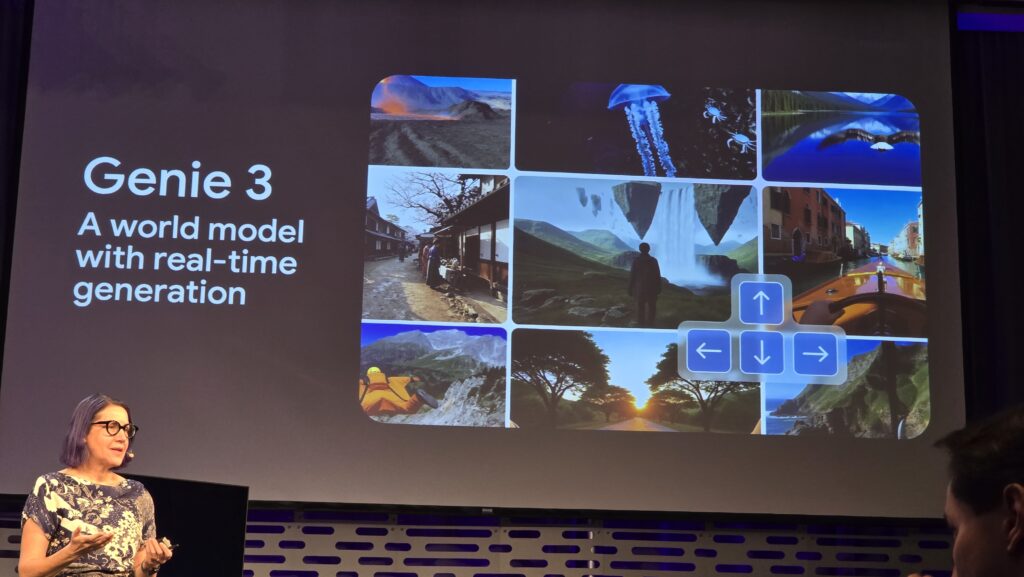
The conversation then shifted from planetary science to real-time simulation. Hadsell introduced Genie 3, a world model that marks a clear break from standard video generation tools.
Commercial video models like Sora or Runway generate impressive video clips, but those outputs are static, non-interactive recordings that run along a single, predetermined visual track. You cannot walk through the frame, alter the environment, or bump into an object to test its physical friction.
“A world model needs to pass a much higher bar of being able to encode physics that you can interact with. It is not just playing out a single scene, a single trajectory in the world that is very realistic like a video model, but it is actually that it learned the whole physics, all of the interactions that could happen within this space.” – Raia Hadsell
Genie 3 functions as a real-time, interactive environment engine generated on the fly from a simple prompt. A user can type a text description, such as a cobblestone lane in Kent during a rainstorm, and step directly into the scene using keyboard controls, walking around corners, seeing puddles splash realistically, and observing environmental reflections respond dynamically to movement.
By incorporating Imagen 3 in the loop, users can pause the simulation, sketch adjustments onto the scene, like drawing a winter theme or dropping in obstacles, and restart the world engine with updated physics instantly.
For physical robotics, world models provide an indispensable development tool. Human beings navigate physical spaces effortlessly because our minds run continuous, subconscious world models that simulate footing, friction, and balance with every step. By training robotic systems inside responsive, physics-grounded simulators like Genie 3, robots can safely explore edge-case hazards and master manipulation dynamics long before deploying in the physical world.
The Limits of Compute and the Fallacy of Flat LLMs
Addressing the ongoing debate over foundation model scaling, Hadsell dismissed assertions that large language models have hit a permanent wall. The critical breakthrough is that language models are becoming proficient programmers.
Because human infrastructure runs on code, from factory machinery to communications networks, models that write reliable code can execute actions with real-world impact.
The primary barrier to deploying real-time world models for consumer and educational applications remains compute availability. Simulating complex physical environments in real time requires immense GPU resources.
However, Hadsell noted that each generational jump, from Genie 2 to Genie 3, delivers major efficiency gains. She projected that within several years, specialized world models will run efficiently on consumer-grade hardware, transforming education by letting students explore ancient civilizations or travel through human blood vessels in interactive simulations.
Key Takeaways
- Beyond Text-Based Tokens: Frontier artificial intelligence is moving beyond language models toward spatial graph architectures and interactive world models grounded in physical dynamics.
- Spherical Graph Neural Networks: DeepMind’s WeatherNext 3 runs a continuous 3D planetary mesh that incorporates satellite data to provide hourly weather updates across fifteen-day horizons.
- Critical Life-Saving Forecasts: Early storm modeling enabled WeatherNext 3 to forecast Hurricane Melissa’s jump to Category 5 intensity five full days before landfall.
- Real-Time Physics Environments: Genie 3 generates interactive virtual worlds that adapt dynamically to user inputs, maintaining spatial consistency and physical friction.
- Accelerating Robotic Training: Grounding robots inside interactive world models allows machines to practice complex physical interactions in simulation before deploying onto factory floors.
Looking Forward
The expansion of artificial intelligence into planetary sensing and interactive world modeling offers an exciting, deeply inspiring glimpse of the future of computing. We are moving beyond static software and flat screens into an era of adaptive, interactive simulation engines. The ability to simulate physical systems with fine precision will transform weather prediction, ecosystem protection, hardware engineering, and education. Significant engineering hurdles remain in scaling compute infrastructure, reducing power demands, and building robust safety rails to prevent deepfake synthesis. Yet the trajectory is unmistakable: intelligence is expanding from reading words on a page to understanding and modeling the physical dynamics of our universe.
Call to Action: Engineering teams and educators should explore Google DeepMind’s open research models, incorporating interactive spatial simulation and graph-based data architectures into their technical workflows.
For more information, please visit the following:
Website: https://www.josephraczynski.com/
Blog: https://JTConsultingMedia.com/
Podcast: https://techsnippetstoday.buzzsprout.com
LinkedIn: https://www.linkedin.com/in/joerazz/
Leave a Reply
You must be logged in to post a comment.