
Cambridge, MA – MIT Media Lab – EmTech Future. This talk was mind altering. For four decades, the MIT Media Lab has served as an intellectual sanctuary for wild ideas, unconventional prototypes, and iconoclastic thinkers who refuse to fit into neat academic categories. In the session titled The Human Frontier, introduced by Media Lab Director Jessica Rosenworcel and moderated by MIT Technology Review’s Casey Crownhart, four researchers presented an inspiring vision of our shared biological and computational future: Hugh Herr, Paul Pu Liang, Deblina Sarkar, and Pat Pataranutaporn.
The message connecting their work was clear: technology must transcend raw computational benchmarks. Whether engineering robotic limbs, injecting wireless nanoscale chips into the brain, coordinating multi-agent systems, or measuring emotional health, technology must be designed to expand human capability and well-being.
The Transition from Tool to Embodiment
Hugh Herr, Professor of Media Arts and Sciences and co-director of the K. Lisa Yang Center for Bionics, opened with a fundamental philosophical distinction: the difference between using a tool and experiencing embodiment.
For thousands of years, prosthetic devices, from ancient Egyptian wooden toes to modern carbon-fiber blades, have functioned strictly as passive mechanical tools. Herr, a double amputee himself, walked onto the stage wearing bionic legs governed by localized microprocessors. Yet, as he was quick to note, even those advanced legs are controlled by onboard algorithms, not by his direct neurological intent.
To cross that final frontier, Herr’s lab pioneered the Agonist-antagonist Myoneural Interface (AMI). By surgically reconnecting opposing muscle pairs during amputation, the system preserves natural biological proprioception.
When the user moves their phantom limb, the muscle pairs contract dynamically, firing neural signals that are decoded by sensors and translated into robotic joint torque in real time. Crucially, the feedback loop is bidirectional. By implanting cutaneous mechanoneural interfaces (CMIs), physical contact on a robotic foot stretches transplanted skin cells in the residual limb, enabling patients to feel the texture of the ground underfoot.
“When your brain controls it and you can feel it, it becomes you. It does not matter the materials of the body part. This is very different than tool use. We are going into a new era of embodiment with technology.” – Hugh Herr
Herr highlighted commercial spinouts like Dephy and partnerships with Nike (Project Amplify) that adapt this technology into motorized, robotic calf footwear designed to restore youthful gait to older adults and augment long-distance runners. Looking further out, Herr envisioned individuals using neural links to control remote robotic systems anywhere on Earth or across the solar system, projecting their physical presence across vast distances.
Nanoscale Circulatronics: Brain Interfaces Without Surgery
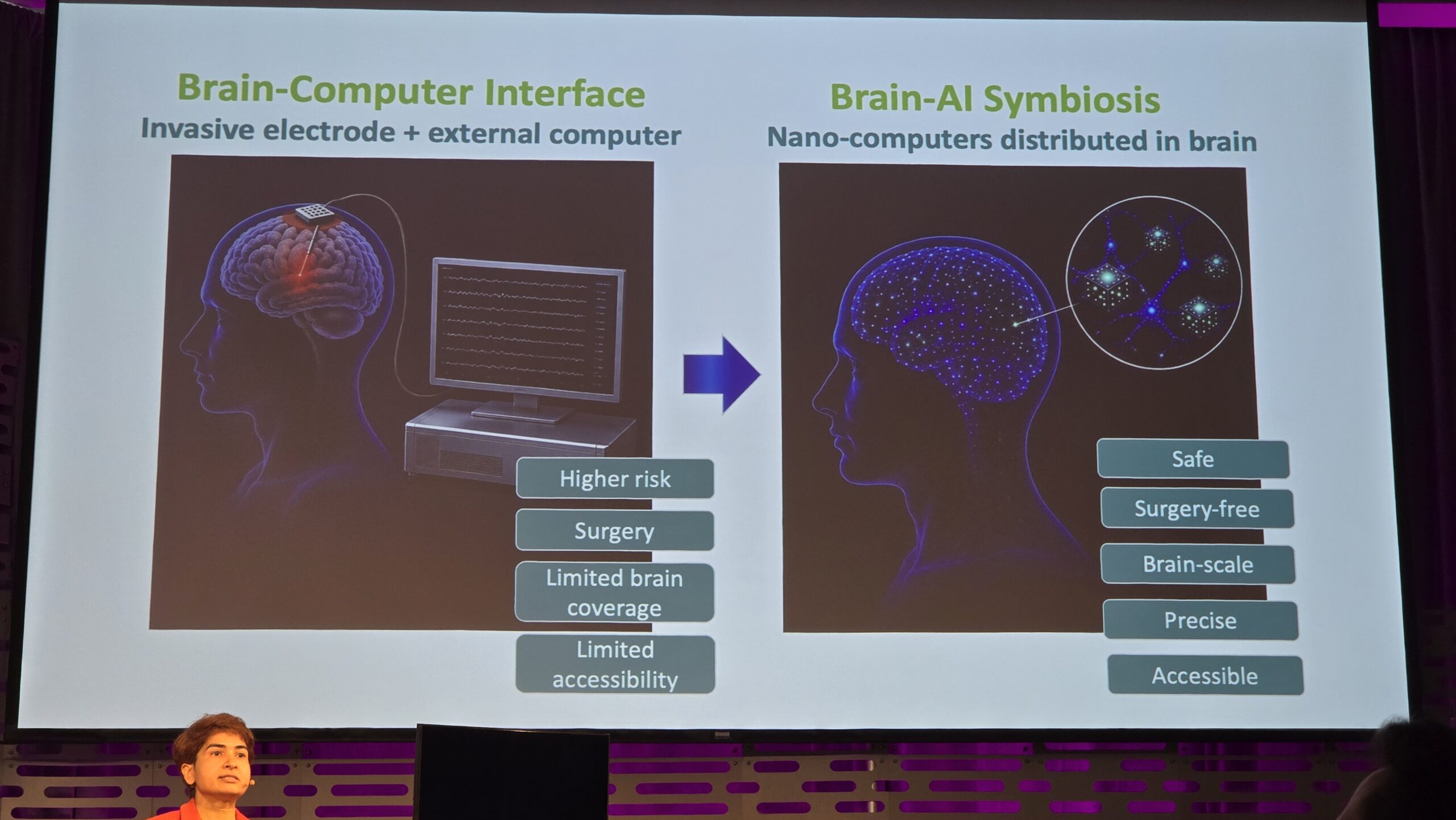
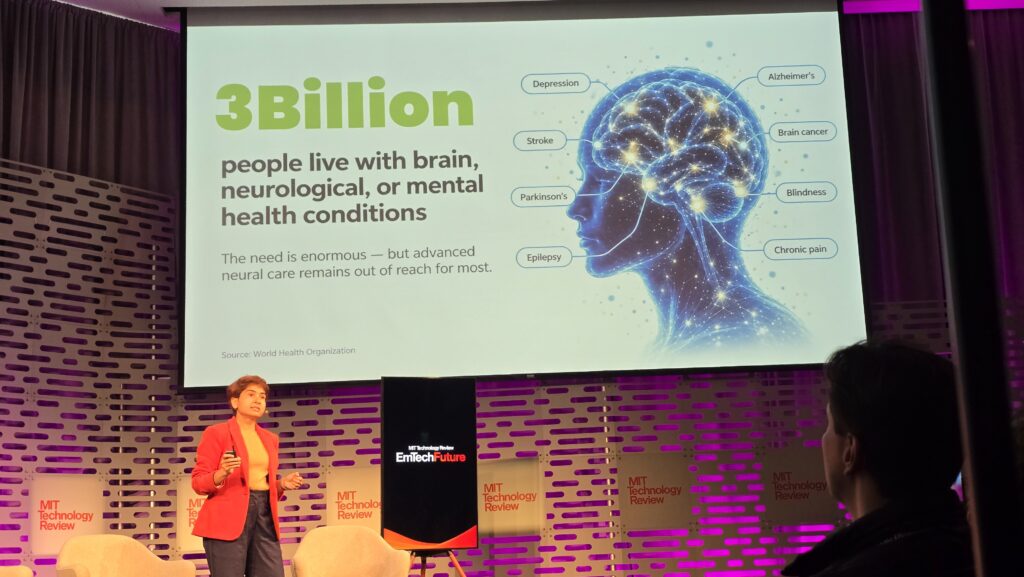
Deblina Sarkar, Associate Professor at MIT and director of the Nano-Cybernetic Biotrek Lab, tackled neural interfaces from an entirely different angle: eliminating brain surgery altogether. Over three billion people worldwide suffer from neurological conditions, yet existing brain-computer interfaces (BCIs) require invasive craniotomies, drilling through bone to implant rigid silicon probes that trigger severe tissue inflammation and cost hundreds of thousands of dollars.
Sarkar’s lab pioneered circulatronics: sub-cellular, wireless nanoelectronic chips a billion times smaller than a grain of rice. By fusing these nanoscale chips with living biological cells, the team created cell-electronic hybrids that can be injected directly into the bloodstream.
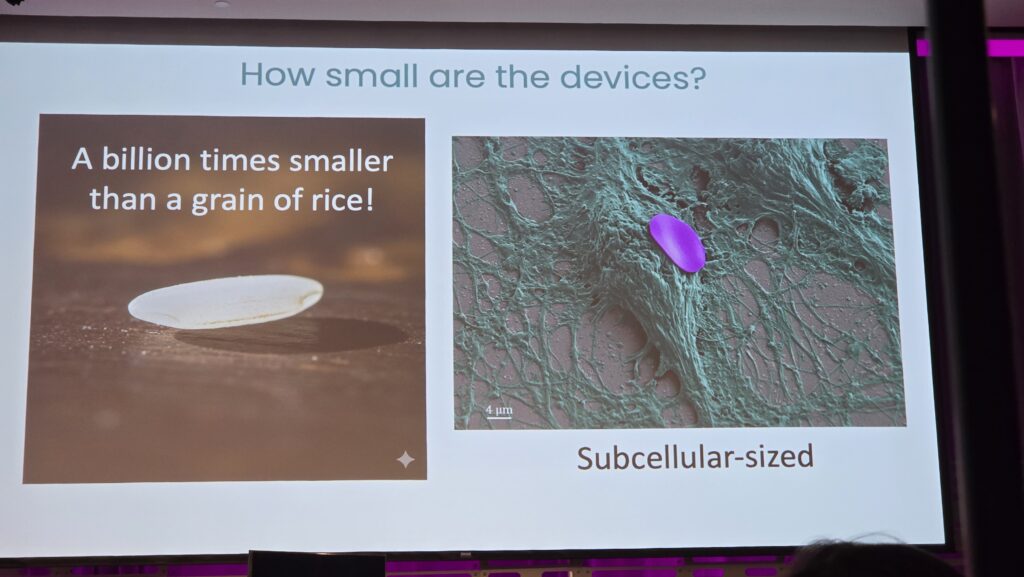
These hybrid devices circulate through the bloodstream, cross the blood-brain barrier intact, home in on diseased brain tissue, and lodge autonomously alongside neurons to deliver targeted electrical stimulation with 30-micrometer precision. In preclinical models of glioblastoma developed with the Mayo Clinic, this bioelectronic therapy extended median survival by more than 50 percent. Sarkar recently co-founded Caohira Technologies to advance this technology into human clinical trials within three years, laying the groundwork for a future where neural interfaces are delivered as easily as a standard vaccination.
Recursive Self-Evolution and the Nutrition Label for AI
The session then shifted toward artificial cognitive systems and human health. Paul Pu Liang, Assistant Professor of Computer Science at MIT, detailed his team’s work on self-evolving systems like Reef, Coral, and Mem-1. Rather than locking models into static weights, Liang builds systems that recursively optimize their context windows, update internal parameters, and coordinate cooperative multi-agent networks to solve difficult engineering tasks.
Pat Pataranutaporn, Assistant Professor and director of the Cyborg Psychology research group, addressed the psychological impact of these systems. Pataranutaporn argued that the technology industry has obsessed over benchmark performance while ignoring the impact on human well-being. Excessively agreeable chat agents can foster psychological dependence, while overly capable models can induce cognitive atrophy, homogenizing independent human thought.
To solve this, the Media Lab developed an open benchmark that functions like a nutritional label for AI. By simulating diverse conversational scenarios across 800 multidisciplinary metrics, the framework evaluates models on real human outcomes: does this system support critical thinking and agency, or does it encourage addiction, sycophancy, and anxiety?
Key Takeaways
- The Embodiment Breakthrough: Bidirectional neural interfaces (AMI and CMI) allow patients to control bionic limbs and perceive real physical sensation, transforming prosthetics from external tools into an integrated part of the physical self.
- Surgery-Free Neural Nanotechnology: Circulatronics combines wireless microchips with living cells to cross the blood-brain barrier via simple injection, eliminating the trauma of invasive brain surgery.
- Bioelectronic Oncology: Injectable nanoelectronic devices can deliver localized electrical stimulation to malignant glioblastoma cells, extending median survival by over 50 percent in preclinical trials.
- Recursive Multi-Agent Learning: Open-source architectures like Reef combine inference with asynchronous training, allowing agent swarms to improve their reasoning dynamically without offline downtime.
- The AI Nutrition Label: Evaluating models must expand beyond technical capability to benchmark social and emotional impact, measuring whether tools foster independent judgment or fuel dependency.
Looking Forward
The work showcased on the Media Lab stage offers a hopeful, deeply human vision for deep technology. For decades, popular culture has framed the fusion of biology and computing with dystopian unease. Yet the breakthroughs demonstrated by Herr, Sarkar, Liang, and Pataranutaporn suggest a far more uplifting horizon: a world where paraplegic individuals walk with direct neurological control, terminal brain cancers are treated with simple outpatient injections, and software agents are engineered to nurture human creativity and agency. Realizing this future requires uncompromising technical excellence, open-source transparency, and an ethical commitment to accessible healthcare. The ultimate measure of technology is not how far it outstrips human capability, but how effectively it helps humanity heal, grow, and flourish.
Call to Action: Clinicians, hardware engineers, and software architects should actively back open-source, non-invasive bioelectronic initiatives, while applying human flourishing benchmarks to evaluate the models they deploy.
For more information, please visit the following:
Website: https://www.josephraczynski.com/
Blog: https://JTConsultingMedia.com/
Podcast: https://techsnippetstoday.buzzsprout.com
LinkedIn: https://www.linkedin.com/in/joerazz/
Leave a Reply
You must be logged in to post a comment.