
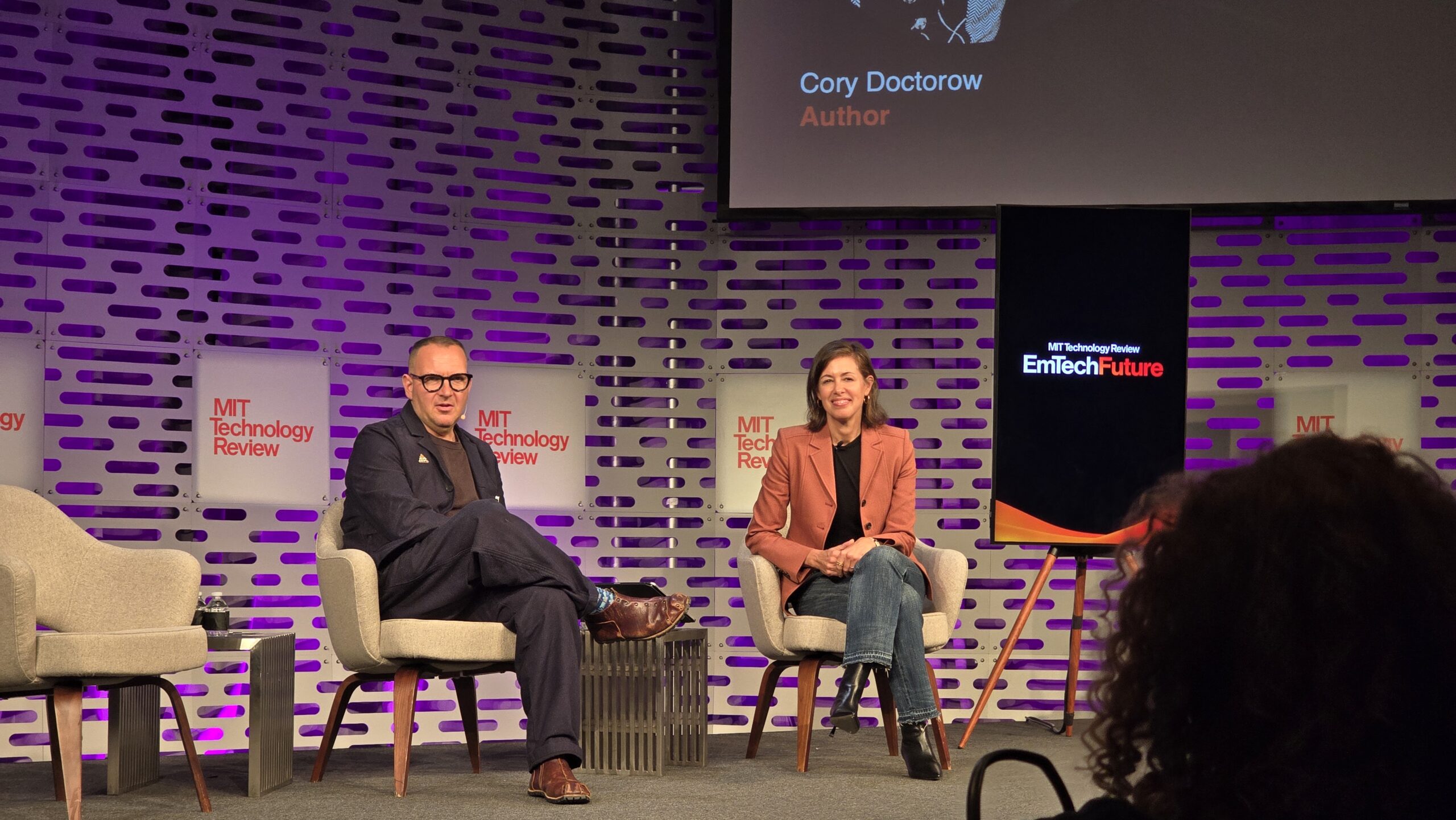
Cambridge, MA – MIT Media Lab – EmTech Future. Few cultural critics can diagnose digital rot with the ferocious precision, moral clarity, and linguistic flair of Cory Doctorow. Taking the stage for the session titled Rethinking Our Relationship with AI, Doctorow, an activist, author, and special advisor to the Electronic Frontier Foundation, was interviewed by Jessica Rosenworcel, fellow at the MIT Media Lab and former chairwoman of the Federal Communications Commission. What followed was not a boilerplate meditation on machine intelligence, but an incisive post-mortem on corporate monopoly, worker disempowerment, and the systemic decay of platform capitalism.
Doctorow began by admitting that writing his latest book on artificial intelligence felt like a massive blunder, if only because he was weary of being asked about technology that he views primarily as an intriguing computational parlor trick rather than an existential transformation of the human condition. The real story is not about algorithmic silicon. The real story is about power.
The Centaur Versus the Reverse Centaur
To understand where automation actually lands in the workplace, Doctorow reached into classical automation theory to contrast two divergent archetypes: the centaur and the reverse centaur.
In classical mythology, the centaur is half human and half horse. In operational design, a centaur system pairs human intellect with machine horsepower. The human brain sits on top, exercising discernment, professional taste, and ethical judgment, while the machine functions as a tireless physical engine. A cyclist riding a road bike is a centaur; an experienced radiologist using a computer-vision model to highlight suspicious micro-calcifications on a mammogram is a centaur. The human chooses to use the tool, directs the workflow, and retains absolute agency over the outcome.
Then comes the reverse centaur. Here, the dynamic flips entirely. The machine is the boss, and the human is degraded into a meat peripheral, conscripted to serve the pacing of the algorithmic core.
“Warehouses are the most automated workplaces we have ever seen, and they have the highest rate of injuries, triple the national average. That is not a coincidence. It is the consequence of a seven-figure automation upgrade where you do not want to starve the asset. And since the slowest piece is the human, the human is worked as fast as they can go… If you make a mistake, you get crushed by a forklift.” – Cory Doctorow
This explains the modern programmer paradox. One coder celebrates generative AI because they use it as an assistant to rapidly prototype personal ideas. Another programmer watches nine of their colleagues get laid off, and is suddenly ordered by management to review ten thousand lines of machine-generated code every afternoon. That second engineer is not an augmented worker; they are an accountability sponge, paid to rubber-stamp statistically plausible hallucinations and absorb the liability when the codebase explodes in production.
Enshittification and the Locked-In Trap
Doctorow connected this labor crisis directly to his celebrated diagnosis of platform decay: enshittification. Platforms begin by being good to their end users to build network effects. Once consumers are captive, platforms monetize their attention to attract business suppliers. Once businesses are dependent, the platform extracts value from both ends, maximizing margins for executives and shareholders while degrading service quality into sludge.
The critical driver of this decay is not natural economic evolution, but explicit legal and regulatory architecture. Doctorow pointed to Section 1201 of the Digital Millennium Copyright Act of 1998, which made it a legal violation to bypass digital locks or reverse-engineer commercial software without the manufacturer’s permission.
This legal shield protects rent-seeking monopolies from market discipline. An entrepreneur cannot sell a low-cost, third-party printer ink cartridge without risking a federal lawsuit, enabling printer companies to charge ten thousand dollars a gallon for ink. Rivals cannot launch an alternative app store on a closed smartphone ecosystem. Big Tech giants run massive stock buybacks rather than innovating, safe in the knowledge that users, advertisers, and workers have nowhere else to run.
Restoring Adversarial Interoperability
Doctorow rejected the toothless regulatory remedies that rely on subjective, bureaucratically impossible content moderation rules. Trying to police speech online creates an administrative nightmare that bogs agencies down in endless litigation.
Instead, Doctorow championed clear, bright-line structural remedies that restore market competition and consumer freedom:
- Mandatory Protocol Interoperability: Legally oblige dominant platforms to allow users to leave while remaining connected to their social graphs. If telecom networks were forced to allow seamless communication between rival carriers decades ago, social messaging platforms should be legally compelled to expose open APIs.
- Safe Harbors for Reverse Engineering: Protect independent developers and startups that create interoperability bridges, wrappers, and security extensions from intellectual property lawsuits.
- End-to-End Delivery Rights: Outlaw platform throttling and search manipulation. If a user follows a creator, the creator’s posts must appear in their feed without requiring the creator to pay payola boosts. If a consumer searches for a specific merchant or SKU on an e-commerce platform, the exact product match must appear first, rather than a sponsored advertisement running 29 percent more expensive.
Key Takeaways
- The Power Divide in Workplace Tech: Technology deployment improves work life only when workers hold the agency to direct its use; when management imposes automation from above, it routinely degrades human workers into high-stress liability sponges.
- The Reverse Centaur Problem: Automated warehouses and automated software suites often speed up physical workflows past safe human limits, elevating catastrophic injury rates and severe cognitive fatigue.
- DMCA Section 1201 as a Monopoly Moat: Anti-circumvention laws prevent competitors from reverse-engineering complementary goods, cutting off legitimate market competition and consumer repair rights.
- Structural Remedies Over Content Policing: Regulatory agencies must enforce interoperability and API access rather than attempting subjective, impossible content moderation schemes.
- Eliminating Digital Hostage-Taking: Mandating open data portability and communication across competing platforms eliminates predatory lock-in, forcing tech platforms to compete on service quality again.
Looking Forward
Doctorow’s prognosis is rooted in active, hard-nosed political struggle rather than passive techno-optimism. If corporate boards remain free to spend hundreds of billions of dollars constructing speculative compute clusters and financial engineering buybacks while gutting skilled labor, our digital tools will become increasingly brittle, exploitative, and extractive. Yet, hope persists precisely because this sclerotic monopoly state was engineered through human policy, which means it can be dismantled through human policy. By revitalizing antitrust enforcement, protecting reverse engineers, and demanding strict interoperability, society can break the monopoly stranglehold on computing. The future of technology should not consist of digital walled gardens that harvest human attention; it must be an open, competitive landscape where machines serve human workers, not the other way around.
Call to Action: Technologists, legal scholars, and engineers must actively organize within their organizations, build open-source interoperability bridges, and lobby lawmakers to amend DMCA Section 1201 to legalize reverse engineering.
For more information, please visit the following:
Website: https://www.josephraczynski.com/
Blog: https://JTConsultingMedia.com/
Podcast: https://techsnippetstoday.buzzsprout.com
LinkedIn: https://www.linkedin.com/in/joerazz/
Leave a Reply
You must be logged in to post a comment.