
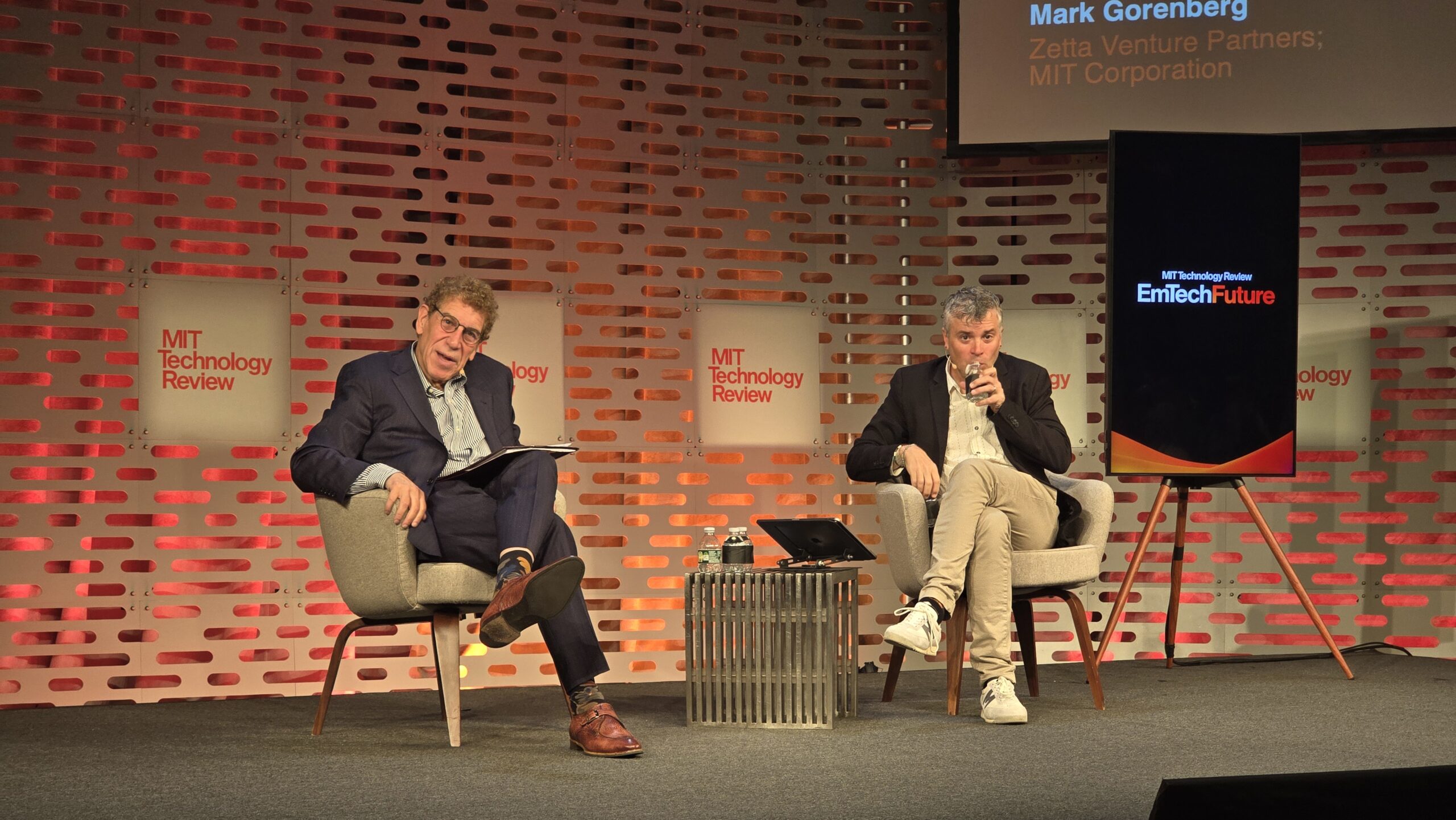
Cambridge, MA – MIT Media Lab – EmTech Future. A profound structural shift is underway inside advanced research laboratories, and it has almost nothing to do with generating conversational marketing copy. In the session titled Designing the Future, Bob Metcalfe, legendary Ethernet co-inventor and chair of the MIT Corporation, sat down with prominent venture investor Mark Gorenberg, founder and managing director of Zetta Venture Partners, to discuss the technological convergence reshaping scientific discovery. Introduced by MIT Technology Review’s editor-in-chief Mat Honan, Gorenberg delivered a compelling insider analysis of the venture and technical forces re-anchoring the software universe.
Gorenberg laid out a clear argument: the tech industry has over-indexed on the consumer dazzle of standard pre-trained foundation models. While the launch of ChatGPT in late 2022 captured the cultural imagination, the true inflection point arrived with the emergence of reasoning models. Moving beyond next-token guessing games into deliberate, multi-step inference chains is fundamentally disrupting the scientific discovery process.
The Shift from Scale to Inference Time Compute
The original generative AI boom was defined almost entirely by brute-force pre-training. Mega-labs ingested scraped Internet corpora, spent hundreds of millions of dollars on computing clusters, and trained static networks whose inference layers were shallow and instantaneous. A user asked a prompt, and the model immediately shot back an answer based on statistical likelihood.
With the emergence of models like OpenAI’s o1 and similar advanced reasoning architectures across the industry, that computational center of gravity has radically shifted.
“Training is just the beginning part of the model… In the reasoning models, it’s a loop that can think. It can go back and forth and ask: before I pump that answer out, is that really right? Should I be thinking more about that? Should I ask a different question? Reasoning changes the compute model, it changes where the center of gravity is, and it changes the world.” – Mark Gorenberg
This extended inference-time compute allows models to reason like meticulous scholars. Gorenberg cited portfolio benchmarks: on complex mathematical and scientific reasoning examinations where traditional models scored a dismal 9 percent accuracy, reasoning models routinely hit 74 to 93 percent.
In practical drug discovery, this means software can dedicate two and a half days of continuous computational runtime to iterate, critique, and model an RNA target for oncology, exploring thousands of dead ends in silico before generating a synthesized molecule for physical lab validation. A computational search costing several thousand dollars replaces two years and millions of dollars of manual wet lab flailing.
Kendall Square and the Co-Scientist Revolution
The geography of this convergence matters. Silicon Valley undeniably commands the raw consumer and capital infrastructure of software, out-investing other regions by wide margins. But when software collides with the physical and life sciences, the undisputed global capital is Kendall Square.
The physical proximity of MIT, Harvard, world-class teaching hospitals, and major pharmaceutical hubs creates a uniquely dense ecosystem. Frontier labs can spin out algorithmic discoveries directly into automated facilities. Gorenberg pointed to transformative new ventures emerging across this corridor:
- Periodic Labs: Constructing autonomous physical laboratories driven by AI co-scientists, coordinating thousands of virtual agents to model high-temperature superconductors and next-generation materials.
- Lila Sciences: Pioneering autonomous life science engines alongside Flagship Pioneering, giving entire hypothesis-generation loops over to computational architectures.
- Boltz: An open-source bio-simulation foundation model built by European and MIT researchers, serving over a million scientists globally to simulate molecular binding up to forty times faster than older physics engines.
- Enveda Biosciences and Recursion-backed teams: Training foundation models on specialized cellular imaging and mass spectrometry data to discover novel chemistry and personalize cancer therapy.
The traditional academic research lab, populated by a hundred graduate students manually executing repetitive pipetting experiments over two years, is undergoing an irreversible economic restructuring. Laboratories can now pair four human researchers with an army of specialized AI co-scientists to achieve identical discovery outcomes in eight weeks. This leap removes the manual grind, empowering young researchers to act as research directors defining core strategic inquiries rather than spending their best years as human pipetting machines.
Re-Inventing the MIT Flywheel
This technological convergence is simultaneously breaking down the historical academic silos established by Vannevar Bush eighty years ago. For decades, federal funding subsidized independent, departmental academic fiefdoms. But federal basic research grants have compressed significantly as a percentage of overall university activity.
In response, MIT has restructured its operating model around problem-driven convergence, launching massive cross-disciplinary initiatives spanning the Schwarzman College of Computing, mechanical engineering, climate, and human health. Instead of departmental isolation, the modern university model relies on a fast-spinning flywheel: basic teaching leads directly into sponsored interdisciplinary research, which rapidly spins out commercial enterprises that funnel market data and endowment returns straight back into university labs.
Key Takeaways
- The Supremacy of Inference-Time Compute: The greatest technological frontier has moved from raw pre-training cluster size to extended chain-of-thought reasoning during inference.
- The Autonomous Co-Scientist Pipeline: Software agents have graduated from drafting summaries to proposing testable scientific hypotheses, generating molecular structures, and designing complex physical assays.
- Radical Research Economics: Small teams of human scientists orchestrating autonomous AI agent networks are outperforming traditional hundred-person academic laboratories in both speed and cost.
- Kendall Square’s Geographic Moat: The physical convergence of top-tier universities, venture funding, and clinical biology secures Cambridge as the undisputed epicenter for deep tech and AI-driven life sciences.
- The Problem-Centric University Model: Academic research is rapidly moving away from siloed academic departments toward integrated, multi-disciplinary ventures partnering directly with industry.
Looking Forward
The outlook for AI-accelerated science is extraordinarily invigorating, opening a golden era of physical and biological discovery. As computational architectures transition from simple language models to multi-modal world models capable of understanding spatial physics, material properties, and molecular chemistry, our capacity to tackle existential human challenges will accelerate exponentially. The bottleneck in scientific innovation will no longer be the mechanical labor of testing hypotheses, but our human wisdom in asking the right questions. The next decade will reward those who apply computational reasoning to the physical world to manufacture real-world, life-saving breakthroughs.
Call to Action: Venture investors and research directors must pivot their strategic capital allocation away from generic conversational AI applications, focusing aggressively on vertical, reasoning-driven models tackling hard problems in material science, fusion physics, and generative medicine.
For more information, please visit the following:
Website: https://www.josephraczynski.com/
Blog: https://JTConsultingMedia.com/
Podcast: https://techsnippetstoday.buzzsprout.com
LinkedIn: https://www.linkedin.com/in/joerazz/
Leave a Reply
You must be logged in to post a comment.