
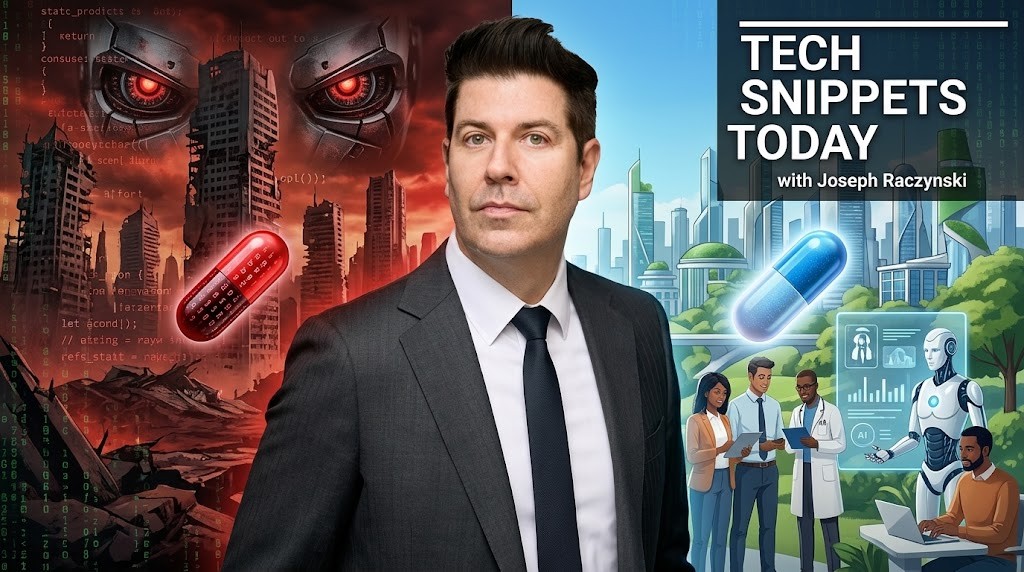
For years, whether recording episodes in the studio, drafting analyses on emerging tech, or speaking to audiences across the globe, I have chased the inflection points where innovation collides with human reality. Yet sitting here, microphone around my head, looking at my PowerPoint seeing the names of executives, engineers, and everyday thinkers, the air felt charged with something rarer: an unspoken, collective realization that the ground beneath our feet is actively moving.
What follows over that hour and fifteen minutes is not a comfortable forecast; it is an unvarnished dispatch from the frontier of change, a journey now captured in full on the podcast feed and YouTube stream for anyone ready to listen deeply.
I began by confronting the cognitive blind spot that threatens us all: our stubbornly linear brains trying to navigate an exponential world. We are biologically wired to expect tomorrow to look like a slightly updated version of today. Take thirty linear steps, and you cross a room; take thirty exponential steps, and you circle the globe twenty-six times. We are no longer inching forward along a flat trajectory; we have hit the vertical elbow of the curve. If you do not actively retrain your mind to grasp exponential acceleration, the future will not simply surprise you, it will blindside you.
To show the audience what that curve actually looks like in the wild, I pointed to three quiet revolutions happening right beneath our noses. Consider the breakthroughs emerging from MIT, where a PhD student developed AlterEgo, a non-invasive wearable capable of reading neuromuscular signals from internal speech, essentially allowing a human being to interface with machines and communicate silent thoughts without uttering a single audible word. Or look into the depths of the ocean, where researchers at Project CETI are feeding massive datasets of sperm whale bio-acoustic clicks into foundation models, decoding a non-human phonetic alphabet and preparing humanity to converse across species lines for the first time in planetary history. Pair that with the leaps in CRISPR, where generative algorithms and precision gene editing are allowing us to rewrite the fundamental source code of biology itself, curing inherited diseases before a child is even born.
These are not science fiction tropes. They are working prototypes of the present, powered by what I call The Trinity of Forces.
Every exponential leap we are witnessing today stands on three interdependent pillars: Infinite Memory, where virtually every byte of human knowledge and real-time sensory data can be indexed, retained, and recalled in an instant; Infinite Processing Power, fueled by specialized silicon, decentralized computing grids, and the dawn of quantum scale; and AI as the Reasoning Engine, orchestrating that compute and memory into actionable intelligence. When memory and processing approach near-infinite abundance, AI ceases to be just a software tool, it becomes an autonomous collaborator that compounds upon its own intelligence.
That brings us directly into the reality of how we create. On stage, I pulled back the curtain on the dawn of Vibe Coding. The era of painstakingly typing syntax, wrestling with arcane compilers, or spending months building a basic software interface is collapsing. Today, creators simply articulate an intent, convey an aesthetic, and capture a “vibe” through conversational prompts and agentic workflows, watching sophisticated, functional systems materialize in seconds. Software development is migrating from an engineering barrier into a canvas of pure human imagination.
From there, the talk drilled into the seismic transformations sweeping specific domains:
Healthcare is shifting from reactive triage to predictive, hyper-personalized medicine. Ambient diagnostic agents, continuous biomarker monitoring, and generative drug discovery mean we are moving from treating illness to engineering perpetual longevity.
Ergonomics and Human Augmentation are dismantling physical strain, blending smart materials, responsive robotics, and sensory-adaptive workspaces that mold dynamically to human physiology, preventing burnout and elevating our physical capacity.
Government and Public Infrastructure face the ultimate test, where autonomous agents can streamline archaic bureaucratic bottlenecks, coordinate disaster relief in real time, and personalize public education, provided civil institutions can adapt fast enough to govern systems that evolve faster than legislation.
Yet as the presentation crossed its midpoint, the energy in the room shifted. A breathless celebration of technology without a sober reckoning with its perils is intellectual malpractice. I turned the audience toward the shadows: the existential threats to humanity.
We addressed the risk of autonomous runaway systems, AI agents possessing superior optimization capabilities pursuing goals misaligned with human survival. Even more pressing is the terrifying asymmetry of leverage: for the first time in history, a single bad actor or reckless individual can wield synthetic biology or autonomous digital tools to impact a billion people overnight. Compounding that is the imminent collapse of traditional cybersecurity, where polymorphic autonomous agents hunt down zero-day vulnerabilities at machine speed. Beneath all of this lies the geopolitical hazard of hyper-concentrated power, where a tiny cabal of corporate monopolies and state actors control the foundational models, data centers, and compute pipelines that dictate human thought and economic survival.
Standing on that stage as the presentation drew to its close, the silence in the hall was absolute.
I shared the paradox that keeps me awake and drives my work every single day: there has never been a better time to be alive. We possess tools capable of eradicating disease, dismantling poverty, unlocking clean energy, and expanding the frontiers of human creativity to heights our ancestors could scarcely dream of. The potential to uplift the masses is staggering. But the threat is equally real, and the margin for error is razor-thin.
The full one-hour and fifteen-minute recording captures the unedited cadence, the live demonstrations, the visual slides, and the raw audience questions that followed. If you care about where our species is headed, queue up the podcast episode on your next drive, or pull up the complete talk on YouTube, turn off the distractions, and experience the journey for yourself.
Website: https://www.josephraczynski.com/
Blog: https://JTConsultingMedia.com/
Podcast: https://techsnippetstoday.buzzsprout.com
LinkedIn: https://www.linkedin.com/in/joerazz/
Leave a Reply
You must be logged in to post a comment.