
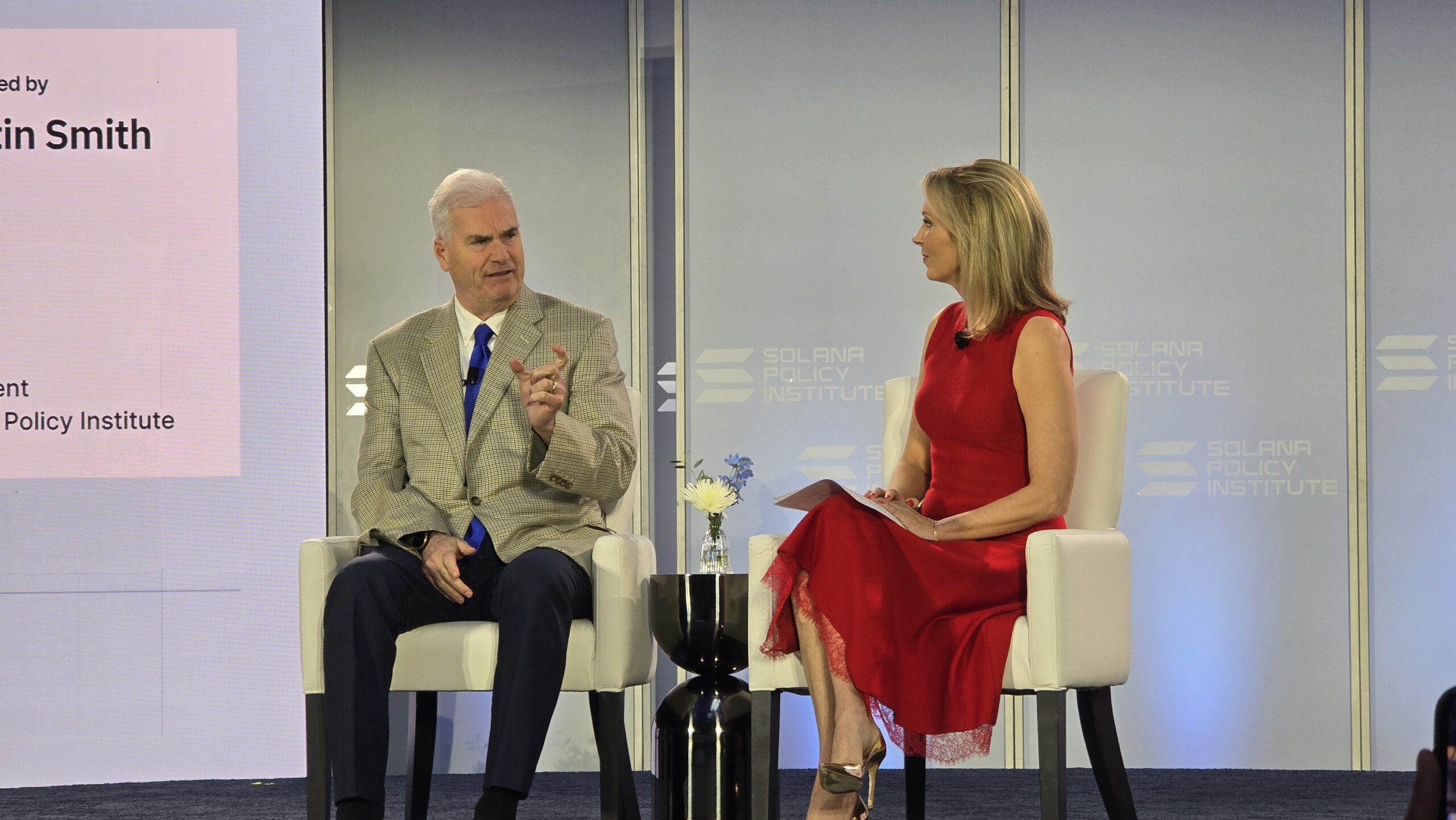
Union Station, Washington DC: The Solana Summit: Washington x Wall Street, the dissonance between the two worlds was impossible to ignore. Outside was the slow, deliberate machinery of Capitol Hill; inside, engineers and founders were measuring latency in milliseconds and debating state machine transitions. Yet when House Majority Whip Tom Emmer took the stage with Kristin Smith for their fireside chat, the conversation cut straight to the core architectural dilemma modern developers face: whether America will allow open, decentralized systems to exist without forcing them into 20th-century custodial molds.
For builders, Emmer’s breakdown of the CLARITY Act was not just another political status report; it read like an API specification for the rule of law.
As someone who writes and deploys open-source code, your primary anxiety isn’t market volatility—it’s ambiguous liability. If you deploy a smart contract that manages liquidity or mints tokens, are you an unlicensed money transmitter? Emmer tackled this head-on, zeroing in on the integration of his long-championed Blockchain Regulatory Certainty Act and Securities Clarity Act into the broader package.
As Emmer emphasized, the foundational goal of this market structure framework is making sure that:
“The CLARITY Act is a thoughtful bill that creates regulatory guardrails tailored to the unique attributes of blockchain technology while giving users and developers the confidence to engage and innovate in this ecosystem.”
From an engineer’s lens, the most pivotal distinction Emmer made revolves around custody vs. non-custodial computation. Traditional financial regulations were engineered to mitigate the risk of intermediaries absconding with user funds. In a peer-to-peer network, code executes deterministically; the developer never touches the private keys. Emmer warned against the chilling effect that arises when regulators fail to make this separation:
“The Securities Clarity Act establishes the principle that a token is distinct from an investment contract… The CLARITY Act focuses on legal certainty for custodial entities, but its current draft raises an important question about those who are not.”
Without explicit legal shields for non-custodial software developers, validators, and protocol architects, writing code becomes an act of legal exposure. Emmer pointed out the urgency of codifying these lines in the sand, noting that Congress cannot afford endless hesitation: the process “cannot afford to lose another year” while foreign jurisdictions race ahead. For engineers in the audience, that urgency resonated. You cannot optimize a system when the runtime environment keeps shifting under your feet.
Why Market Structure Legislation Matters
- Separating the Asset from the Agreement: By establishing that an underlying digital token is distinct from an investment contract, developers can build utility into tokens without the constant threat of retroactive securities violations.
- Safe Harbors for Code Authors: Explicit non-custodial exemptions prevent open-source protocol contributors and node operators from being treated as traditional custodial financial intermediaries or money transmitters.
- Capital and Operational Predictability: Institutional infrastructure cannot scale on informal regulator remarks or ad-hoc court battles; deterministic statutory rules turn blockchain from a legal gamble into a deployable computing layer.
Legislation like the CLARITY Act ultimately decides whether decentralized software can be developed domestically with transparent guardrails, or whether American developers will be forced to geofence protocols and ship open-source innovation from abroad.
For more information, please visit the following:
Website: https://www.josephraczynski.com/
Blog: https://JTConsultingMedia.com/
Podcast: https://techsnippetstoday.buzzsprout.com
LinkedIn: https://www.linkedin.com/in/joerazz/
Leave a Reply
You must be logged in to post a comment.