
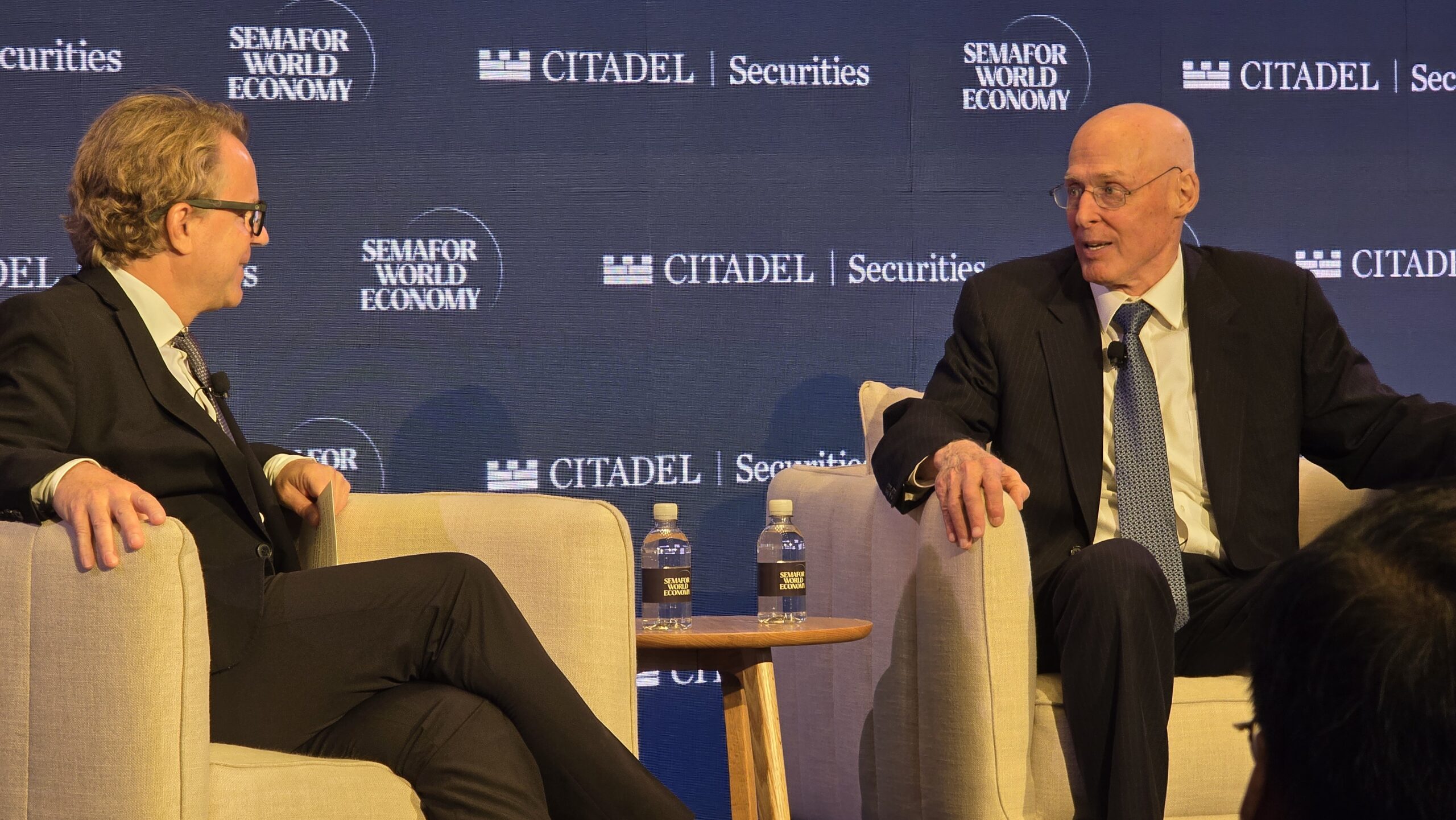
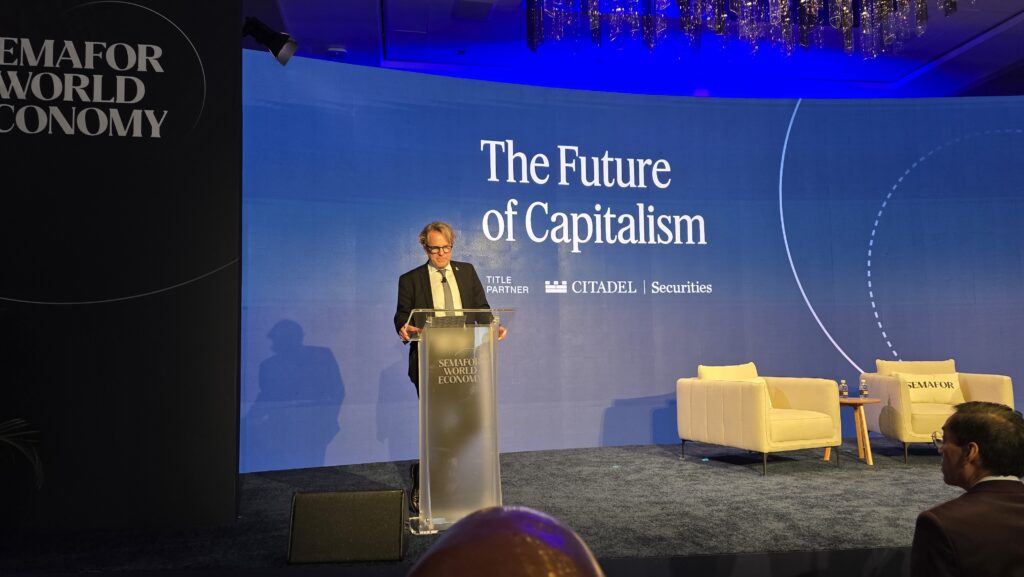
At the Semafor World Economy summit, held during the pivotal World Bank & IMF Spring Meetings, Henry “Hank” Paulson Jr., former U.S. Treasury Secretary and one of the world’s most seasoned China diplomats, offered a masterclass in “realist” geopolitics. He was questioned by the Co-founder and CEO of Semafor, Justin B. Smith.
For the technologist, the session was a sobering update on the infrastructure of global power. Paulson introduced a provocative new framework for the 2026 landscape: we have moved past the era of “engagement” and even “de-risking” into a state of Mutually Assured Economic Disruption (MAED).
The Macro View: Mutually Assured Economic Disruption
Paulson argues that the current stability between Washington and Beijing doesn’t stem from mutual trust, of which there is a massive deficit, but from a cold calculation of consequences. Neither country can currently afford a full-scale trade war or an uncontrolled escalation.
“We are in an imperative of what I would call Mutually Assured Economic Disruption,” Paulson explained. Like the MAD doctrine of the Cold War, MAED suggests that because both economies are still so deeply intertwined, the cost of total “decoupling” would be catastrophic for both. This creates a “glass floor” for the relationship, preventing a total freefall even as both sides aggressively compete in advanced technology.
The Micro View: The Electricity Bottleneck in the AI Race
While much of the media focus is on LLMs (Large Language Models) and GPU (Graphics Processing Unit) clusters, Paulson highlighted a more foundational micro-bottleneck: Electricity.
In the AI arms race, the U.S. currently holds the lead in software and innovation. However, we are facing a critical disadvantage in energy infrastructure.
- The US Grid Challenge: U.S. electricity demand is spiking due to a “triple threat” of climate change, massive data center expansion, and the electrification of the economy. Our grid is bumping up against its ceiling, and new capacity is mired in regulatory and political polarization.
- The Chinese Energy Pivot: Conversely, China is investing in renewables at an industrial scale that exceeds the U.S. and Europe combined. Half of their electricity is projected to come from renewables (solar, wind, and nuclear), giving them a potential long-term “energy runway” to power their AI ambitions that the U.S. currently lacks.
Notable Insights from Henry Paulson Jr.
“We can make a mistake by overestimating the strength of China, and we can make a big mistake by underestimating it. They are the supreme manufacturer of the goods the world needs.”
“Mutually Assured Economic Disruption… doesn’t come out of mutual trust. It comes out of the fact that each knows the cost of escalation is high.”
“The biggest drag we’re going to have for the next five years of the big competition is: How far are we going to be behind on electricity? That’s going to be a drag unless we can close the gap.”
The “Excess Capacity” Dumping Ground
A significant portion of the discussion centered on China’s massive internal economic challenges, specifically its property sector collapse and a “centralization” of power that has left local officials paralyzed by a fear of making mistakes.
Because domestic Chinese consumption is falling, the country is facing a massive excess capacity problem. Paulson noted that China is producing far more steel, solar panels, and EV batteries than its own people can buy. To survive, they are “dumping” these products on the global market, totaling over $1.2 trillion in exports last year. This creates a secondary complexity for U.S. enterprises: how to navigate supply chains that are being flooded with cheap Chinese hardware while Washington intensifies export controls and tariffs.
Geopolitics and Energy: The Middle East Factor
With the current instability in the Middle East, Paulson pointed out that China is far more exposed than the U.S. to energy insecurity.
- Import Dependency: China is the world’s largest oil importer, with half of its volume transiting through the Strait of Hormuz.
- The Diplomatic Balancing Act: Beijing is attempting the nearly impossible task of maintaining strong ties with Iran while simultaneously cultivating relationships with the rest of the Gulf.
This exposure, Paulson argues, is why China has a “big interest” in behind-the-scenes peace and stability, not out of altruism, but to secure the energy flow required to sustain their 5% growth targets.
Final Takeaway: The Trust Deficit
As President Trump prepares for a high-stakes summit in Beijing, Paulson’s advice to CEOs and policymakers is clear: be an expert in “material politics.” In 2026, there is no such thing as a “pure” business decision; every choice is a geopolitical one.
The goal for the upcoming summit isn’t just to talk about trade deficits, but to establish “red lines” and “mechanisms to manage investment.” We need to move from MAED toward a baseline of “commercial trust.” The world will be a much more dangerous, and less prosperous, place unless these two giants find a way to compete without collapsing the shared system that supports them both.
For more information, please visit the following:
Website: https://www.josephraczynski.com/
Blog: https://JTConsultingMedia.com/
Podcast: https://techsnippetstoday.buzzsprout.com
LinkedIn: https://www.linkedin.com/in/joerazz/
Leave a Reply
You must be logged in to post a comment.