
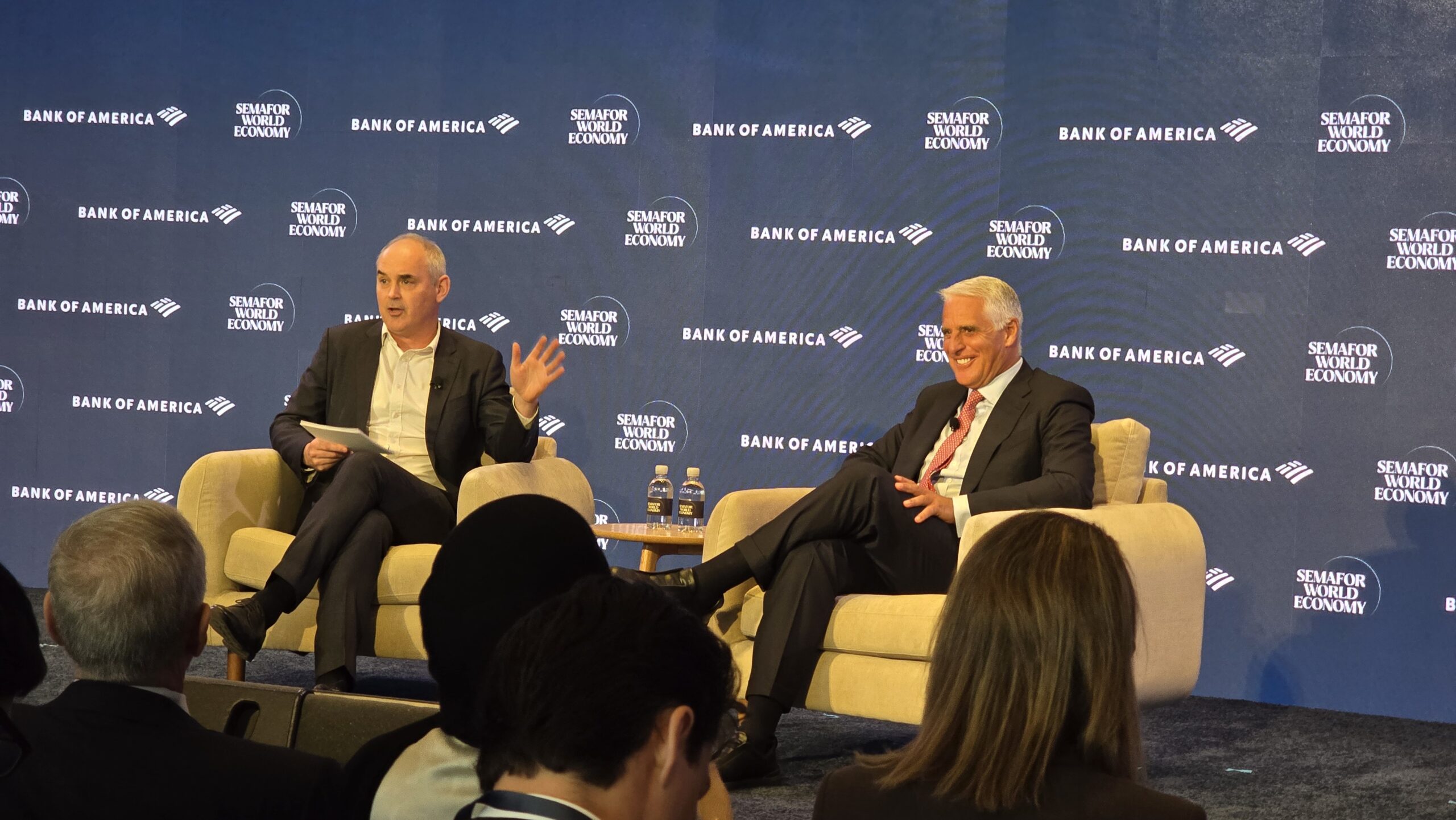
At the Semafor World Economy summit, held during the high-level World Bank and IMF Spring Meetings, the “Future of Global Finance” took a decidedly Continental turn. While the morning headlines focused on U.S. inflation and Middle Eastern volatility, Andrea Orcel, CEO of UniCredit SpA, sat down with Thorold Barker to address the “Sandwich Question”: Does anybody still care about Europe?
From a technologist’s vantage point, Orcel’s argument was less about banking and more about systems architecture. He framed Europe not as a failing experiment, but as a powerful engine running on “fragmented plumbing.” For Europe to compete with the sheer scale of U.S. “hyperscale” banks like JPMorgan, it must stop optimizing for individual nations and start building a common digital and financial operating system.
The Macro View: The Convergence Imperative
Orcel was refreshingly blunt: Europe has been “punching below its weight” for two decades. The macro-economic gap between the U.S. and Europe isn’t just a matter of culture; it’s a matter of market capitalization and scale. Today, JPMorgan and Bank of America are worth roughly the same as the top ten European banks combined.
Orcel argues that this isn’t due to a lack of talent or resources, but a lack of convergence. While the U.S. operates on a unified “platform” of trade, law, and regulation, Europe remains a patchwork of barriers. To survive the “Cognitive Industrial Revolution,” Orcel believes Europe must move beyond being a collection of sovereign silos and toward a Common Denominator approach in energy, defense, and finance.
The Micro View: Patience and the Commerzbank “Steak”
On a granular, operational level, Orcel provided a masterclass in the “Long Game” of European M&A. His ongoing pursuit of Germany’s Commerzbank serves as a perfect micro-case for the friction inherent in the European system.
The Stakeholder Equilibrium:
- The “Steak” Strategy: Orcel described the process of building a stake in Commerzbank as a patient, transparent attempt to explain value to a wide array of stakeholders, shareholders, employees, and clients.
- The Decision Loop: Unlike the U.S., where a CEO can “go right down to the middle and take the decision,” Europe requires navigating a web of national governments and cross-border politics. Orcel argued that while this makes the loop longer, it creates a more resilient “equilibrium” once the deal is struck.
- The Success Metric: He noted that UniCredit’s current success, boasting a 20% Return on Tangible Equity (RoTE) and a 38% cost-to-income ratio, is the tangible proof that a leaner, pan-European approach works even within a fragmented environment.
Notable Insights from Andrea Orcel
“Europe has been consistently punching below its weight… we have been talking about not crystallizing on the opportunity of a united Europe. The time is now.”
“If you want to transform, that is the machine. The bank is the machine, the capital market is the gasoline. In one, we are undersized; in the other, we are under-present. Together, Europe does not have the fuel to do what it needs to do.”
“People are less and less ready to accept stories that demonize Europe in favor of non-convergence.”
The Fuel Problem: Banking vs. Capital Markets
For the technologists in the room, Orcel’s most “clever” analogy involved the Fuel of Transformation. He argued that Europe’s lack of sophisticated capital markets acts as a “gasoline shortage” for the “banking machine.”
Currently, European savings are largely funneled into U.S.-based institutional investors, who then direct that capital back into U.S. or Chinese markets. Europe is essentially exporting its “fuel” (savings) to power other people’s transformations. To reverse this, Europe needs a Capital Markets Union (CMU) that allows European companies to be funded by European investors, keeping the innovation cycle, and the wealth, within the continent.
The Talent Leak: Nobel Prizes and Mobility
Orcel pointed to a poignant micro-stat: many Nobel Prize winners are European-born but won their awards while working in the U.S. This is the ultimate “brain drain” metric. Europe has the talent pool and the education, but it lacks the convergent infrastructure that allows that talent to “fire” at a global scale. He believes that by closing the mismatch between “haves and have-nots” through convergence, Europe can create value opportunities that keep its best minds at home.
Final Takeaway
Andrea Orcel’s view is that Europe is at a “jump” point. The next 5 to 10 years will determine whether it becomes a “Poland of the Industrial Revolution” or a global leader. His “European Optimism” is built on the fact that the downside of staying fragmented is now so apparent that the “wake-up call” has finally been heard by the national governments.
For the global technologist, the message is clear: watch the plumbing. If Europe can fix its common denominator, it remains one of the largest untapped value-creation opportunities in the world.
For more information, please visit the following:
Website: https://www.josephraczynski.com/
Blog: https://JTConsultingMedia.com/
Podcast: https://techsnippetstoday.buzzsprout.com
LinkedIn: https://www.linkedin.com/in/joerazz/
Leave a Reply
You must be logged in to post a comment.