If you’ve spent the last decade in the blockchain space, you’ve likely been lulled into a comfortable sense of “Quantum Procrastination.” The prevailing wisdom was that a Cryptographically Relevant Quantum Computer (CRQC) was a “2040-something” problem, a massive engineering hurdle requiring tens of millions of physical qubits that felt more like science fiction than a line item on a risk assessment.
That comfort vanished on March 31, 2026.
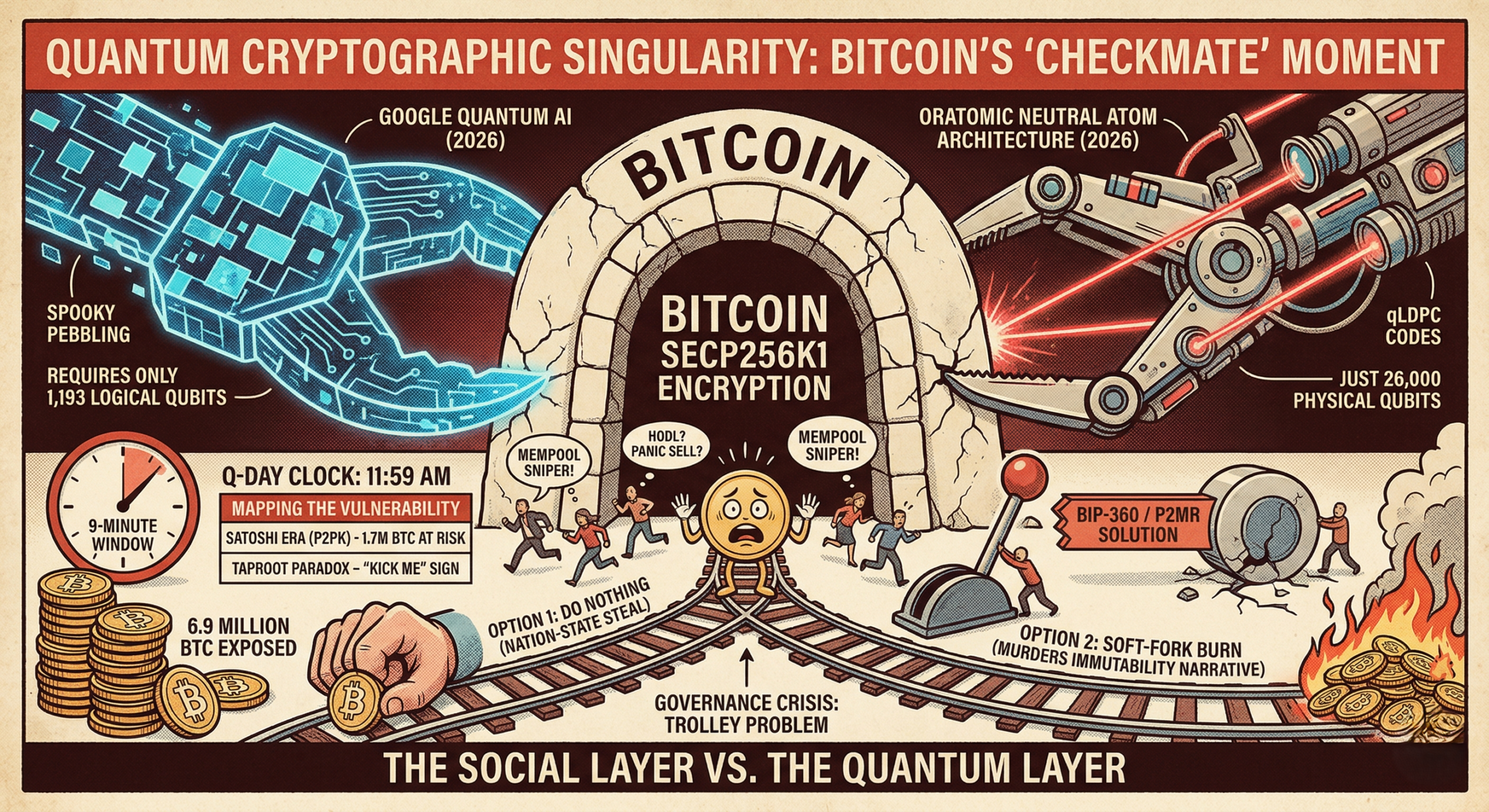
The simultaneous release of two seminal papers, one from Google Quantum AI and another from the neutral-atom startup Oratomic, has effectively moved the “Q-Day” clock from a distant midnight to a very looming brunch. We aren’t just looking at faster hardware; we are witnessing a mathematical “pincer movement” that has reduced the resources needed to crack Bitcoin’s secp256k1 encryption by nearly two orders of magnitude.
As a technologist who lives in the “next five minutes” of the future, I see this not just as a vulnerability, but as a total paradigm shift in how we define digital scarcity and immutability.
The Architecture of the Siege: The Logical Layer
Historically, the “Shor’s Algorithm” threat relied on a brutalist approach: throw 20 million physical qubits at the problem to generate the ~2,000 error-corrected logical qubits needed to break 256-bit Elliptic Curve Cryptography (ECC).
Google’s breakthrough, led by the wizardry of Craig Gidney, flipped the script. Their paper introduces “Spooky Pebbling.” In standard quantum circuits, point addition (the heart of ECC) requires massive qubit overhead to “remember” intermediate steps so the process remains reversible. Spooky Pebbling uses measurement-based uncomputation to “ghost” those intermediate results. It’s the quantum equivalent of clearing your browser cache in real-time while the page is still loading.
The result? We no longer need 2,000 logical qubits. We need 1,193.
The Physical Pincer: The Oratomic Breakthrough
While Google optimized the “math,” Oratomic optimized the “metal.” Traditional superconducting qubits (the “fast-clock” variety) are notoriously difficult to scale because they require 2D grid layouts where qubits can only talk to their neighbors. This leads to a bloated physical-to-logical ratio (often 1000:1).
Oratomic utilizes neutral-atom architectures held in optical tweezers. These atoms can be physically moved during computation, allowing for “non-local” connectivity. This enables high-rate Quantum Low-Density Parity-Check (qLDPC) codes. Instead of millions of qubits, Oratomic suggests a machine with just 26,000 physical qubits could finish the job.
| Research Entity | Logical Qubits | Physical Qubits (est.) | Primary Innovation |
| Häner et al. (2020) | 2,124 | 40,000,000 | Standard Surface Code |
| Google Quantum AI (2026) | 1,193 | 500,000 | Spooky Pebbling |
| Oratomic (2026) | ~1,000 | 26,000 | qLDPC & Neutral Atoms |
The “9-Minute Window”: A Race Against the Mempool
The most sobering takeaway from the Google paper isn’t just if it can be done, but how fast. On a superconducting processor, which operates at MHz speeds, the optimized circuit has a shallow depth. Under “primed” conditions, a Shor run could be completed in 9 minutes.
Why does 9 minutes matter? Because the average Bitcoin block time is 10 minutes.
This creates the Mempool Hijack. Even if you use modern, hashed addresses (P2PKH) that hide your public key, you must reveal that key the second you broadcast a transaction. A “fast-clock” quantum adversary could:
- Sniff your public key from the mempool.
- Crack your private key in 9 minutes.
- Broadcast a fraudulent transaction with a massive fee to “front-run” your legitimate one.
For any high-value transfer, Bitcoin becomes a probabilistic coin-flip against a quantum sniper.
Mapping the Vulnerability: 6.9 Million BTC at Risk
Not all Bitcoin is created equal in the eyes of a quantum computer. The risk profile depends entirely on whether your public key is visible on the ledger.
- The “Satoshi Era” (P2PK): Early addresses stored the public key in plain sight. Roughly 1.7 million BTC are “quantum-dead on arrival.” Even a “slow-clock” Oratomic machine (which might take 10 days to crack a key) can systematically drain these.
- The Taproot Paradox: Ironically, the 2021 Taproot upgrade, intended to boost privacy, reveals the internal public key immediately for its primary spend path. In our post-2026 reality, Taproot is looking less like an upgrade and more like a “Kick Me” sign for quantum actors.
The Governance Crisis: Burn vs. Steal
Technically, we have a solution: BIP-360 and the Pay-to-Merkle-Root (P2MR) architecture. This allows for a “shell” that can hold Post-Quantum Cryptography (PQC) signatures like ML-DSA (Dilithium).
But the real hurdle isn’t the code; it’s the consensus. What do we do with the 6.9 million “exposed” BTC?
- Do nothing: The first nation-state with a CRQC becomes the largest holder of BTC, potentially crashing the market.
- The Soft-Fork Burn: We render any non-migrated, exposed address unspendable after a certain date. It saves the network’s scarcity but murders the “immutability” narrative.
It is the ultimate “Trolley Problem” for decentralized governance.
A Futurist’s Prescription
The “Quantum Singularity” is no longer a theoretical horizon; it is an engineering roadmap. We have moved from asking “if” to measuring “how many Toffoli gates.”
As we navigate this, three things are clear:
- Stop Address Reuse: If you’ve sent money from an address, move the remaining balance to a fresh Native SegWit (bc1q) or, eventually, a P2MR address.
- Watch the Testnets: The “Bitcoin Quantum” testnet is currently running Dilithium opcodes. It’s the laboratory where the survival of the species is being engineered.
- The Privacy Debt is Due: “Store Now, Decrypt Later” (SNDL) is a reality. Any public key you’ve exposed is already in an NSA or MSS data center waiting for the hardware to catch up.
The 9-minute window is closing. We have the math, we have the hardware, and now, thanks to the breakthroughs of 2026, we have the motivation. The question is whether the social layer of the blockchain can move as fast as the quantum layer.
I’ll be watching the mempool. Hopefully, I won’t see you there.
For more information, please visit the following:
Website: https://www.josephraczynski.com/
Blog: https://JTConsultingMedia.com/
Podcast: https://techsnippetstoday.buzzsprout.com
LinkedIn: https://www.linkedin.com/in/joerazz/
Leave a Reply
You must be logged in to post a comment.