
We are witnessing a quiet but profound shift in how we interact with machine intelligence. For years, the paradigm has been transactional: we prompt, the model replies. We wait. We prompt again. But the friction of that loop is dissolving.
I’ve been spending time with OpenClaw, a piece of technology that represents the next logical step in this evolution: the autonomous agent. This isn’t just a chatbot; it is a system designed to do things. It lives not on a distant server farm controlled by a mega-corporation, but on your own infrastructure, holding your keys, executing your logic, and reporting back to you on your terms.
The Evolution of an Identity
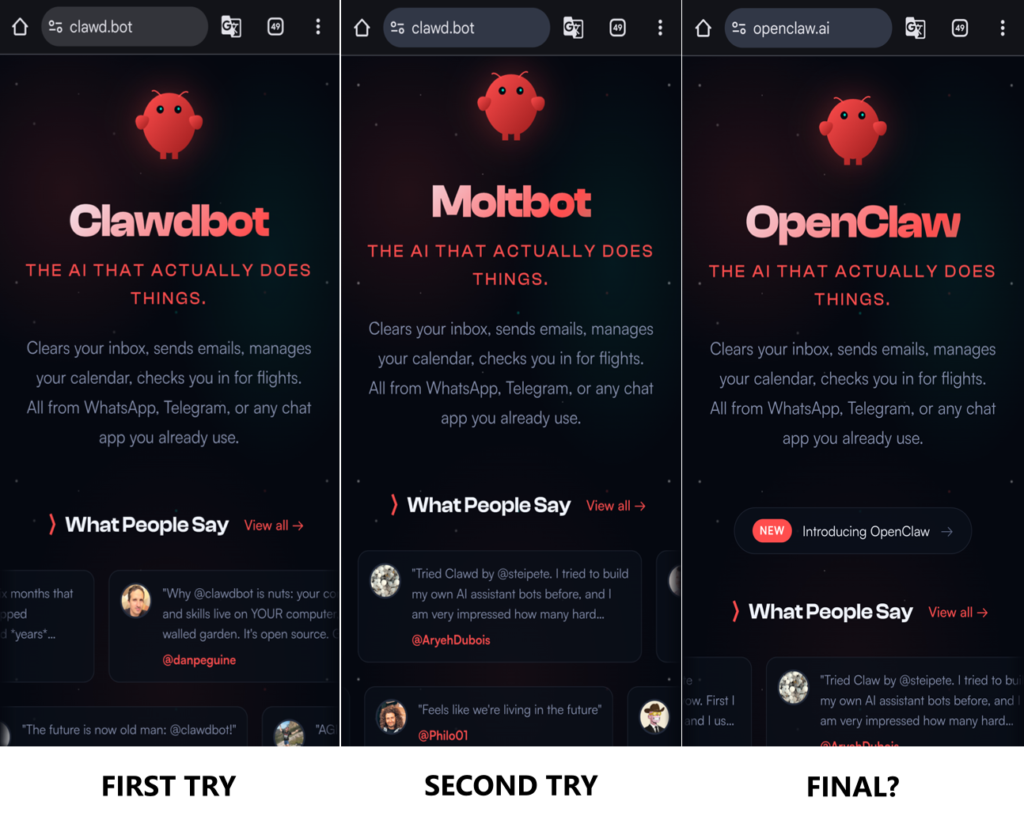
The history of this project is a fascinating case study in modern open-source velocity and the inevitable collisions with trademark law. It has been a rapid metamorphosis, one I’ve documented as I watched the repository evolve.
It began as Clawdbot. The name was a clear nod to its underlying engine, Anthropic’s Claude, but it signaled intent: a bot wrapper for a powerful model. It was direct, functional, and perhaps a bit too close for comfort for the legal teams involved.
Then came the pivot to Moltbot. This was a clever lateral move. If the original identity was about the engine, this intermediate stage was about the process, the shedding of the old shell to grow a new one. It felt organic, almost biological, which fittingly describes how these agents seem to “live” on our servers.
Finally, we arrived at OpenClaw. This is the mature identity. “Open” signals the philosophy, transparent, accessible, community-driven. “Claw” retains the heritage of its grip on tasks, its ability to manipulate the digital environment.
I’ve included the screenshots (dorky) I took during this transition over a few weeks, below. They serve as a digital archaeological record of a project finding its footing in real-time.
The Architecture of Autonomy
From a technologist’s perspective, the beauty of OpenClaw lies in its sovereignty. You are not renting an agent; you are hosting one.
I am currently running my instance on a Virtual Private Server (VPS). I’ve utilized Hostinger for this deployment, and the experience is clinically precise. You spin up a KVM 4 VPS (giving it enough RAM to breathe, ideally 16GB+ if you plan on heavy context retention), install Docker, and deploy the container.
The distinction here is critical. When you run this on a VPS, the agent is “always on.” It is not a tab in your browser that sleeps when you close your laptop. It is a daemon in the cloud, a persistent presence waiting for a signal. It monitors, it waits, and it executes. The latency is minimal, and the uptime is entirely within your control. Though many are buying a Mac Minis, that is expensive and totally unnecessary.
The Interface: Meeting You Where You Are
The most compelling feature of OpenClaw is its refusal to force you into a new UI. It meets you in the encrypted channels you already inhabit.
I interact with my agent primarily via WhatsApp. The experience is surreal. I text a request, and moments later, a response arrives, not just text, but confirmation of an action taken. It does have it’s own SIM, which is unnecessary, but an interesting experiment, as it feels more personal.
However, for the privacy-focused technologist, Telegram is arguably the ideal conduit, which I have experimented with as well. The bot API integration is cleaner, the encryption is robust, and the file handling capabilities are superior. Telegram allows for a richer dialogue with the agent, supporting larger payloads and more complex command structures without the friction of Meta’s ecosystem.
Use Cases for the Modern Builder which I am Contimplating
Each example assumes the agent is running on your VPS, has access to specific APIs, and utilizes the “sovereignty” you value. Be careful!
The Fiscal Hawk (Financial)
Focus: Active Audit & Arbitrage
Most ‘financial AI’ is just a glorified dashboard. I am seeking an agent that acts like a forensic accountant with a sleepless work ethic. I can configure my OpenClaw instance to interface with my bank’s API (via Plaid) and my email receipts. It won’t just categorize spending; it audits it.
If a subscription price increases, the agent will flag it and, using a pre-written script, draft a cancellation email or a negotiation script for me. More impressively, it can monitor high-yield savings APY rates across the market. If my current holding rate drops below a threshold relative to a competitor, it can prepare the transfer paperwork for my review. It would not just watch my money; it could actively defend its value against inflation and corporate ‘creep’.”
The Dynamic Logistics Engine (Travel)
Focus: Real-Time Intervention
Travel planning is easy; travel management is hard. Another option is to built a ‘Logistics Engine’ that hooks into flight APIs (like Google Flights) and real-time weather data. When I have a trip upcoming, the agent doesn’t sleep.
The scenario… Last week, it detected a developing storm front 48 hours before my airline issued a delay notification. The agent proactively placed a hold on a backup flight on a different carrier and reserved a hotel room near the airport, sending me a WhatsApp message: “Probability of cancellation 85%. Backup logistics secured. Reply EXECUTE to confirm switch.” It turns the chaos of modern travel into a simple binary choice.
The Sovereign On-Chain Proxy (Web3)
Focus: Decentralized Execution & Wallet Management
This is where the ‘Open’ in OpenClaw gets radical. I am contemplating equipping my agent with a dedicated ‘hot’ wallet (holding minimal funds) and authorizing it to interact with smart contracts. It would monitor gas fees on the Ethereum network.
When gas drops below 15 gwei, (cheaper network fee) my agent could execute a batch of pending transactions, staking rewards claims, token swaps, and bridge transfers, that I might have queued up during the week. It essentially acts as a ‘transaction buffer,’ optimizing my on-chain activity for cost efficiency without me needing to glue my eyes to a gas tracker. It is an efficient digital employee to manage digital assets.
The Bio-Metric Correlator (Health)
Focus: Data Synthesis
We generate terabytes of health data that we never use. Another thought: I could connect my OpenClaw to the export APIs of my Oura Ring and MyFitnessPal – if I had them. 😉. Every morning, it could run a correlation analysis.
So, the thought, it wouldn’t just say ‘you slept poorly.’ It would look at the variables and reports: ‘Deep sleep down 40% on days with >50g sugar intake after 8 PM.’ It then could cross-reference this with my calendar. If I have a ‘High Priority’ meeting tagged for the next day, and it detects poor sleep trends, it could automatically block out the hour before the meeting for ‘Cognitive Recovery’ – nap time – and send a high-protein breakfast suggestion to my grocery list, no sweets. It closes the loop between biology and productivity.
The Future
We are standing at the precipice of a new internet. The “Moltbook” phenomenon, where agents interact with other agents in a social layer excluding humans, is just a glimpse of the weird, powerful future ahead.
We are moving toward a world where our personal agents will negotiate with other agents. Your OpenClaw instance will talk to a travel vendor’s agent to book a flight, or a vendor’s support agent to resolve a billing dispute, all while you focus on high-value cognitive work.
This technology is raw, it is exciting, and it is dangerous in the way all powerful tools are. But for those of us who speak the language of systems, it is the only way forward.
For more information, please visit the following:
Website: https://www.josephraczynski.com/
Blog: https://JTConsultingMedia.com/
Podcast: https://techsnippetstoday.buzzsprout.com
LinkedIn: https://www.linkedin.com/in/joerazz/
Leave a Reply
You must be logged in to post a comment.