
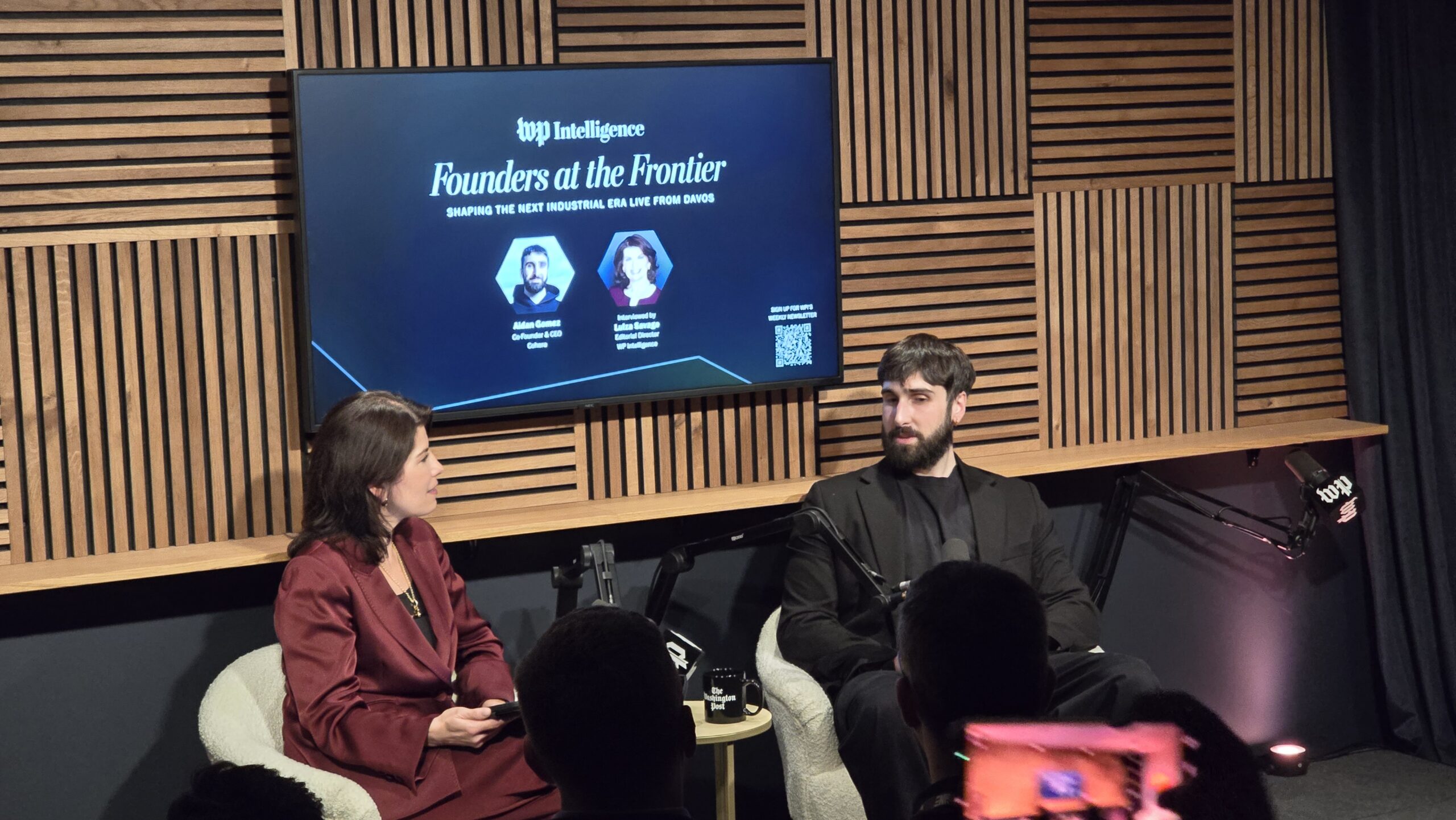
Davos, Switzerland: Session from The Washington Post House
For the past few years, the narrative around artificial intelligence has been one of ethereal magic. Models spun text from prompts, conjured images from imagination, and lived inside our browsers. But as the dust settles at the 2026 World Economic Forum, a new, more grounded conversation has taken center stage. The discourse is no longer just about the capabilities of large language models, but about their cost, not in dollars, but in watts, infrastructure, and real-world constraints.
Listening to key sessions with the founders and CEOs shaping this next wave, from Qualcomm’s Cristiano Amon to the pioneers at Cohere, Emerald AI, and Eolian Energy, it’s clear that AI is undergoing a profound reckoning. It’s colliding with the physical world, and this collision is forcing a fundamental re-architecting of the entire technology stack, from silicon to the software that governs it.
The Energy Bill Comes Due: The Grid as the New Bottleneck
The most visceral illustration of this collision came from the “Founders at the Frontier” panel. Dr. Varun Sivaram of Emeral AI and Aaron Zubaty of Eolian Energy laid out the stark reality: the U.S. grid is unprepared for the coming “AI super cycle.” The numbers are staggering. A projected 50-gigawatt demand from new AI data centers in three years, a 30-fold increase in AI’s energy consumption by 2035, and a grid infrastructure that can only service half of the immediate demand.
From a technologist’s perspective, this isn’t just a capacity problem; it’s a legacy system problem. The electrical grid was designed for a different era, a centralized, slow-moving world with predictable demand curves. As Sivaram noted, our power systems are only utilized at about 50% capacity, with massive infrastructure built out to handle rare “peak load” events. An inflexible, always-on AI data center is the worst possible citizen for this kind of system, forcing costly over-provisioning that everyone pays for.

The solution proposed is elegantly technical: make the data center a grid-aware, flexible asset. By using AI to manage AI, Emerald can throttle non-critical computations, shift workloads across fiber networks, and leverage on-site storage. Eolian Energy reinforces this by co-locating data centers with battery storage, creating a symbiotic relationship where the data center can either reduce its own load or inject power back into the grid.
The implication is profound: “the data center is no longer just a consumer of power; it is becoming an active, intelligent node on the energy network.” This transforms the problem from a brute-force issue of building more power plants into a sophisticated optimization challenge. AI is creating an existential threat to the grid, and the only viable solution is a more intelligent, AI-managed grid.
The Great Disaggregation: Relearning the Lessons of Mobile
If the grid is the macro-level constraint, power and heat are the micro-level tyrants. Qualcomm CEO Cristiano Amon provided the crucial link between the data center’s energy crisis and the silicon it runs on. His core argument, born from decades of mobile innovation, is that the monolithic compute model is dead. To combat the impossible physics of ever-increasing compute demands within a finite power and thermal budget, you must disaggregate.
Amon’s analogy to the smartphone is perfect. A phone couldn’t afford to run MP3 decoding on its main CPU; it would drain the battery in an hour. The solution was dedicated hardware, specialized chips for audio, for image processing, for communications. We are now seeing this exact pattern play out in the data center at a massive scale. The GPU, a general-purpose parallel processor, is brilliant for training, but it’s not always the most efficient tool for inference.
Qualcomm’s bet on the Neural Processing Unit (NPU) is a direct response to this. It’s a purpose-built architecture optimized for the high-density, low-power matrix math that defines AI inference. This isn’t just about competing with NVIDIA; it’s a fundamental argument that the future of the data center is heterogeneous. You will have different architectures for different tasks, all orchestrated to maximize performance-per-watt. The solution to the energy crisis isn’t just more power; it’s more efficient and specialized compute.
From Generic Models to Governed Systems: AI Gets a Job
While the hardware and infrastructure layers are being re-architected, the software layer is undergoing its own maturation. Aidan Gomez, a co-creator of the original Transformer and now CEO of Cohere, articulated the shift from a consumer-facing, “move fast and break things” model to a high-stakes enterprise reality.
In the enterprise, and especially in critical industries like government and finance, performance is table stakes. The real challenges are security, reliability, and governance. Gomez’s focus on building AI that operates within a company’s private environment, connected to its proprietary data and tools, is the next logical step. A generic chatbot that hallucinates is an amusing novelty; an enterprise AI that does so with sensitive financial data is a catastrophe.
The concept of “autonomy policies”, allowing an organization to define what an AI can do on its own versus what requires human oversight, is a critical innovation. It acknowledges that AI is not a monolithic oracle but a tool that must be governed. This represents a move away from the “black box” and toward a configurable, auditable system. Gomez’s observation that the biggest bottleneck is the “upfront integration burden” is telling. The hard work is no longer just training the model; it’s the unglamorous, painstaking process of plumbing it into the complex, messy reality of an organization’s existing systems.
The Synthesis: A New Stack for a New Era
Viewed together, these sessions paint a clear picture of AI’s next decade. The technology stack is no longer just software. It is a deeply integrated system where the model’s software is governed by enterprise policy, runs on disaggregated, power-efficient hardware, and is deployed in a physical data center that acts as a dynamic participant in the electrical grid.
The era of pure software is ending. The challenges are now physical, logistical, and regulatory. The heroes of this next phase may not be the researchers discovering novel architectures, but the systems engineers, the utility regulators, and the integration specialists who can bridge the digital and physical worlds. As Gomez noted, the biggest constraint is now hiring people to do this complex integration work. The hype of Davos may feel distant, but the technological currents underneath are real. AI is growing up. It’s moving out of the browser and into the real world, the power grid, the factory floor, the financial system. This transition will be slower and harder than the last, but its impact will be infinitely more profound. This is the real industrial revolution, not one of bits alone, but of bits meeting atoms.
For more information, please visit the following:
Website: https://www.josephraczynski.com/
Blog: https://JTConsultingMedia.com/
Podcast: https://techsnippetstoday.buzzsprout.com
LinkedIn: https://www.linkedin.com/in/joerazz/
Leave a Reply
You must be logged in to post a comment.