
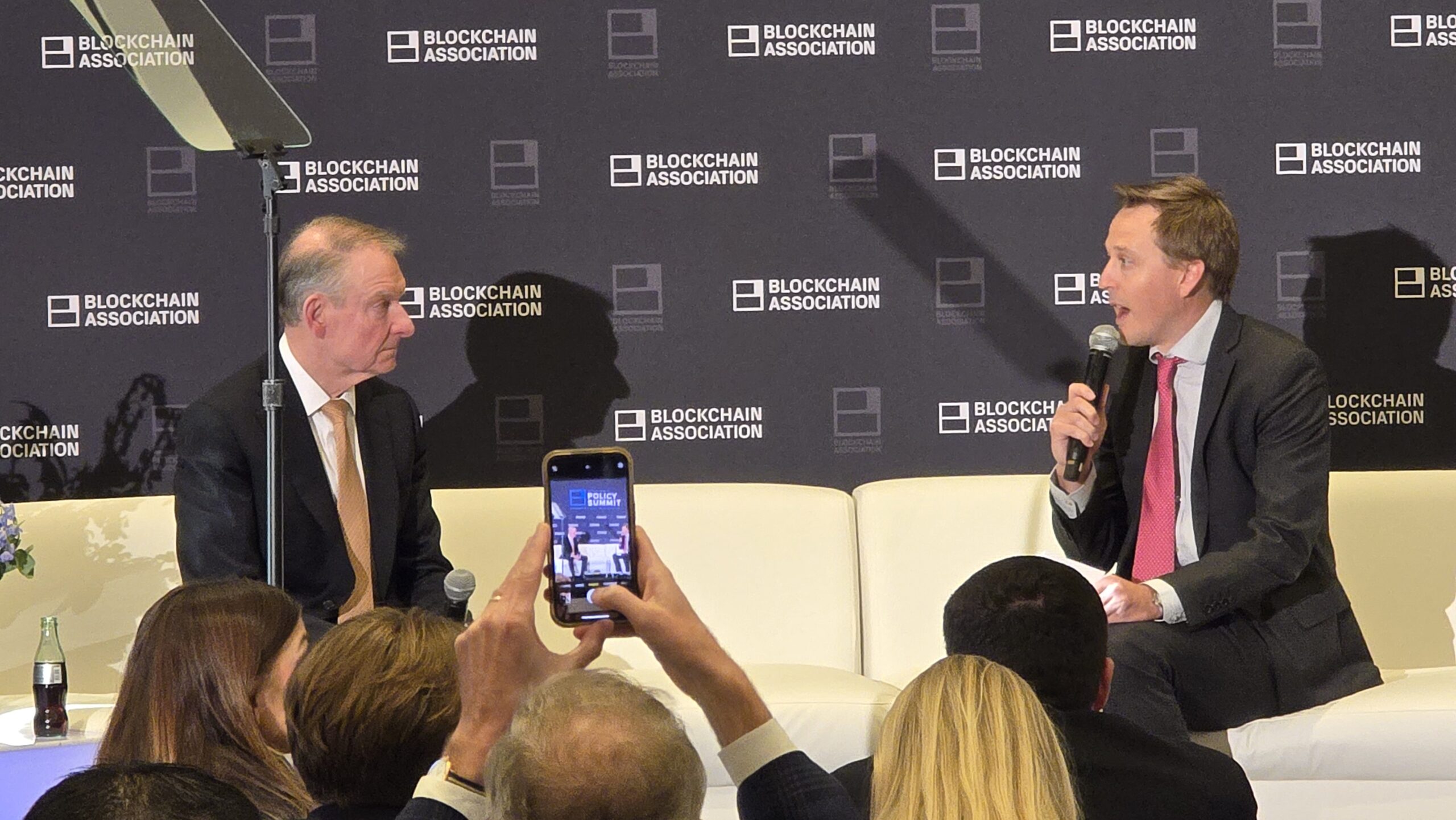
Blockchain Association Policy Summit 2025, Washington, DC: When Miles Jennings, Crypto Head of Policy and General Counsel at a16z crypto, sat down with former SEC Commissioner Paul Atkins for the session “A View from the SEC”, the room was charged with a mix of cautious optimism and anticipation. Over the past year, digital asset regulation in the U.S. has shifted from ambiguous posturing to what increasingly resembles structured engagement. As Jennings opened, he remarked that even the most optimistic participants “couldn’t have imagined the progress made in such a short period of time.”
Atkins, a long-time advocate for regulatory clarity and market-driven innovation, struck a pragmatic tone. His central message: the SEC must evolve to recognize that blockchain-based systems are not mere speculative novelties but the foundation of a new financial architecture. Yet, he cautioned that policy changes must come not just from within the Commission but in concert with Congress, ensuring that “future-proof frameworks” allow technology to progress without bureaucratic friction.
“The last thing we need,” Atkins warned, “is special-market structures that wall off innovation.” His emphasis on avoiding “no-man’s-land regulations” where novel digital securities fall between jurisdictions reflected a theme surfacing across the Summit, collaboration over isolation.
An SEC Learning to Listen
One of the most striking moments came when Jennings echoed what many in the room had observed over recent years , that under previous administrations, “no lawyer would have advised their client to contact the SEC.” Atkins smiled at that and agreed that the tone has changed dramatically. “Please come talk to us,” he urged. “Be open, bring your questions, the worst outcomes come from silence.”
This marks a quiet but notable cultural shift. The SEC, long seen as an opaque monolith toward crypto innovators, is acknowledging its need for dialogue. Atkins described this as a matter of “mutual education,” a phrase that captures a deeper truth about technology’s collision with law: regulators are learning the technology as quickly as technologists are learning policy.
From a technologist’s perspective, this is an essential inflection point. Open engagement with the SEC can accelerate not only compliance but interoperability, regulators understanding code and developers understanding statutes. If properly nurtured, this could evolve into an era where open-source transparency harmonizes with public oversight, rather than being at odds with it.
Digital Assets as Market Infrastructure
Atkins reiterated that digital assets shouldn’t be pigeonholed merely as “tokens” or “securities.” Instead, he urged that policymakers see them as digital infrastructure layers, the rails for future capital markets. “We need to keep in mind that what we build today must still make sense twenty-five years from now,” he said, referencing the foundations laid by the Securities Exchange Act of 1934. “We can’t assume the frameworks of 1934 are suited to a 2034 world.”
Technologists in the audience nodded knowingly. Blockchain networks serve as both record-keeping mechanisms and programmable marketplaces. Regulating them purely as instruments of financial speculation is like judging the early Internet solely by its ability to send emails. Atkins’s framing aligns with a systems-engineering mindset: problems must be modularized, and rules must evolve alongside the system’s architecture. His concept of focusing on “functional realities”, rather than categorical labels, resonates deeply with software development principles.
The Challenge of Future-Proof Policy
The conversation turned toward the European Union’s approach, with Atkins suggesting that regulators there may already be rethinking parts of their “crypto taxonomy.” Europe’s Markets in Crypto-Assets (MiCA) framework, though ambitious, has shown early signs of rigidity. “You can’t lock technology in amber,” he remarked. “Flexibility is strength.”
For technologists building decentralized applications, this recognition is critical. Systems evolve rapidly, protocols fork, governance models shift, and token uses iterate faster than legislative cycles. Atkins’s call for adaptable statutes mirrors the agile development methodology: release, observe, iterate. A future-proof legal framework should do the same, establishing foundational principles while leaving room for continuous learning and upgrading.
Rebuilding Trust in Regulation
When Jennings raised the often-cited tension between Congress’s legislative efforts and the SEC’s rulemaking authority, Atkins drew attention to the progress made in aligning the two. He praised bipartisan collaboration and noted that the current environment “feels far more fluid” than in prior years. Still, he warned of the dangers of creating artificial distinctions between “market structures,” which could fragment liquidity and innovation.
His repeated invocation of “collaboration” was anchored by a belief that regulators, developers, and the investing public share a unified goal: efficiency and transparency in markets. The difference lies only in perspective, not purpose.
From a technologist’s standpoint, this represents an invitation to rethink the developer–regulator relationship. Instead of approaching the SEC with defensiveness, emerging builders can approach as co-architects. Atkins’s belief that “dialogue prevents dead ends” should resonate strongly across the ecosystem, especially among DeFi, tokenization, and compliance-layer developers designing systems that already embed regulatory logic directly into smart contracts.
The Value of Open Architecture
Atkins closed with a reflection on why open collaboration matters. Regulation’s goal, he insisted, isn’t to freeze innovation but to stabilize trust. “We can’t know what the world looks like in twenty-five years,” he said, “but we can ensure that our principles are sound foundations.”
This idea, that law, like code, must rely on stable primitives, may be one of the most important insights of the Policy Summit. Every decentralized architecture depends on consensus protocols to enable trustless collaboration. Law functions similarly: it defines the consensus protocols of society. When these two systems respect each other, innovation becomes self-reinforcing rather than adversarial.
From Adversaries to Collaborators
As the discussion wrapped, Atkins sounded almost optimistic, not about instant harmony, but about the possibility of productive friction. “You can’t change the future, but you can build for it,” he said, a sentiment that encapsulated the mood of the Summit.
In 2025, the crypto industry finds itself at a rare point of convergence: a regulator willing to engage and technologists ready to build responsibly. The dialogue between Atkins and Jennings embodied that middle ground, informed dissent, mutual respect, and a shared desire for lasting architecture.
For those of us watching from the vantage point of technology, that is the real story: blockchain regulation no longer feels like an arms race; it’s beginning to look like systems integration.
For more information, please visit the following:
Website: https://www.josephraczynski.com/
Blog: https://JTConsultingMedia.com/
Podcast: https://techsnippetstoday.buzzsprout.com
LinkedIn: https://www.linkedin.com/in/joerazz/
Leave a Reply
You must be logged in to post a comment.