
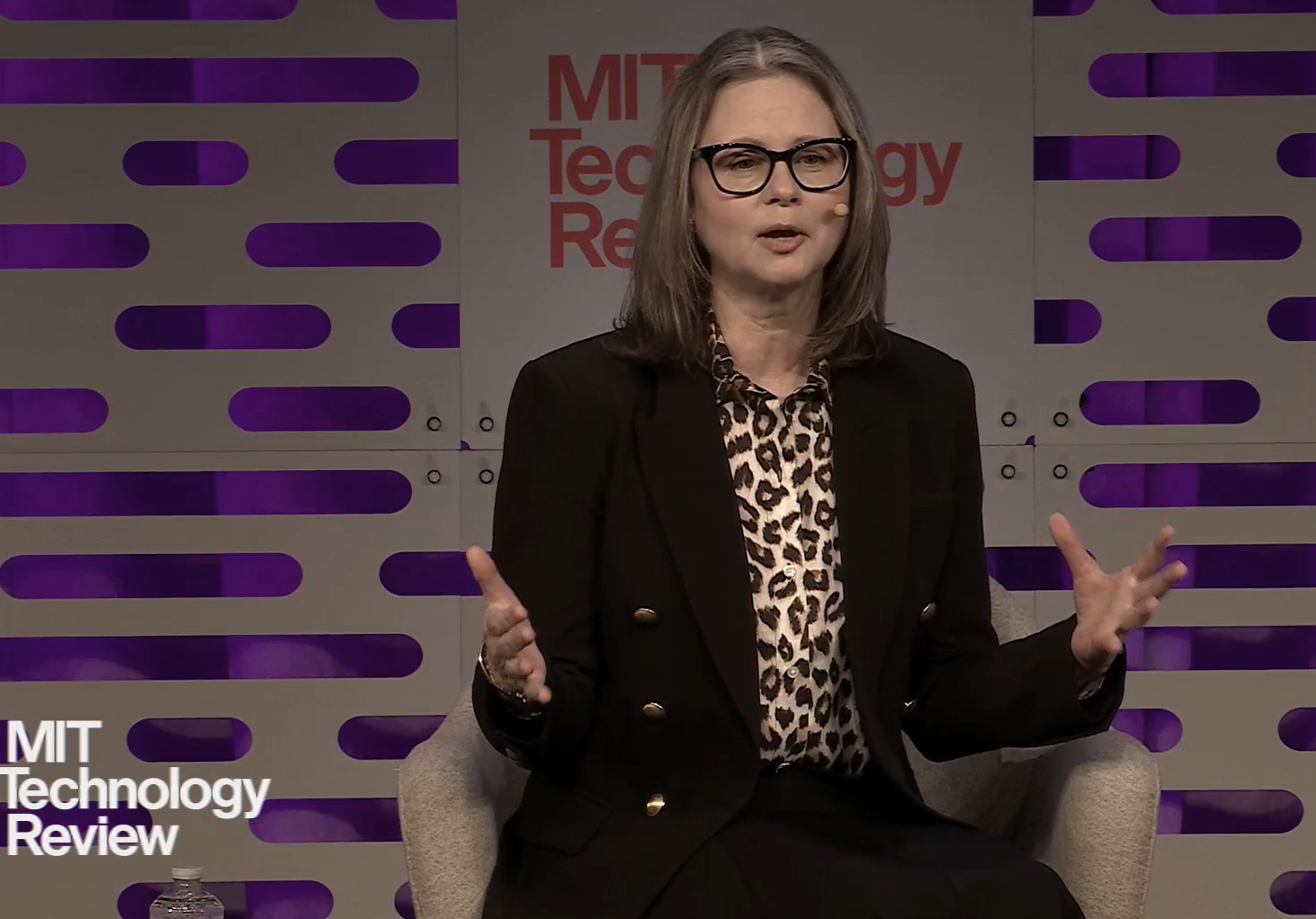
EmTechMIT, Cambridge, MA: AI is not just an accessory, it is becoming the beating heart of how work happens in the most forward-looking organizations. In “The Agentic Workday,” Colette Stallbaumer, GM of Microsoft Copilot and co-founder of Microsoft’s WorkLab, unpacked how the rise of AI agents is reshaping workflows, expectations, and the very nature of business advantage in the digital economy.
What is a Frontier Firm?
Stallbaumer introduced the concept of the “frontier firm”, an organization for which AI-driven automation is not merely a tool, but an operating system. She described Microsoft’s Work Trend Index, encompassing over 31,000 survey responses from 31 countries, as well as deep analysis of Microsoft 365 and LinkedIn labor data to map how work habits are evolving globally. The firm found that “frontier” adopters of AI, those who put the technology at the core of business operations, report higher job satisfaction and are consistently outpacing peers who treat AI as an add-on.
Frontier firms can look like ad agencies where “on day one, everyone has access to all the data around advertising strategy.” No more lengthy onboarding to internalize expertise; agents surface and contextualize it for everyone. As Stallbaumer emphasized, this is not about replacing people but amplifying them, allowing smaller, leaner teams to outperform traditional structures by leveraging shared intelligence and automation.
The Progression: Assistant to Agent Boss
Stallbaumer outlined a clear progression in AI adoption:
- Using AI as an assistant
- Collaborating with AI as a digital colleague
- Becoming an “agent boss,” managing networks of AI agents that complete entire workflows
This evolution isn’t strictly linear; organizations find themselves at various stages simultaneously. The crucial transition occurs when workers move from viewing AI as a passive search engine to integrating it as a routine collaborator and eventually delegator of complex tasks. As she put it, “People are really becoming what we call agent bosses… managing teams of agents, which in turn communicate and work with each other to carry out increasingly complex workflows.”

Case Study: AI Agents in Action
One compelling example came from the chemical giant DOW, a Microsoft client. By deploying agent teams on logistics and supply chain invoices, one agent detects billing anomalies, another initiates resolution, the company has saved millions. Such advances are not restricted to tech-centric industries; Stallbaumer sees growth everywhere, but especially where information silos are costly and repeated manual scrutiny is the status quo.
This drives home that agentic automation is not about replacing workers with bots, but scaling the scope and caliber of what each employee can accomplish. “Every organization is on their own journey here… the most forward-thinking recognize they need to disrupt themselves, or be disrupted,” she warned.
The Capacity Gap: Why AI Matters Now
The presentation illuminated a striking mismatch shaping the future of work: 53% of leaders declare the need for heightened productivity, yet 80% of the global workforce, including leaders, admit they lack the time or energy to get everything done. This “capacity gap”, a collision of rising expectations and finite human bandwidth, is not going away.
Stallbaumer’s answer is two-fold. First, AI must attack the “digital debt” and routine drudgery choking knowledge work. Second, the real challenge is not technological, but behavioral: “The hardest thing to do is change human behavior.” She noted that real gains come only as people “start working every day by asking, how much of this project do I need to take on, and how much can I delegate to AI?”
The Microsoft Copilot Revolution
Microsoft is betting big on what it calls the “agentic workday.” Copilot, now deeply embedded in Word, Excel, Outlook, Teams, and other Microsoft 365 apps, sits “in the flow” of daily tasks. “You never need to take meeting notes again when Copilot gathers them, assigns action items, and even sends recaps,” Stallbaumer explained. The Company’s latest “Workflows agent” allows users to automate repetitive tasks, everything from sending emails, managing calendars, synthesizing project updates, or even acting as a live meeting facilitator, through natural language prompts.
Recent advances enable users to delegate the orchestration and monitoring of entire multi-step workflows to Copilot, while APIs and Copilot Studio empower more sophisticated users to create bespoke agents tailored to specialized domains (like research or data analysis). Copilot’s integration with Microsoft’s Power Platform now means users can build apps, logic, and backend data flows without writing a single line of code, AI as co-creator, not just executor.
The Barriers: Habits and Human Supervision
Copilot is powerful, but Stallbaumer acknowledged hurdles remain. Chief among them: human habit. Many still interact with AI as a Q&A engine, not a process ambassador. To really reap value, users must “progress from using AI as an assistant to being an agent boss, managing teams of agents.” She shared the story of Alex, a data scientist at Microsoft, who orchestrates three agents, one scans for new research, another extracts insights, a third writes reports, freeing him to pursue more strategic work. “Every company has Alexes, early adopters who can light the path for organization-wide behavior change.”
Accuracy is another challenge. With more agents comes compounded error risk. “That’s why it’s so important to have a human in the workflow…you have to check, validate, and evaluate the outputs,” she stressed. The tech will keep improving, but oversight remains crucial.
Building AI Fluency: Skills for the Future
For job-seekers and students, Stallbaumer’s advice was clear: AI isn’t a “nice-to-have” skill, it’s the new literacy, much as email became in the late 1990s. “By 2030, 70% of today’s skills will be different. The critical thing is aptitude, curiosity, critical thinking, and judgment, how you apply the tool, not just that you know it exists.”
The Next Five Years: Redefining Differentiation
With core AI tools now widely accessible, “the differentiator used to be who ‘knew how;’ today, anyone can use Gemini, Copilot, or OpenAI”, Stallbaumer predicts competitive advantage will hinge on depth of application. “Whether you’re a company or an individual, the better you make use of these tools, the more competitive you’ll be.” She sees the next half-decade as a leap forward: companies pushing AI to optimize inefficiencies and, at the same time, using it to invent entirely new offerings.
The Ethical Generation: Preparing the Next Workforce
Stallbaumer is optimistic, both as an executive and a parent. “Now is not a time to sit on the sidelines. With guardrails, we should be encouraging students to experiment, learn, and invent…there will never be a better time to build something new, to launch a business, or to contribute to a lean, high-output team.” The true agentic workday, she argues, will mean more creative, less burdensome jobs, and more opportunities for everyone willing to lead, and learn.
Leave a Reply
You must be logged in to post a comment.